




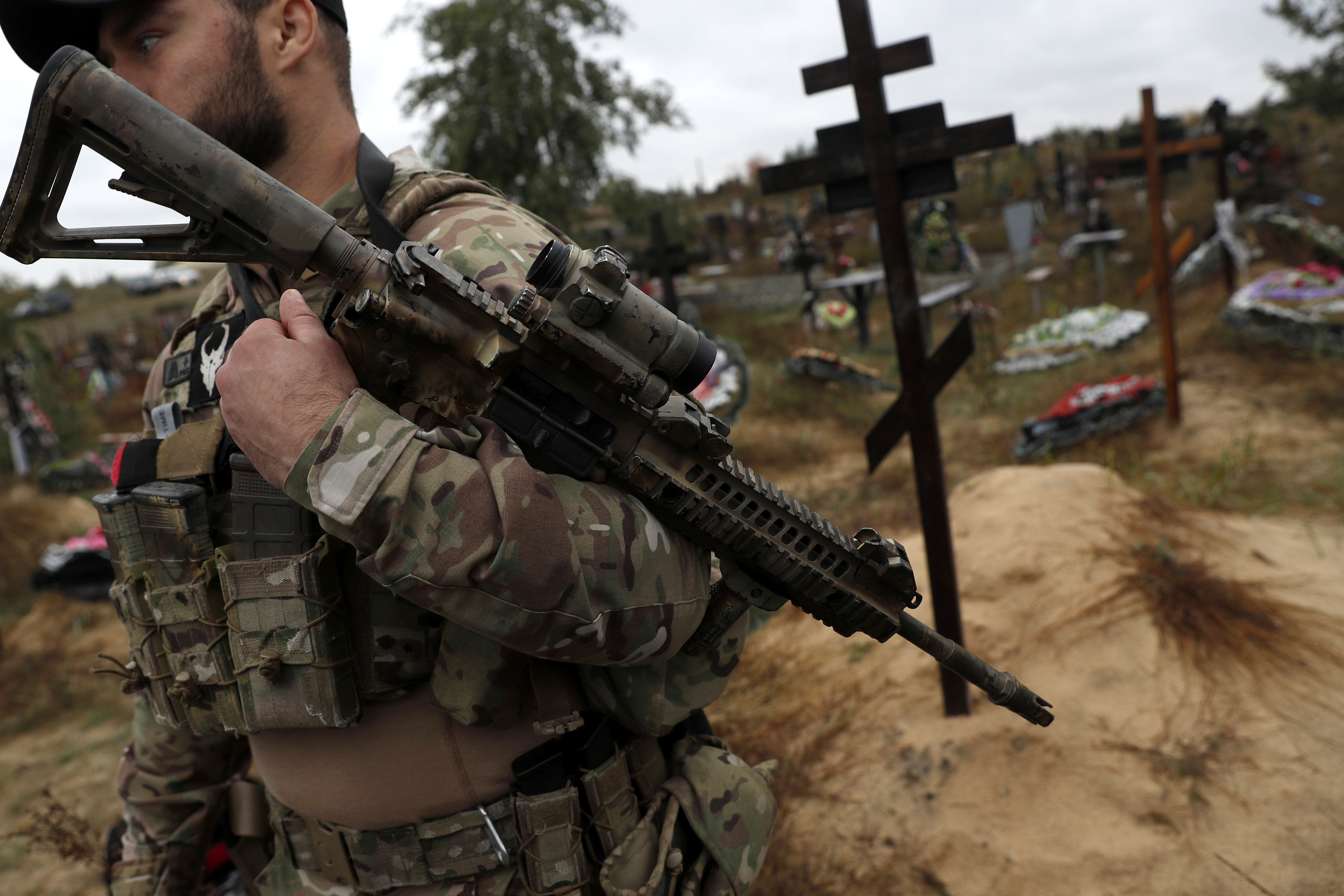
 A Ukrainian soldier standing guard next to Forensic technicians working at a burial site in the recently recaptured city of Lyman, Donetsk area, Ukraine, 11 October 2022 (issued 12 October 2022). Two burial sites were found after Ukrainian troops recaptured the town of Lyman, said Ukrainian Donetsk region governor Pavlo Kyrylenko on 07 October 2022. Ukrainian authorities have started exhuming and identifying the bodies of the partially unmarked graves. EPA-EFE/ATEF SAFADI
 The gathering in Brussels is the first big NATO meeting since Russia annexed four occupied Ukrainian regions, began a partial mobilisation and issued veiled nuclear threats - moves the Western alliance has classified as a clear escalation of the war that started with Moscow's invasion of Ukraine on Feb. 24.
Two days after Russian air missile strikes killed 19 people in Ukraine and knocked out power supplies across the country, NATO Secretary-General Jens Stoltenberg urged allies to send more air defence systems to Ukraine.
Stoltenberg said the "horrific, indiscriminate attacks" showed why this was so important.
"We need different types of air defence - short-range, long-range, air defence systems to take ballistic missiles, cruise missiles, drones, different systems for different tasks," he told reporters on arrival for the meeting.
Allies also needed to scale up the supply of air defence systems to help Ukraine defend even more cities, he said.
On Tuesday, Ukraine received the first of four IRIS-T SLM air defence systems that Germany had promised to supply, a German defence ministry source said.
A senior U.S. defence official, speaking on condition of anonymity, said Germany's IRIS-T was another sign of the commitment to provide air defences to Ukraine, predating Russia's latest missile fusillade against the country.
"Again this is a horrible set of circumstances, what's occurred," the official said. "But the fact that Russia has this capability and is willing to use that capability, including against civilian infrastructure and civilian targets, is not a surprise."
Stoltenberg called Russia's missile attacks a sign of weakness, showing President Vladimir Putin was running out of alternatives as his forces were losing on the battlefield.
Moscow, which calls its actions in Ukraine a "special military operation" to eliminate dangerous nationalists and protect Russian-speakers, has accused the West of escalating the conflict by supporting Kyiv.
Ukraine accuses Russia of an unprovoked imperialist land grab, three decades after the Moscow-led Soviet Union broke up.
NATO VIGILANT ON RUSSIAN NUCLEAR STANCE
NATO defence ministers will first meet with partners of the Ukraine Defense Contact Group, a body established on the initiative of the United States to keep up arms supplies to Kyiv. Ukrainian Defence Minister Oleksii Reznikov will also take part.
The NATO ministers then kick off their talks with a dinner before Thursday's first session on nuclear planning.
Stoltenberg said the alliance had not seen any changes in Russia's nuclear posture.
"But we will remain vigilant, we will continue to monitor closely because the nuclear threats, the nuclear rhetoric, and the veiled threats from Russia are dangerous and reckless."
NATO will hold its annual nuclear preparedness exercise, dubbed "Steadfast Noon", next week, with training flights for fighter jets capable of carrying nuclear weapons based in Europe and support planes. No live weapons are used.
NATO ministers are also due to discuss protecting critical infrastructure, a need that has become more urgent after attacks on Nord Stream pipelines running under the Baltic Sea, although it remains unclear who was behind the explosions.
On Wednesday, Polish operator PERN said it had detected a leak in one pipeline in the Druzhba system that carries oil from Russia to Europe. It said this was probably due to an accident.
NATO warned Moscow on Tuesday that it would meet attacks on allies' critical infrastructure with a "united and determined response".
Stoltenberg pledged to boost the protection of critical infrastructure, saying NATO had already doubled its presence in the Baltic and North Seas to more than 30 ships supported by aircraft and undersea activities.
By Sabine Siebold, Philip Blenkinsop and Phil Stewart
(Reporting by Sabine Siebold and Philip Blenkinsop; Additional reporting by John Chalmers; editing by Mark Heinrich)