




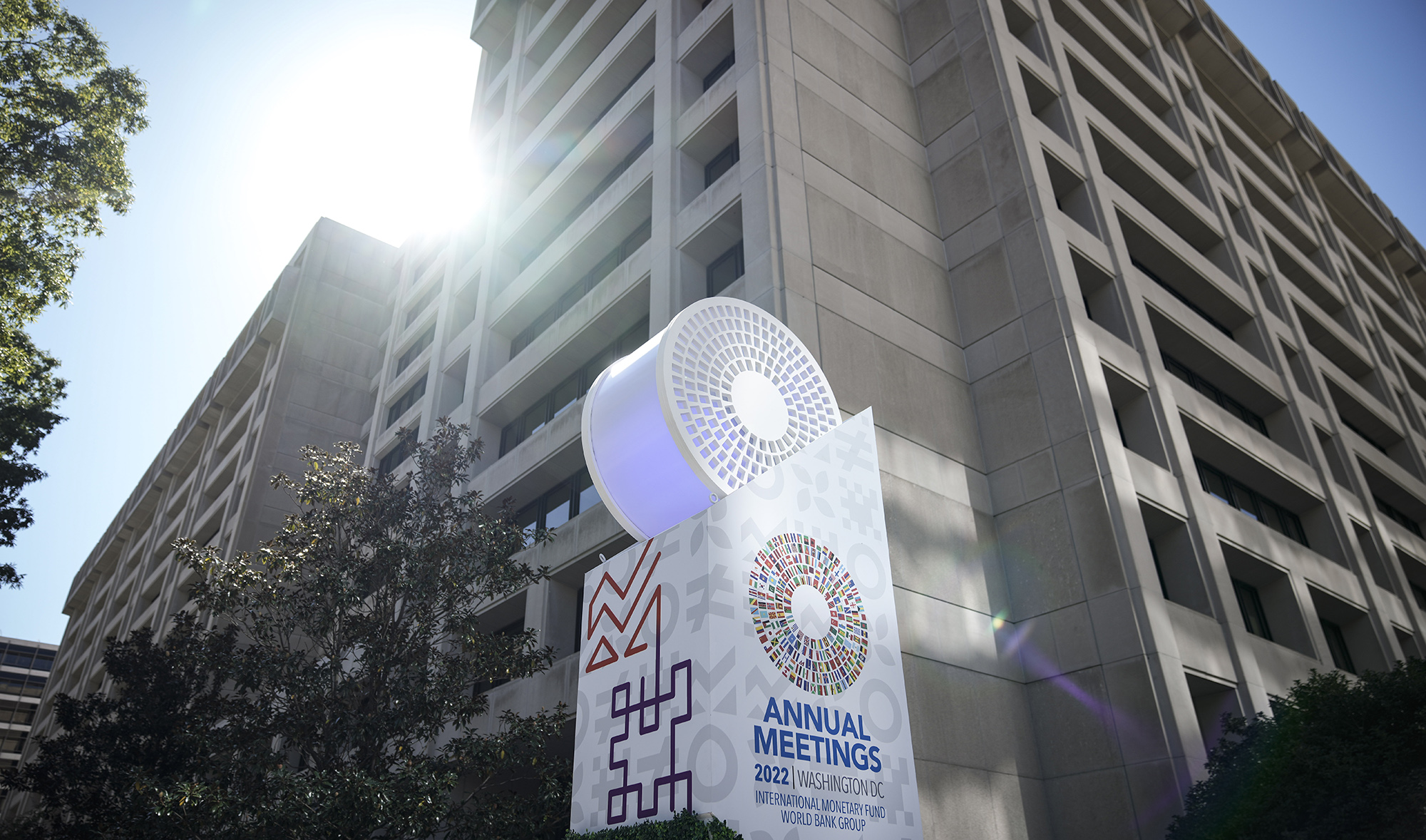
 Signage outside the IMF headquarters on the first day of the IMF and World Bank Annual Meetings on 10 October 2022 in Washington, DC. (Photo: Drew Angerer / Getty Images)
 The forecasts were laid out in the International Monetary Fund’s (IMF’s) latest World Economic Outlook, which coincides with the fund’s annual meetings in Washington.
It has downgraded its outlook for South African economic growth, lowering its 2022 forecast to 2.1% from 2.3% in July and to a limp 1.1% for 2023 from 1.4% previously.
Frankly, those forecasts look optimistic and out of touch with realities on the ground. My colleague Richard Poplak suggested on Twitter that the fund’s number crunchers were perhaps “mainlining Glenfiddich.”
Certainly compared with domestic forecasts, it looks at least like some brandy has been mixed with the coke. The South African Reserve Bank’s (Sarb’s) latest forecast is for growth of 1.9% this year, and subsequent events can only herald a downgrade from there. Rolling blackouts have cranked up to industrial-scale levels, while the Transnet strike threatens to take the SOE’s appalling track record right off the rails.
On the other hand, the Sarb’s 1.4% growth forecast for 2023 is wildly out of line with the IMF’s 1.1% prediction. Those will likely line up soon.
Contraction
South Africa’s economy looks increasingly like it is going to join the third of the global economy that the IMF reckons is about to contract, in no small measure because of Russia’s war in Ukraine.
According to the IMF: “Our latest forecasts project global growth to remain unchanged in 2022 at 3.2% and to slow to 2.7% in 2023 — 0.2 percentage points lower than the July forecast — with a 25% probability that it could fall below 2%. More than a third of the global economy will contract this year or next, while the three largest economies — the United States, the European Union, and China — will continue to stall.”
Visit Daily Maverick’s home page for more news, analysis and investigations
“In short, the worst is yet to come, and for many people 2023 will feel like a recession,” said the IMF, which is usually more reserved and technocratic in its English.
A stalling/slowing/contracting global economy is the kind of headwind that can knock South Africa into a recession, given its plethora of home-grown and ANC-sponsored problems. Chinese growth is a major concern: when South Africa’s ports function, that’s the primary export destination for our bulk commodities and the main source of a lot of the cheap stuff that we import while the local manufacturing sector withers.
Russian invasion
The IMF reiterated its view — one ground that is firmly in reality — that the Kremlin bears a lot of the blame for the sour global economic outlook.
“Russia’s invasion of Ukraine continues to powerfully destabilise the global economy. Beyond the escalating and senseless destruction of lives and livelihoods, it has led to a severe energy crisis in Europe that is sharply increasing costs of living and hampering economic activity,” the fund said.
“More broadly, the conflict has also pushed up food prices on world markets, despite the recent easing after the Black Sea grain deal, causing serious hardship for low-income households worldwide, and especially so in low-income countries.”
It did note some glimmers of hope on the global economic horizon.
“These challenges do not imply that a large downturn is inevitable. In many countries, including the United States, the United Kingdom, and the euro area, labour markets remain tight, with historically low unemployment rates and high levels of vacancies.”
This of course hardly begins to describe South Africa with its official unemployment rate of almost 34%. For many South Africans, the recession feels perpetual. DM/BM