




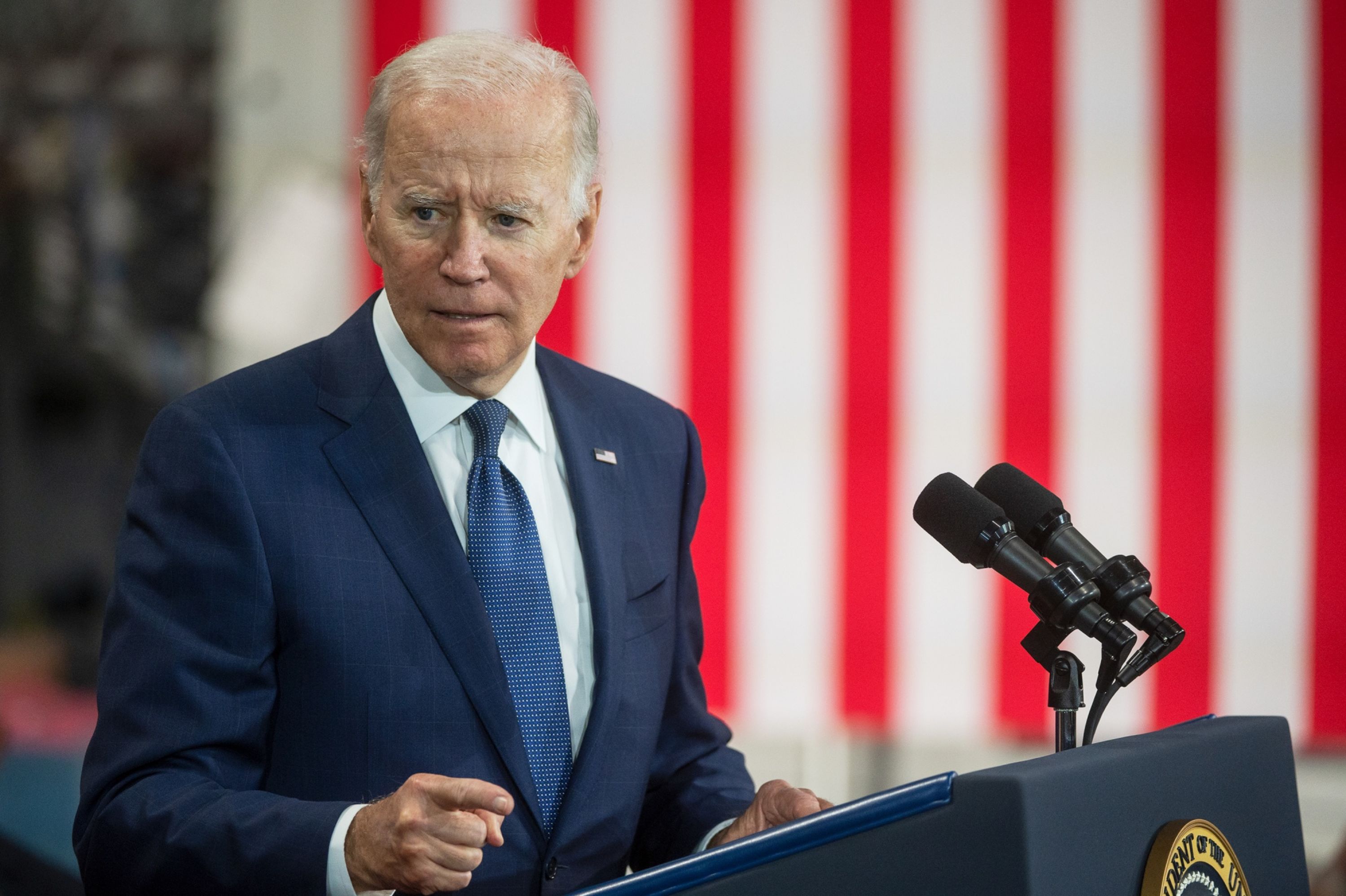
 US President Joe Biden speaks at the Volvo Group powertrain manufacturing facility in Hagerstown, Maryland, US, on 7 October 2022. (Photo: Bloomberg)
 Biden in a statement Monday did not specify how the US will respond to the attacks, but signalled he could approve new sanctions on Russia and weapons shipments to Ukraine. He said the US and its allies would “continue to impose costs” on the Kremlin and “provide the support necessary for Ukrainian forces to defend their country and their freedom”.
“These attacks only further reinforce our commitment to stand with the people of Ukraine for as long as it takes,” the president said.
The strikes, which included the first on Kyiv in months, were Russia’s most intense since the early days of the invasion and raised pressure on the US and its allies to supply Ukraine with more advanced military equipment, including air-defence systems and long-range weapons.
Ukrainian President Volodymyr Zelensky said he spoke with Biden on Monday and stressed that “air defence is currently the number one priority”. Leaders of the Group of Seven (G7) nations will hold an emergency call Tuesday with Zelensky to discuss their response.
A White House official confirmed Biden and Zelensky spoke Monday afternoon but didn’t describe the contents of the call.
The US and its allies have been reluctant to provide their most sophisticated weapons to the Ukrainian military, in part to avoid drawing themselves into direct conflict with Russia. Zelensky on Monday urged allied nations to do away with such restraints in a series of calls with G7 leaders.
Biden said last week that the world would face “the prospect of Armageddon” if Vladimir Putin decides to use a nuclear weapon in Ukraine, asking what the Russian leader’s “off-ramp” would be to avoid further escalation.
Administration officials said the president’s comments were not based off new intelligence and that the US has no information indicating Putin is imminently seeking to use nuclear weapons. Still, the comments revealed Biden’s worries that the conflict could spin out of control and have drastic, deadly consequences for the continent and the world.
“The Department of Defense will continue to work closely alongside our international allies and partners to support Ukraine in their fight to defend their country for as long as it takes,” Brigadier General Patrick Ryder, the Pentagon spokesperson, said in a statement on Monday.
US Defense Secretary Lloyd Austin is hosting defence and military leaders from nearly 50 nations in Brussels on Wednesday for the previously scheduled Ukraine Defence Contact Group, and will attend the Nato Defence Ministerial meeting, Ryder said.
Secretary of State Antony Blinken spoke Monday with Ukrainian Foreign Minister Dmytro Kuleba and “commended Ukraine for not allowing President Putin to break Ukraine’s spirit and reaffirmed US resolve to support Ukraine”, according to the State Department.
“He also extended his deepest sympathies to the Foreign Minister for the people of Ukraine who have lost loved ones today,” the department said in a statement.
Putin threatened additional strikes following Monday’s blitz, which came a day after he accused Ukraine of carrying out an attack on a road and rail bridge connecting Crimea to Russia across the Kerch Strait - a symbolic and strategic blow to the Russian leader.
The bridge, which Putin personally opened in 2018 to signify Russia’s annexation of Crimea, is a key supply link for the Kremlin’s military operations in southern Ukraine.
The bombardment killed at least 11 and wounded 64 others, while knocking out electricity in five regions, as well as disrupting power in Kyiv and other parts of the country. Photos and video on social media showed missiles hit Kyiv’s most popular park as well as an important pedestrian bridge and other civilian infrastructure at the center of the capital.
Russian officials and Kremlin allies cheered the strikes, which hard-line nationalist figures urged in response to the Kerch Strait bridge explosion.
The European Union denounced the Russian attacks as “war crimes” and French President Emmanuel Macron said they showed “a deep change in the nature” of the war.
Russia in recent weeks suffered its worst defeats since February, when Putin launched his full-scale invasion of Ukraine.
Ukrainian forces took back large swaths of occupied territory in the east and south, forcing Russian units to retreat. Putin has turned to increasingly desperate measures in response to Ukrainian gains, authorising the mobilisation of roughly 300,000 reservists and hurriedly annexing four regions under partial Kremlin control using staged votes that the United Nations condemned as illegal.
The attacks, and Putin’s subsequent threats to do more, underlined Ukrainian officials’ longstanding requests for air defenses and long-range weapons. Kuleba tweeted Sunday in response to missile attacks on Zaporizhzhia that “we urgently need more modern air and missile defence systems to save innocent lives”.
“I urge partners to speed up deliveries,” he wrote.
While Putin’s hints that he could use nuclear weapons in the conflict have provoked condemnations from Biden and allies, they have not broken the will to continue military and financial support for Kyiv.
The battlefield setbacks have sparked a wave of recriminations inside Russia, with one Kremlin-backed occupation official suggesting Russian Defence Minister Sergei Shoigu should shoot himself. They have also bolstered calls from hard-liners to take more aggressive military action inside Ukraine.