




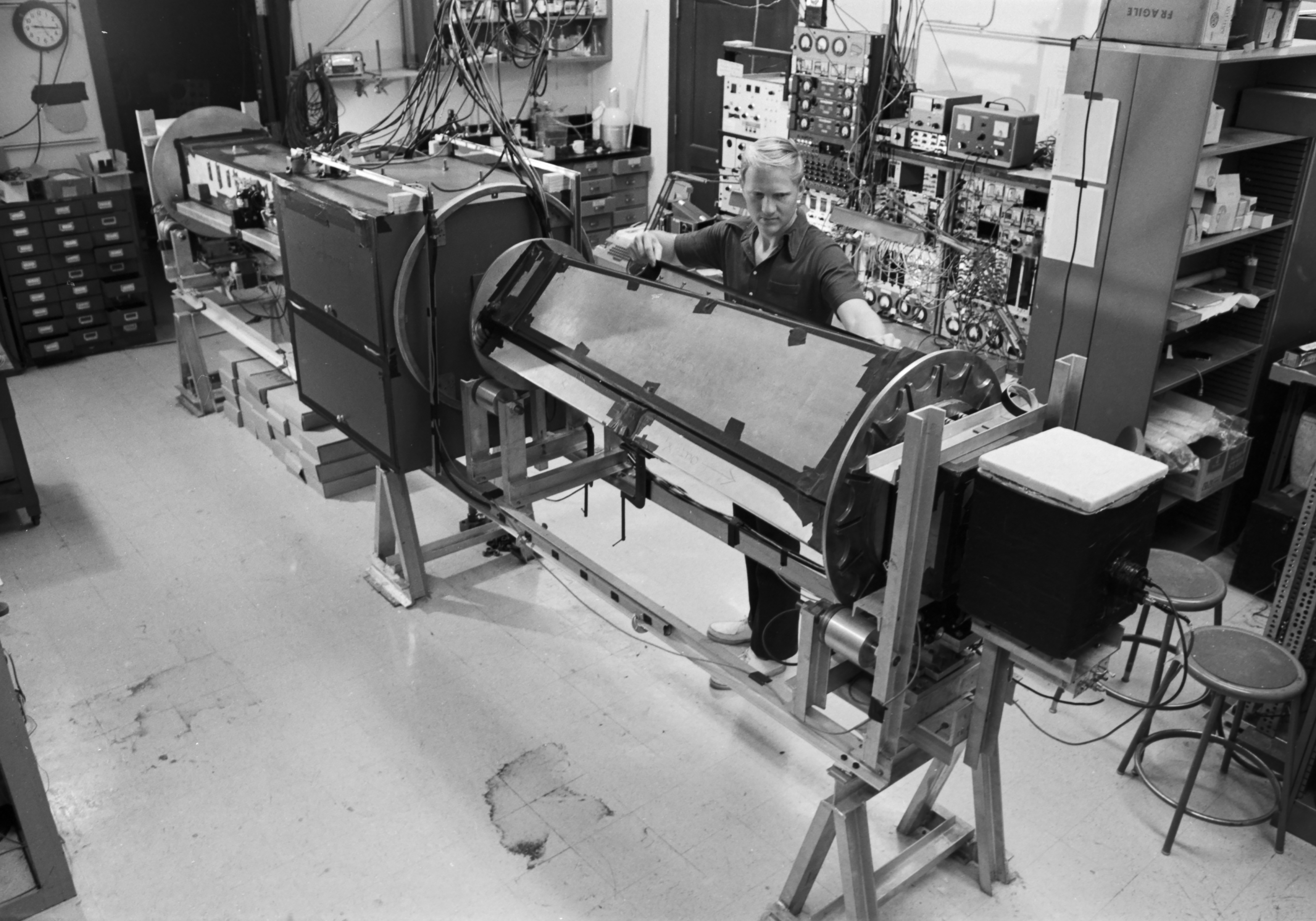
 John Clauser with a quantum mechanics experiment to test Bell's theorem at Berkeley, California, USA, 07 November 1975. The 2022 Nobel Prize in Physics was awarded to Clauser along with Alain Aspect from France and Anton Zeilinger from Austria for their 'groundbreaking experiments using entangled quantum states, where two particles behave like a single unit even when they are separated. Their results have cleared the way for new technology based upon quantum information', the Royal Swedish Academy of Sciences in Stockholm announced on 04 October 2022. EPA-EFE/STEVE GERBER/Lawrence Berkeley National Laboratory/HANDOUT NO DERIVATIVE WORKS, MANDATORY CREDIT: LAWRENCE BERKELEY NATIONAL LABORATORY HANDOUT
 The awards were given for "experiments with entangled photons, establishing the violation of Bell inequalities and pioneering quantum information science", the award-giving body said on Tuesday.
The Royal Swedish Academy of Sciences said the laureates -- Aspect is French, Clauser American and Zeilinger Austrian -- enabled further fundamental research and also potentially cleared the way for new practical technology.
The scientists all conducted experiments into quantum entanglement, where two particles are linked regardless of the space between them, a field that unsettled Albert Einstein himself, who once referred to it in a letter as "spooky action at a distance".
"It was very kind to receive your phone call just about an hour ago and I'm still kind of shocked, but very positive, so thank you very much," Zeilinger told a news conference over the phone.
"I have to say that I was I was always interested in quantum mechanics from the very first moment when I read about it. I was suddenly struck by some of the theoretical predictions because they did not fit in all the usual intuition which one might have."
In background material explaining the prize, the academy said the laureates' work involves "the mind-boggling insight that quantum mechanics allows a single quantum system to be divided up into parts that are separated from each other but which still act as a single unit."
"This goes against all the usual ideas about cause and effect and the nature of reality."
ENCRYPTED COMMUNICATION
The Academy said that as a result of their work, development was underway to use the "special properties of individual particle systems to construct quantum computers, improve measurements, build quantum networks and establish secure quantum encrypted communication."
The laureates explored in ground-breaking experiments how two or more photons, or particles of light, that are "entangled" because they come from the same laser beam, interact even when they are separated far apart from each other.
The more than century-old prize, worth 10 million Swedish crowns ($902,315), is awarded by the Royal Swedish Academy of Sciences.
Physics is the second Nobel to be awarded this week after Swedish geneticist Svante Paabo won the prize for Physiology or Medicine on Monday.
The prestigious prizes for achievements in science, literature and peace were created in the will of Alfred Nobel, who made a fortune from his invention of dynamite, and have been awarded since 1901 with a some interruptions, primarily the two world wars.
The physics prize has often taken centre stage among the awards, featuring household names of science such as Albert Einstein, Max Planck, Pierre Curie and Marie Curie, and rewarding breakthroughs that have reshaped how we see the world.
Last year, scientists Syukuro Manabe, Klaus Hasselmann and Giorgio Parisi shared the physics prize for their work on complex physical systems such as Earth's changing climate, key in understanding global warming.
Announced over consecutive weekdays in early October, the physics prize announcement will be followed by awards for chemistry, literature, peace and economics, the latter added in 1969 to the original line-up.
(Reporting by Niklas Pollard, Simon Johnson and Johan Ahlander in Stockholm, and Ludwig Burger in Frankfurt; additional reporting by Terje Solsvik in Oslo, Anna Ringstrom in Stockholm and Marie Mannes in Gdansk, Editing by William Maclean)
Comments
Scroll down to load comments...