




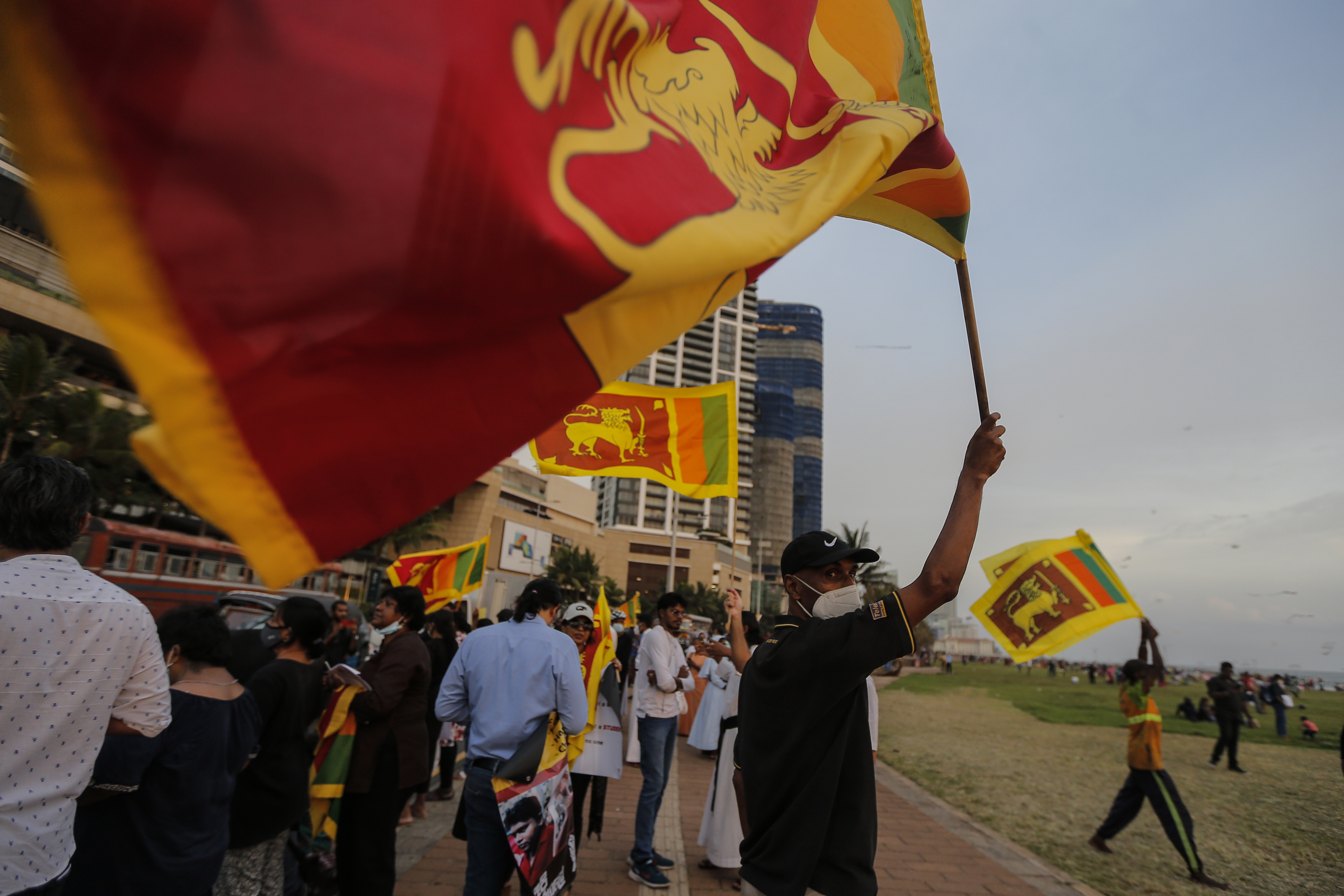
 Protesters hold national flags and shout slogans during a protest against government crackdown in Colombo, Sri Lanka, 09 September 2022. Hundreds of anti government protesters staged a protest to condemn the government's crackdown on anti-government protesters by arresting them using the prevention of terrorism act (PTA). Protests have been affecting the country for over four months as Sri Lanka faces its worst-ever economic crisis in decades due to the lack of foreign reserves, resulting in severe shortages in food, fuel, medicine, and imported goods. EPA-EFE/CHAMILA KARUNARATHNE
U.N. member states and international financial institutions should support Sri Lanka as it tries to assist millions struggling with food, fuel, power and medicine shortages, said Nada Al-Nashif, U.N. Acting High Commissioner for Human Rights.
"I encourage the new government to embark on a national dialogue to advance human rights and reconciliation and to carry out the deeper institutional, democratic and security sector reforms needed to restore the independence of key institutions, to combat impunity, to prevent the recurrence of human rights violations, and to tackle the economic crisis," Al-Nashif told the 51st Session of the Human Rights Council in Geneva.
She also urged Sri Lanka's new government led by President Ranil Wickremesinghe to end the use of security laws to arrest protest leaders who helped oust former President Gotabaya Rajapaksa in July.
Sri Lankan Foreign Minister Ali Sabry told the same meeting the government was committed to working with the Office of the High Commissioner for Human Rights (OHCHR) on improving human rights, but would object to any international judicial intervention that it sees as anti-constitutional.
Al-Nashif said Sri Lanka must make more progress towards establishing a credible investigation into alleged war crimes during the civil war that ended in 2009 and promote demilitarisation of the island's north and eastern regions.
The United Nations and rights groups have accused the Sri Lankan military of killing thousands of civilians, mostly ethnic Tamils, during the final weeks of the war and have pressed for justice for the families of those who disappeared. In 2021, OHCHR launched a new 'accountability project' that could one day be used as part of a potential international judicial process.
On the latest protests following the economic crisis, Sabry said the government planned a truth-seeking mechanism to promote reconciliation, and referred to work on constitutional reform to promote anti-corruption measures and trim presidential powers.
By Uditha Jayasinghe
(Reporting by Uditha Jayasinghe; editing by Philippa Fletcher)
Comments
Scroll down to load comments...