




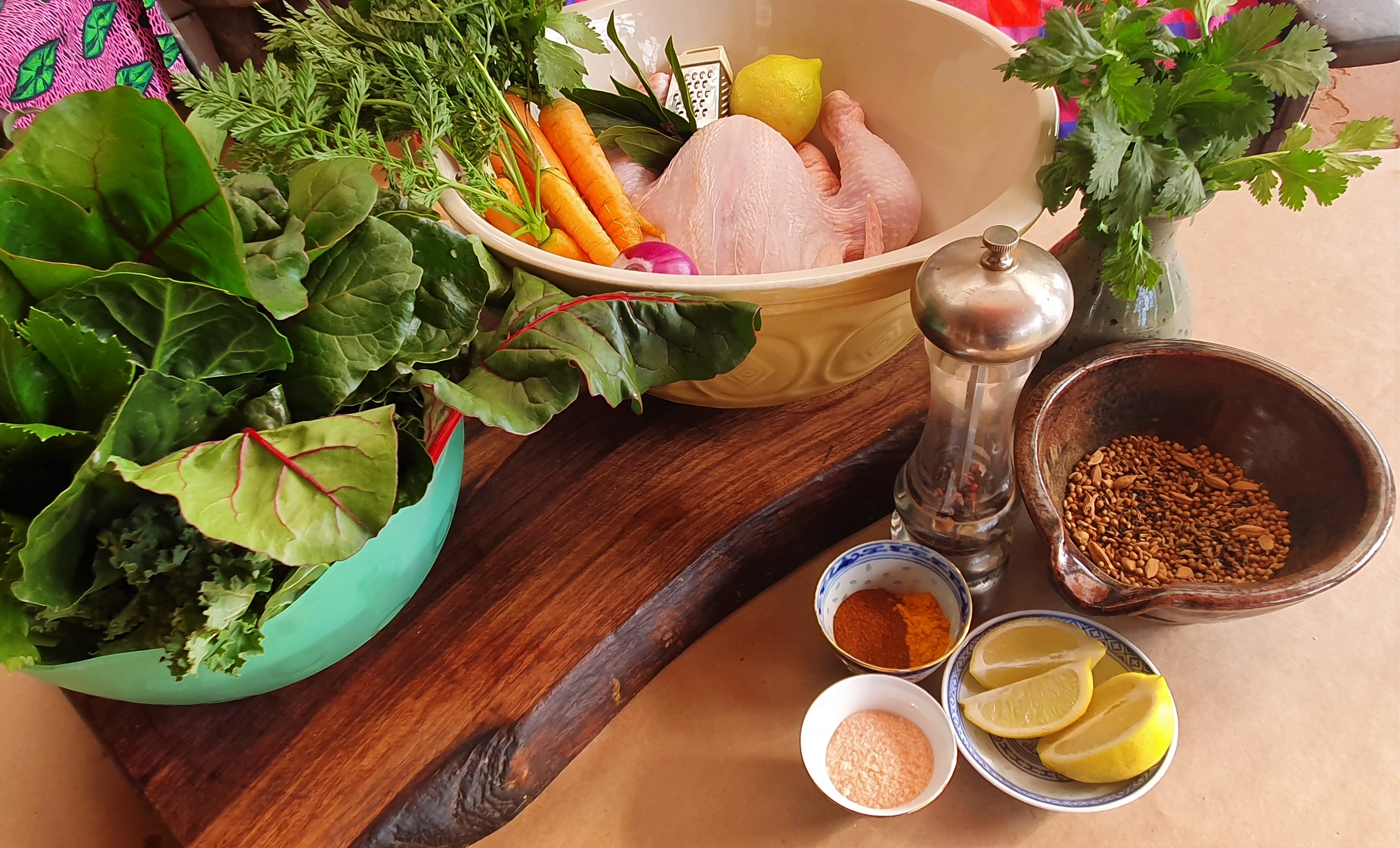
 A free range bird, homegrown organic vegetables and healthy herbs and spices are gathered in preparation for a slow food roast. (Photo: Bridget Hilton-Barber)
Many will remember Marloe Scott Wilson as the singer and actress dubbed the Pink Lady in the 80s. She had returned to South Africa after nearly a decade in the UK as a stage star, where her career highlight was playing the coveted role of Mary Magdalene in Jesus Christ Superstar. She had pink hair, pink eyebrows – yes, pink eyebrows – pink clothes and a pink Jeep and created a great stir everywhere she went.
/file/dailymaverick/wp-content/uploads/2022/09/PInk-Marloe.jpg "Marloe Scott Wilson in her Pink Lady phase. (Photo: Neville Petersen)")
It’s a long and lively story about how Marloe ended up here in Magoebaskloof on her farmette. We sit on a sunny porch surrounded by hanging pots, herbs and roses, sunflowers and solar fairy lights with a snuggly medley of rescue cats, dogs and horses. It involves love and living in Phalaborwa, of all places, for 18 years, before making her bid to be a self-sufficient mountain mama and a passionate proponent of slow food.
“Slow Food is the opposite of fast food,” explains Marloe as she places a fine, plump chicken on the kitchen table to prepare it for roasting. “The movement began in the late 80s in the small town of Bra near Piedmont in Italy, when a group of what I’d call culinary activists, led by Carlo Petrini, took huge exception to the proposed opening of a McDonald’s fast food outlet there. The area is especially famed for its cheese and cured meat, and they believed junk food would destroy their town’s ancient food culture and traditions.”
Petrini managed to stop the McDonald’s from opening and then founded the Slow Food movement which made it their mission to create global awareness around the relationship between plate and planet.
“Magoebaskloof became part of the Slow Food movement,” says Marloe, “when local farmers Nipper and Sylvi Thompson of Wegraakbosch Organic Farm took their homegrown cheese and chorizo to a food expo in Bra in 2016 and walked off with first prize. So they came home, started the Haenertsburg Slow Food chapter and spread the love. Their weekly organic veggie box deliveries are very much part of life on this mountain.
/file/dailymaverick/wp-content/uploads/2022/09/marloe-opener-3.jpg "Outside the kitchen grows a tangle of geraniums, roses, lavender and nasturtiums. (Photo: Bridget Hilton-Barber)")
“The Slow Food movement,” she says, “promotes good, clean and fair food; ‘good’ meaning fresh and flavoursome, promoting regional ingredients and traditions; ‘clean’ meaning food production practices that are humane to animals, and don’t harm people or the environment; and ‘fair’ meaning just conditions for producers and accessible prices for consumers, a sustainable food system for future generations.”
“So,” says Marloe, “I source my chickens locally. This healthy and delicious free range chicken I got from Claire’s Chooks down the road. I know. I eat. I like very much. I’m going to give this bird a nice massage with olive oil, using Saint Sebastian Bay, a South African product, and then I’m going to rub it down with a spice I’ve made from a mix of toasted and ground seeds – cardamom, fenugreek, cumin, coriander, black mustard and graine nigelle or black cumin. Then I’ll add turmeric and cayenne pepper, some zested lime, plus a knob of our homemade butter.”
/file/dailymaverick/wp-content/uploads/2022/09/Marloe1.jpg "Marloe at home on her ‘farmette’ today. (Photo: Bridget Hilton-Barber)")
Marloe ran a small restaurant in Phalaborwa for four years during her time there. It was called Marloe’s and was based largely on the slow food approach, but turned out to be somewhat ahead of its time for a conservative little mining town whose collective palate erred on the side of steak and chips.
Not so Magoebaskloof. The area has small farmers, loads of local produce, a growing farm to fork ethos and a homegrown food culture. Marloe takes a zested lemon to stuff inside the cavity of the chicken. Then puts the bird on top of the homegrown red onions, and the carrots that are still sporting their green topknots (for extra health benefit) in a Romertopf, for a rustic clay-baked vibe, and roasts it for three hours.
/file/dailymaverick/wp-content/uploads/2022/09/marloe-bird.jpg "Slow food slow roast chicken a la Marloe. (Photo: Bridget Hilton-Barber)")
To accompany the roast chicken there are greens and vegetables, all of which come from Marloe’s amazing garden. Together with her two workers, Chichi and Givemore, this edible garden feeds everyone, and then some. There are fruit trees, happy bees, climbing roses, a grapevine. There are a series of growing tunnels and a hothouse for seed propagation. The choice is abundant – from New Zealand spinach, kale, pak choi, beetroot, celery, borage, sage, thyme, parsley, rosemary and basil to rocket, peas, beans and spinach.
Marloe goes for the red-legged chard, to be gently wilted and served with pasta and homemade pesto.
“I sourced our roast chicken locally, and I’m so grateful to my chickens for eggs, but I have to say that when their numbers get too big, we’ll sacrifice one for the pot.” Marloe has personally slaughtered two roosters, once. “It wasn’t easy, but then slow food asks us to consider that profound relationship between planet and plate.”
/file/dailymaverick/wp-content/uploads/2022/09/marloe-pesto-pasta.jpg "Homegrown basil, macadamia nuts and organic local Parmesan are the basis of this pesto sauce. (Photo: Bridget Hilton-Barber)")
Not that the chickens suffer. They are the happiest, cluckiest, glossiest lot of chickens I’ve seen and they live in a series of “chook cabanas” where they aid and abet in the compost curing. Marloe tells me she learnt a great deal about self sufficiency and gardening in 1970s London where she had access to nearby food allotments. She plants according to the lunar calendar, harvests water, talks to her seedlings. Our own conversation is punctuated by the drip-drip of a kimchi pot where she is fermenting mielie kernels for the chickens. It’s all too glorious and abundant.
“I like to think of SLOW as standing for seasonal, local, organic, wholesome,” says Marloe. “I do support the local women selling veggies on the streets of Haenertsburg village. There’s also a local village market on Fridays and Saturdays where I can get homemade sourdough bread and fresh veggies. I can also get raw milk and yoghurt, free range eggs, cured sausages, ciabatta, rye – even turmeric latte at the local bookshop.”
/file/dailymaverick/wp-content/uploads/2022/09/marloe-spice.jpg "Along with olive oil and a dash of lemon, these toasted seeds are ground and used to rub the chicken before roasting. (Photo: Bridget Hilton-Barber)")
“When it comes to beef,” says Marloe, “Top C/Grade C beef is the yellow fat, local beef that is not fed hormones and antibiotics and wanders around grazing on grass. That’s what I get from my local butcher. Game meat is also available locally and that’s about as close to grass pastured that I know of around here. Venison is pure organic, wild pastured meat. If you are a bone broth maker, grass pastured bone broth is the best you can use. I get my pork from nearby Arrabon Farm whose animals have been reared antibiotic free and I can so attest to the quality.”
Later we have our slow-cooked slow food chook. Candles are lit. Gratitudes are uttered. We bless the chicken. It’s sumptuous and delicious, a good old fashioned roast a la mountain mama. The carrots and onions are plump and full of flavour. The pesto pasta is earthy and herby. You can taste the love. Cooking with love provides food for the soul. DM/TGIFood
Follow Bridget Hilton-Barber on Instagram bridgethiltonbarber
Comments
Scroll down to load comments...