




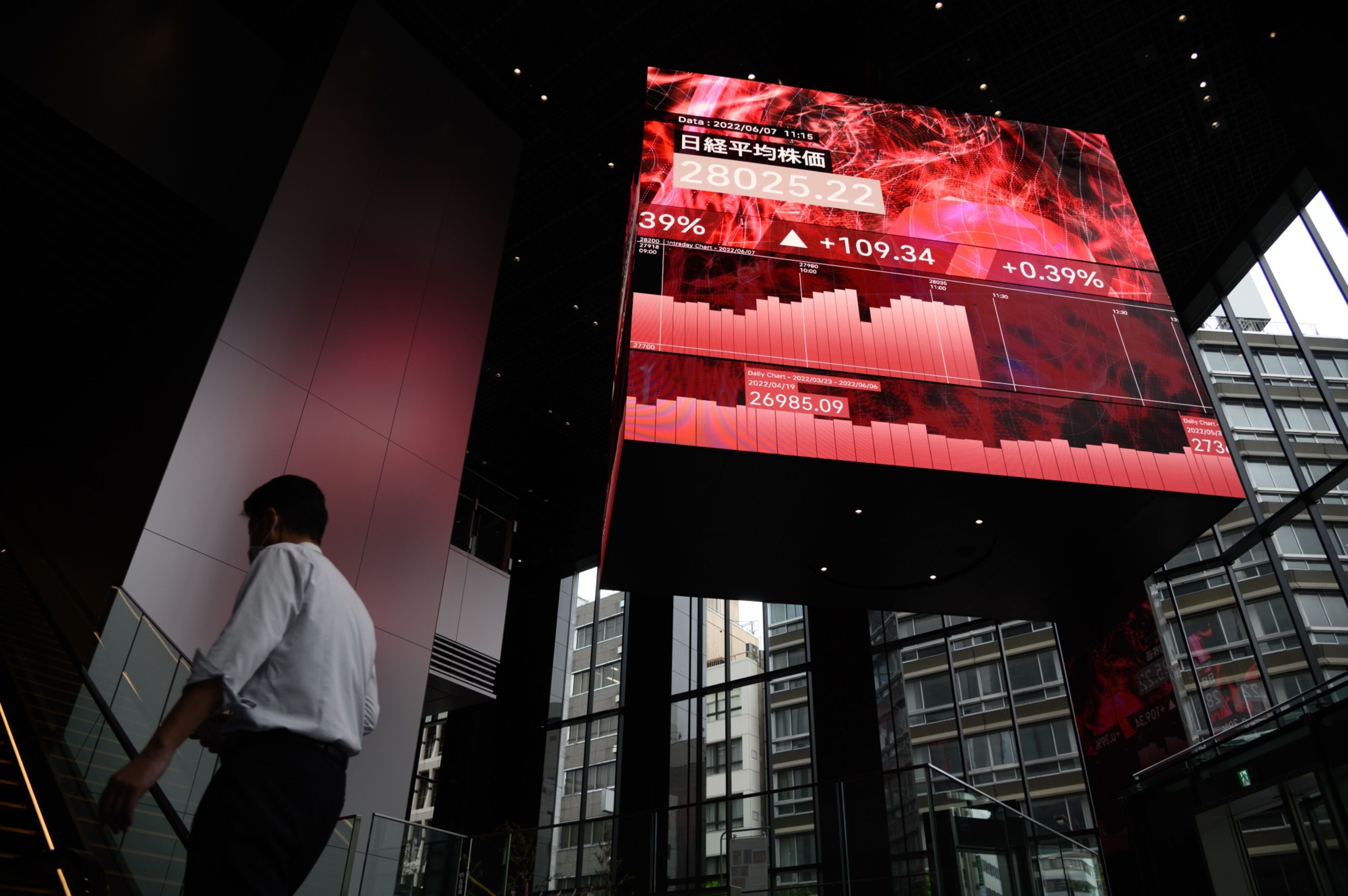
 The Nikkei 225 Stock Average displayed on a rotating-cube screen in an atrium of the Kabuto One building, next the Tokyo Stock Exchange, in Tokyo, Japan, on Tuesday, 7 June 2022. (Photo: Akio Kon/Bloomberg)
An early advance in MSCI’s Asia gauge fizzed as gains evaporated in Japan and Hong Kong while China fluctuated. S&P 500 futures pushed higher but off the peak ahead of the resumption of Wall Street trading after a holiday. Treasuries dipped across the curve, taking the 10-year yield to 3.21%.
Crude has climbed to about $89 a barrel after OPEC+ agreed to cut 100,000 barrels a day in October.
The offshore yuan pared gains after strengthening in the wake of China’s announcement of a cut in the amount of foreign-exchange deposits banks must set aside as reserves. China set its reference rate for the yuan weaker than the 6.9 per dollar for the first time in two years, setting the stage for further depreciation in the currency.
Officials in China also plan to speed up stimulus, stepping up support for an economy saddled with Covid lockdowns, a property slump and power shortages.
“The PBOC and the government completely understand that all this stimulus has to come not only on the monetary policy side, but on the fiscal side,” Stefanie Holtze-Jen, Asia Pacific chief investment officer at Deutsche Bank’s private bank, said on Bloomberg Television. “Q3 is the quarter that you really want to get it all in to support the weakening economy,” she said, adding that this raises hope that Chinese stocks may turn for the better in the fourth quarter.
The next leg in a wave of monetary tightening is due in Australia, where economists expect the central bank to lift the policy rate by a further 50 basis points. Tightening financial conditions globally have been weighing on stocks and bonds in recent weeks. Bouts of investor calm have tended to fizzle.
“A lot of clients are asking, have we seen the bottom yet and are we going into a global recession?” Grace Tam, BNP Paribas Wealth Management Hong Kong chief investment adviser, said on Bloomberg Television. “We do think the risk of a global recession, especially next year, is actually quite high” and that the energy crisis “is not fully priced” into markets, she said.
Incoming UK Prime Minister Liz Truss has drafted plans to fix annual electricity and gas bills for a typical UK household at or below the current level of £1,971 (R39,022). The policy could cost as much as £130-billion over the next 18 months.
Elsewhere, Bitcoin retook the $20,000 level and gold made gains.
The Stoxx Europe 600 Index dropped after Russia’s Gazprom PJSC halted its key gas pipeline indefinitely, although the benchmark gauge recovered from its worst levels as energy stocks rallied. Wall Street equity futures edged higher after the worst week for world shares since June.
The euro retreated to a two-decade low, while the dollar strengthened. The pound was steady after the UK’s Conservative Party named Truss as its leader, clearing her way to become prime minister. Her plan to “turbo-charge” the economy by slashing taxes is already worrying investors amid double-digit inflation.
Gazprom announced its move after Group of Seven leaders agreed to implement a price cap on Russian oil as the Kremlin continues its war in Ukraine. Natural gas surged more than 30% in Europe and nations there could roll out special steps at the end of the week to rein in power costs. Germany plans a $65-billion package to shield consumers.
“Economies have been preparing for some sort of energy constraint and the prospect of rationing, but obviously compared to expectations at the beginning of the year, this is pretty close to the worst outcome,” Wei Li, BlackRock global chief investment strategist, said on Bloomberg Television. “So as we head into the rest of the year, underweight equities at this juncture feels appropriate.”
Monetary authorities including Europe’s central bank are set to keep hiking interest rates this week to fight inflation despite the darkening global economic outlook due to risks such as power shortages. The escalating energy crisis comes ahead of unprecedented tightening expected from the European Central Bank on Thursday in the form of a 75-basis-point rate increase.
An Asian equity index declined, paced by losses in Hong Kong, where tech shares slid as traders weighed the risk of curbs on investment from the US. China reduced the amount of foreign-exchange deposits banks need to set aside as reserves for the second time this year to boost the yuan after the currency hit a two-year low.
The view that global shares already hit their bear-market low back in June is looking increasingly precarious. Europe’s intensifying energy crisis is the latest hit to sentiment, which was already under pressure from a wave of monetary tightening. BM
Comments
Scroll down to load comments...