



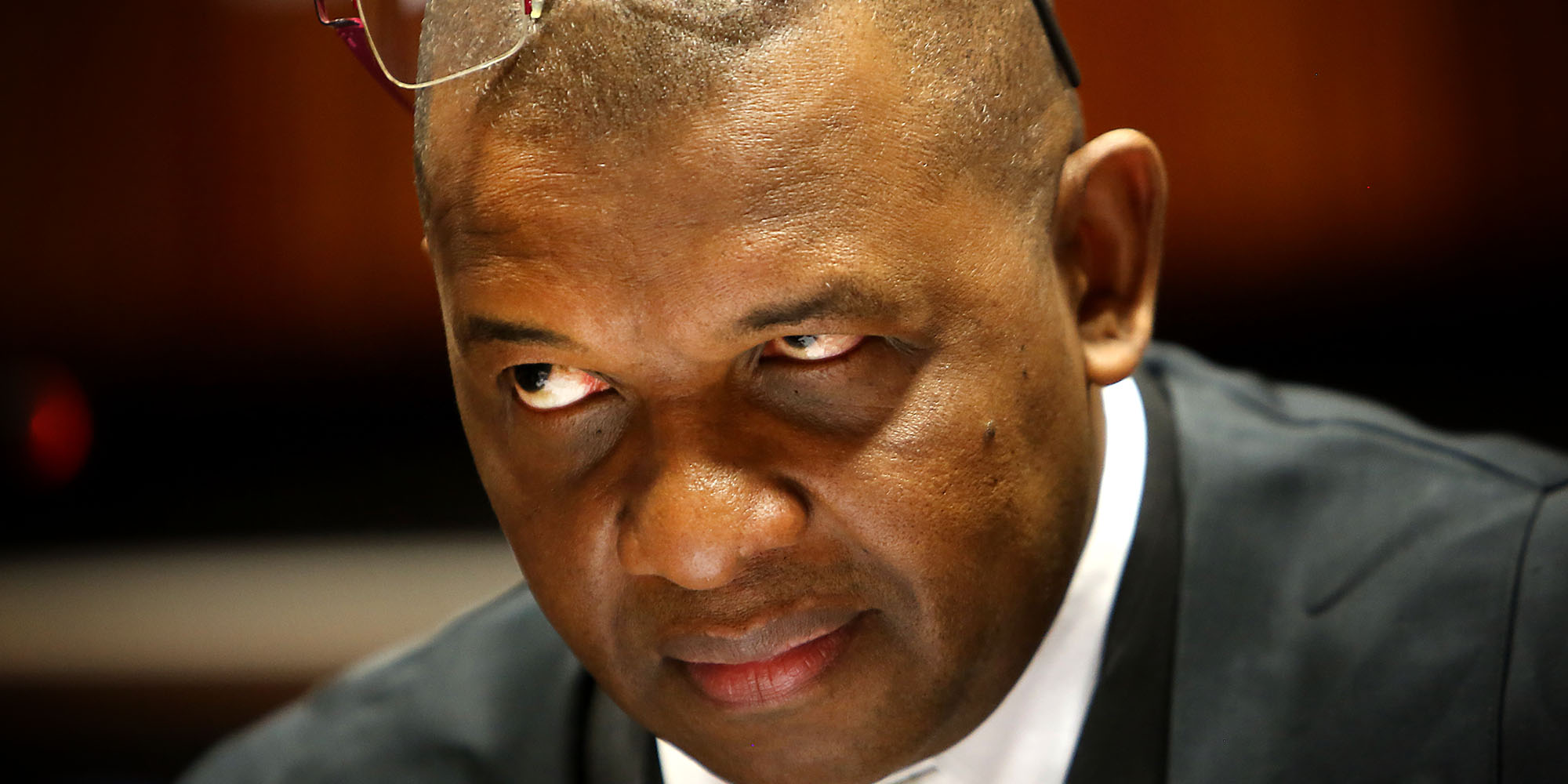
 Advocate Dali Mpofu. (Photo: Gallo Images / The Times / Alon Skuy)
The “protagonists and antagonists” sit at the apex of leadership in South Africa and include a sitting president, a former president, the National Assembly, the judiciary and the head of a Chapter 9 institution tasked with protecting the public from executive and official abuse and overreach.
A more A-list cast in this cutthroat arena of political theatre you do not get.
A 2010 collection of essays titled “Law and Magic”, edited by Christine A Corocos for the Louisiana State University Law Centre, explores the alchemy of language in legal or quasi-legal proceedings.
Though the Section 194 inquiry into Public Protector Busisiwe Mkhwebane’s fitness to hold office is not a court, elements of courtroom conjuring have been evident from the get-go, with her legal representative, Advocate Dali Mpofu, painting some witnesses as “liars” and “disgruntled employees” out to get “revenge”.
For more than a month, two versions of reality, as well as the limits of truth, have been tested and exposed.
“Lawyers and magicians have a lot in common,” writes Corocos in her foreword.
“Both lawyers and magicians are in the business of telling stories, and of doing a certain amount of misdirection (although lawyers must never lie to the court, and magicians announce from the beginning that lying is what they do best).”
Mpofu is lawyer and magician rolled into one. Earlier, cautioning that the work of the inquiry might well continue past its September deadline, Mpofu argued for a widening of scope to allow for the introduction of new evidence and witnesses including Jacob Zuma and Cyril Ramaphosa. That strategy was soon nipped in the bud by inquiry chair Qubudile Dyantyi.
The political game plan was, at least to judge by Mpofu’s early strategy, taking shape: attack, insult, deflect – and reconjure and polish the narrative that Mkhwebane is the victim of a political witch-hunt.
/file/dailymaverick/wp-content/uploads/2022/07/ED_392246.jpg "Public Protector Busisiwe Mkhwebane and her legal counsel, Advocate Dali Mpofu SC, at the Cape Town High Court on 25 July 2022 in Cape Town, South Africa. (Photo: Gallo Images / Brenton Geach)")
Mpofu’s has been a masterclass in gaslighting, cross-examination by omission, facetiousness and nasty ad hominem attack. It is unclear to which gallery Mpofu is playing, but he is playing hard.
With regard to the Vrede Dairy report, Mpofu claimed Mkhwebane had done more in one year than her predecessor, Thuli Madonsela, had accomplished in four. That Mkhwebane’s Vrede report had been set aside on review by the courts was not a fact Mpofu deemed important to mention.
The Section 194 inquiry is a public forum, not unlike those in ancient Greece, where citizens – in this instance in the rippling stream of comments from the virtual peanut gallery on the YouTube live stream of the hearings – freely offer their thoughts.
There are those who cheer Mpofu on and those who loathe him.
One fan, logged in as Nkosi Da Perf, quipped: “Mpofu has been absolutely outstanding. It’s like watching truth being born.”
Queen B was of the opinion that Mpofu “is buying time for his pocket”.
The physical inquiry is taking place in the Marks Building, just a short distance from the forlorn, burnt-out shell of Parliament, razed in January. It is a race against time as the inquiry is scheduled to conclude in September, a month away.
So far, the process to set up the impeachment hearing has been a fiercely litigated one. Mkhwebane’s contract comes to an end in October 2023 and she has vowed to serve out her term. Impeachment could mean a loss of benefits.
The inquiry is the culmination of a shotgun approach to lawfare that has lasted more than two years and cost the Public Protector or her office R67-million in legal challenges.
Advocate Steven Budlender, representing the Democratic Alliance in Mkhwebane’s ongoing Western Cape High Court challenge, read out a list of 21 judges who have ruled against her.
The inquiry also takes place in the aftermath of the final report of the Zondo Commission, which set out how the state was criminally captured.
There are more than 10,000 pages of documents, as well as various damning court findings, including from the Constitutional Court, against Mkhwebane. They include a finding that in the Reserve Bank/CIEX matter, she had acted in “bad faith, misrepresented facts and had peddled a number of falsehoods”.
The EFF and others have made no secret of their support for Mkhwebane and have not contributed a single question of substance so far.
The African Transformation Movement’s leader, Vuyolwethu Zungula, was kicked off the virtual platform this week for theatrically objecting to the return of a witness for cross-examination.
The ultimate impeachment vote will depend on real consideration of and engagement with evidence of Mkhwebane’s misconduct. Voting along partisan lines is bound to happen in this unique moment in South Africa’s history. Stand by. DM168
This story first appeared in our weekly Daily Maverick 168 newspaper, which is available countrywide for R25.

Comments
Scroll down to load comments...