




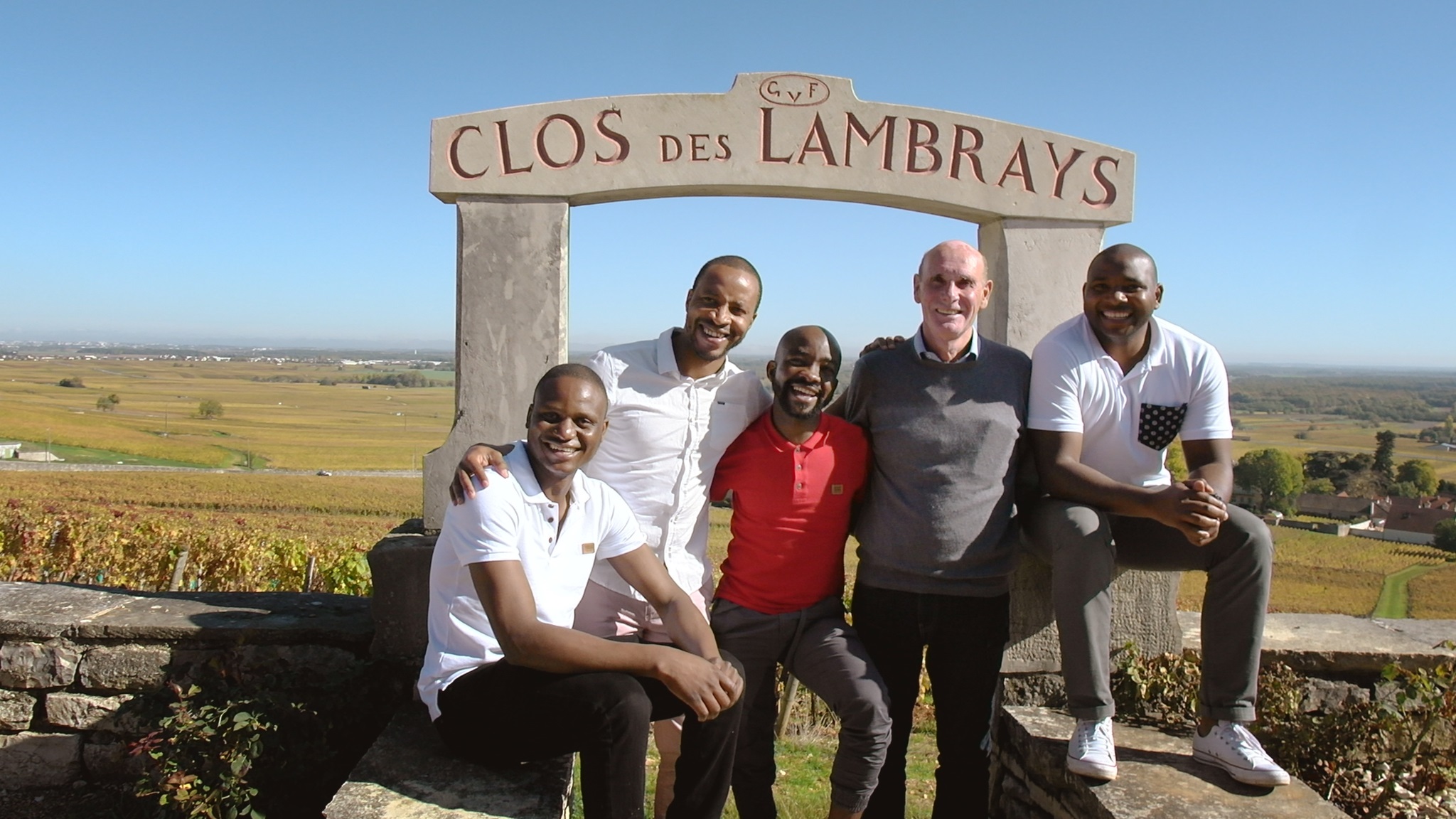
 Training in France. Production still from Blind Ambition. Image: Image courtesy of Universal Pictures
 A few years before the first Zimbabwe team attended the 2017 World Blind Wine Tasting Championships, “the Olympics of wine tasting”, not one of them had ever tasted the drink. Blind Ambition, released in South Africa on 29 July, is an uplifting underdog documentary profiling the four Cape Town-based sommeliers and making sense of their success in the context of the ongoing refugee crisis.
Australian directors Warwick Ross and Rob Coe pick up the story about a month before the competition.
“During my previous film, Red Obsession, which is also set in the wine world, we interviewed so many people in the business and one of them was Jancis Robinson, probably the first-, second- or third-most famous wine writer in the world. She’s written all these big coffee table books on wine, she’s an expert – writes for the London Times… And she knew I was looking for a subject again, and I didn’t want to make another film until I found the right one,” says Ross.
“One day she contacted us about these four Zimbabwe guys who have an amazing story to tell. Within a day or two, we were Skyping with the guys and it was one of those strange ones where they didn’t quite know who we were or what we really wanted of them.
“We were desperately trying to figure out what the story was in this – the individual stories were amazing, but was there going to be an arc to it? And, of course, they were training for the global competition, the first team Zimbabwe ever to compete, the first full team of colour to ever compete. Three weeks later we were here on the ground in Cape Town with a camera crew. I think they were still pretty unsure what we were on about, but it worked out,” he explains.
Even then, team Zimbabwe sommelier Marlvin Gwese admits that he was sceptical of the Australian directors. “At first, I wasn’t sure if it’s going to happen or not, because regularly we get those calls – Reuters for interviews or some opportunity with ABC. I just saw this as one of those calls and I thought it would die down. But when I felt the energy from them I said, this could be happening. The confirmation for me was only when they actually landed and seeing the cameras arriving,” he says.
In the film, we meet the team in high spirits, singing in camaraderie at a braai, white wine in hand. The subject of wine tasting lends itself to constant jokes about drinking and drunkenness intervening with their professionalism, like when Gwese (who came from the Pentecostal Christian church which prohibits alcohol) proudly points out that the first miracle was turning water into wine.
The team also revels in the celebratory comedy of their transition from destitution to the elite context of wine tasting. Every step of the way, the team exudes an exuberance and appreciation for where they are. Robinson, who has been writing about wine for decades, says that following their rapidly ascending careers rekindled the magic of wine tasting for her.
The film cultivates and retains a strong sense of their journey and brings you into it, allowing you to harvest its wonder with fresh eyes.
The interviews about the team’s past are heartfelt and forthright – they speak openly about their experience of fleeing and the xenophobia they suffered upon arriving in South Africa. These sections are often played over footage of them driving, emphasising how far they have come to afford luxuries like a vehicle, but also symbolising their metaphorical journeys.
Team captain Joseph Tongai Dhafana speaks about how he was smuggled across the border in a railway container in sweltering heat, falling and fainting, and how he and his wife were robbed constantly in Johannesburg; and yet it seems indicative of his character that we first see him break down on camera when he speaks of all the people who have helped him, not all the people who have hurt him.
The contrast between the team’s impoverished past and more luxurious present creates a sensitive, complicated dynamic when it comes to the state of Zimbabwe. On the one hand, their success has drastically improved the lives of their families and it’s wonderful to see, but it can also be awkward when they find themselves faced with others in the same situation they were once in.
Telling the story
Ross explains the difficulty of telling the inspiring story of the team’s adventure against the ongoing plight of Zimbabwean refugees who are still struggling.
“We certainly picked up on the polarity of the story very early. I think part of the engine of the film is how those two things are poles apart. We knew it was important to tell the refugee’s story of hardship, but the difficulty for us in the editing room was, how far do you go?” says Ross.
“At one stage we had a cut where we had actual footage of Prince Charles handing over the documents, the instruments of government to Mugabe. [Team Zimbabwe] never even knew this, but that’s how the film actually started at one stage.
“We were going to try to weave that story through, but it’s such a strong story that it tended to dominate the story of the guys. So we pulled back a lot of those things… Mugabe resigned just after the guys competed. It was almost the day of the end of the competition, maybe within two or three weeks, but he resigned and we thought this was a huge thing to bring into the story, that there was a chance now, an opportunity that Zimbabwe would be refreshed and things would happen.
“The guys could go back and then rediscover their lives, so we started working towards that. But then within a very short space of time, it seemed to us that all the hopes of that new government were beginning to melt away before everybody’s eyes. And although the name changed, the government didn’t seem to, and so that story was almost not worth chasing. There was a flash in the pan and then it was gone. So we just kept bringing it back to the guys whenever we were in doubt about what direction to go in,” he explains.
Much of the film is building up to the 2017 World Blind Wine Tasting Championships that took place in Burgundy, France. In a blind tasting, competitors must name all aspects of a wine without knowing what has been poured. Each team tastes 12 wines blind – six white, six red – and must find the cultivar, the country of origin, the region, the producer and even the vintage. A point is scored for every correct full answer.
A team’s success hinges on their ability to work together, to gauge who is most knowledgeable and confident in any particular aspect of a wine and trust their judgement in the event of a disagreement. The detail with which experts can assess a wine is baffling. Just getting Team Zimbabwe to the competition required crowdfunding £6,500 (roughly R132,000).
Once they were there, the only full team of colour from a country which nobody ever expected to compete, the story feels very much like the classic, slightly politically dated American Nineties comedy Cool Runnings about the Jamaican bobsled team that competed in the 1988 Winter Olympics.
Training for the blind wine tasting competition
Team Zimbabwe didn’t have much training and exposure to wine compared with their opponents, but the team captain, Dhafana, explains that much of tasting depends on natural ability. “It’s a bit of both [training and talent], and a bit of luck as well. To be a good soccer player, you need both talent and match fitness, or else you can’t compete. I would like to think that we were born with hidden talents that were kind of activated when we started tasting wines. I also need to mention that a team is only solid if there’s coherence. There’s so much respect among ourselves and we know who is best in what.”
Tinashe Nyamudoka comments in the film that most foreigners are looking for jobs in restaurants but “when they asked us what kind of wines they knew, we only knew red and white”. Once he began to learn more about wine he noticed a Western bias. The adjectival benchmarks used in traditional wine tasting were not things that were familiar to him as an African person – blueberries, blackberries or strawberries rather than indigenous fruit. With regards to wine of origin, he says in the film: “I have never been to that place. Why can’t wine of origin be where the wine is taking me?”
He says: “In all the wine learning and knowledge, that was the most difficult part. And it also meant you felt out of place – you go to a tasting and everyone is screaming about areas you haven’t heard of or mulberries. You just end up picking them up, but there wasn’t a sense of enjoyment. [This] changed when I could associate wine with things I was used to. That’s when I understood that wine is what you perceive, where you’ve been and your memories, and also equating it with food because there was this imbalance when I was working at top establishments, but when I go home, I’m not eating the same food as those people. I felt like wine was for this setting. So the moment I started taking it home and meeting guys with the same tasting palettes, it was just much more fun.”
Dhafana concurs and adds that “we started relating to stuff that we’ve grown up eating, like the fruits from back home, and then it started making more sense. These were really interesting markers for particular wines, particular regions as well.
“We also started with a very clean slate – I don’t think any of us really knew what asparagus was back then. So in that sense I think it was quite a big disadvantage, but it was also an advantage because we were keen and curious. What is asparagus? What does it taste like when it’s raw? How does it taste when it’s pan-fried? So we adapted so fast. Honestly speaking, the amount of time we spent trying to navigate the wine industry is so short for what we’ve achieved. Looking back now, it was like sprinting a marathon,” he says.
The championships
/file/dailymaverick/wp-content/uploads/2022/08/Airport.jpg "Production still from Blind Ambition. Left to right: Pardon Tagazu, Marlvin Gwese, Tinashe Nyamudoka, Tongai Joseph Dhafana. Image: courtesy of Universal Pictures")
The competition itself is only a tense, fleeting 15 minutes at the end of the film, and even though the film is built around it, it doesn’t seem half as important as their journey to get to that point. Just being at the airport, on their way to take part in a world-class competition, is an emotional moment of triumph.
It would be remiss not to mention the team’s legendary coach, French sommelier Denis Garret, described in the film as an encyclopaedia of wine. Over and above that, he is by far the best source of comic relief in the film – pretty much anything Garret says is hilarious – eccentric is an understatement.
He’s also an abrasive character and not necessarily ideal as a coach. When asked whether he can ever irritate people he responds: “Ah! Immediately!” But he adds wonderful vibrancy to the film and the team clearly love him, even though they half-jokingly claim that they only chose him to cut costs by getting a coach who is already in France. Garret’s presence landed up being somewhat disruptive during the competition, but their mission to Burgundy afforded them enormous experience, and they have since returned to the World Championships.
/file/dailymaverick/wp-content/uploads/2022/08/competition.jpg "roduction still from Blind Ambition. Left to right: Tinashe Nyamudoka, Pardon Tagazu, Dennis Garret, Tongai Joseph Dhafana, Marlvin Gwese. Image: Image courtesy of Universal Pictures")
Soon after the championships in 2017, Gwese explains that the team started getting calls from aspiring sommeliers asking for mentorship and guidance. “We probably need to start mentoring the guys that can take over from us in the near future, that we could send [to competitions] and that we can coach… there is great mentorship happening now. And we want to see this happening every year for Team Zimbabwe. We want to see a team going every year.”
Other than the occasional poor choice of music, overusing South African classics like Pata Pata and Shosholoza rather than Zimbabwean tracks, the film gives an impression of authenticity that is a joy to be a part of. Ross and Coe struggle slightly to tie up their messaging regarding the more politically charged aspects of their story-telling, pushing a positive idea that even though change is not coming from the Zimbabwean government, it could come from stories like these.
That may be wishful thinking, but the potency of the story is unquestionable. Despite the turmoil that drove them from their homes, and the comfortable lifestyle they have found through their unlikely talents, Team Zimbabwe speak about their home with moving love and reminiscence. Nyamudoka says at the film’s close: “I hope one day I can go back there and plant the first vines on the slopes.” DM/ML
/file/dailymaverick/wp-content/uploads/2022/08/Poster.jpg "Official poster for 'Blind Ambition': Left to right: Tongai Joseph Dhafana, Marlvin Gwese, Pardon Tagazu, Tinashe Nyamudoka. Image: courtesy of Universal Pictures")
Blind Ambition is on at cinemas. You can contact This Weekend We’re Watching via tevya@dailymaverick.co.za
In case you missed it, also read How to drink wine like a connoisseur
https://www.dailymaverick.co.za/article/2020-10-05-how-to-drink-wine-like-a-connoisseur/