



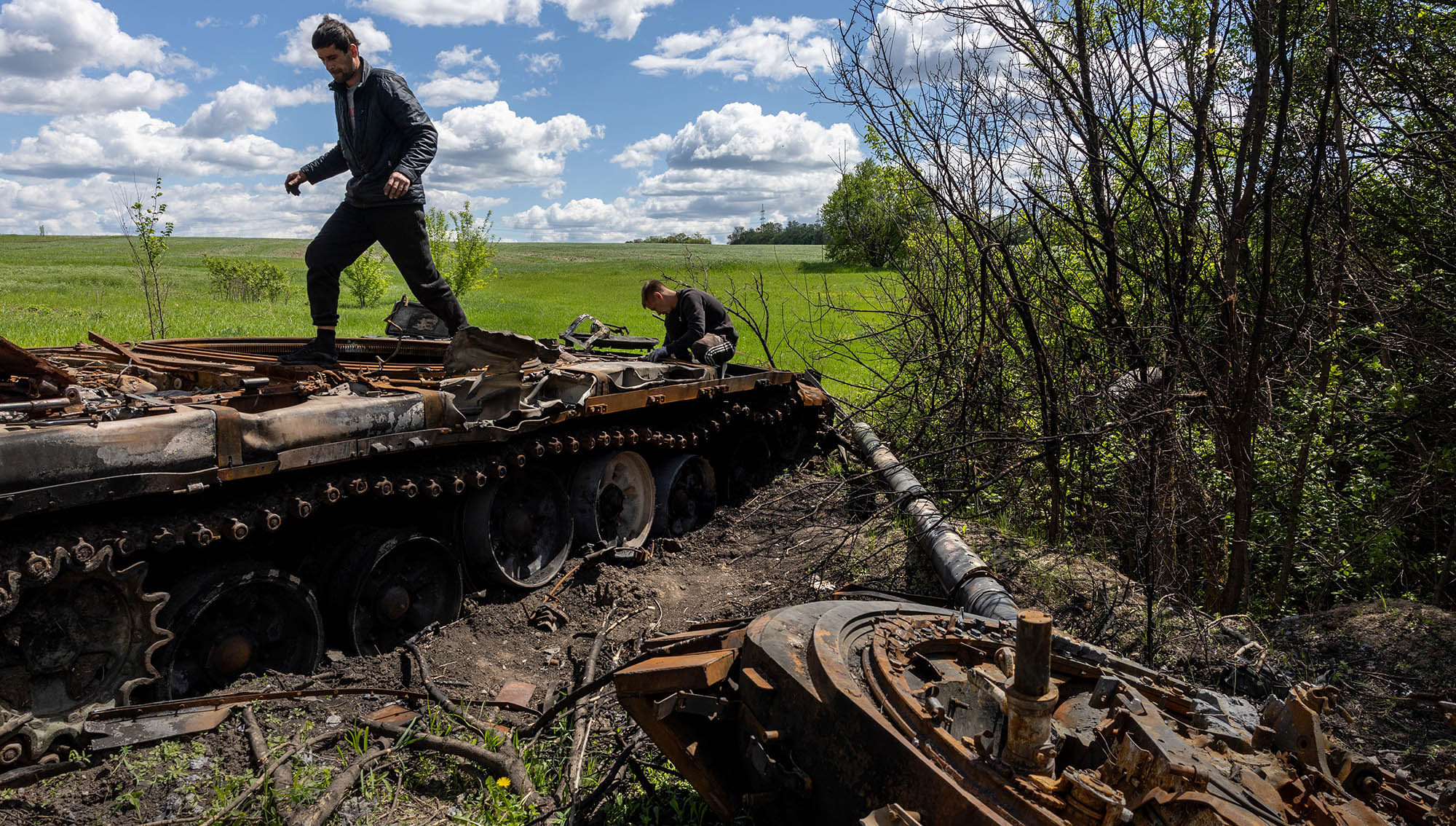
 Residents scavenge pieces of aluminum from destroyed Russian tanks on 16 May 2022 in Biskvitne, Ukraine, to the east of Kharkiv. (Photo: John Moore / Getty Images)
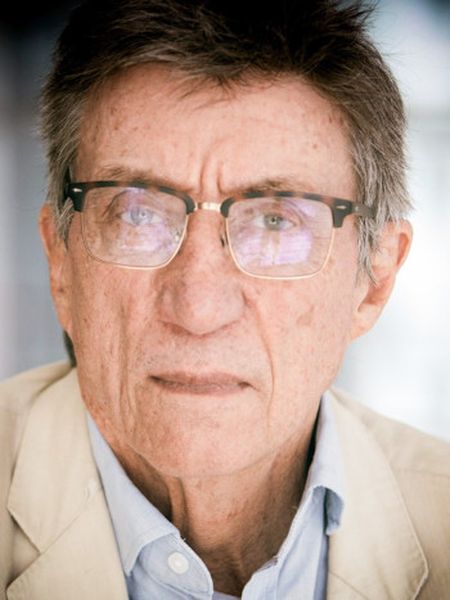
 Almost all the Russian pundit commentary has been obsequious, presenting the war in Ukraine as going well. But in a very rare moment of brutal candour on Russian state TV this week, former colonel Mikhail Khodaryonok told his compatriots to “stop taking information tranquillisers” and accept the reality that the war is about to start getting worse.
He also told his fellow Russians that “we are in full geopolitical isolation… virtually the whole world is against us. And it’s that situation we need to get out of.”
Khodaryonok urged Russians not to believe the “information tranquillisers” being spread among them that the Ukrainian armed forces were on the verge of a psychological breakdown and a crisis of morale.
“All of that, to put it mildly, is false,” he said.
/file/dailymaverick/wp-content/uploads/2022/05/Screenshot-2022-05-17-at-16.54.09.png "A screenshot of military analyst Mikhail Khodaryonok on Russian state TV this week. (Image: Supplied)")
There were some individual cases of breakdown, “But the situation from the overall strategic position is that the Ukrainian armed forces are able to arm a million people,” Khodaryonok said.
The West was arming them with modern weapons, including through the US Lend-Lease programme — the revival of a World War 2 initiative which was about to start functioning.
Khodaryonok predicted the implementation of this programme in an article he wrote just before the Russian invasion of Ukraine, which ridiculed the many pundits who were forecasting that Russia would overrun Ukraine in days or even hours in a lightning “blitzkrieg” attack.
On state TV this week, Khodaryonok said if one added the US Lend-Lease programme to the European aid to Ukraine — which was just about to come into effect fully — “a million Ukrainian soldiers need to be viewed as a reality of the very near future. And we need to take that into account in our operational and strategic calculations, that the situation for us will frankly get worse.”
https://www.dailymaverick.co.za/article/2022-05-17-gentlemans-agreement-despite-mining-ban-russia-scours-antarctica-for-massive-fossil-fuel-deposits/
He fobbed off an objection from the TV presenter that Ukraine did not in fact have such a large professional army. What counted, said Khodaryonok, was not whether the Ukrainian army was professional or conscripted, but the level of its training — “and its morale and readiness to shed blood for the homeland. That’s what determines the level of professionalism.
“A conscript army can be highly professional too. The way an army is recruited never determines the level of any army’s professionalism.
“In our country, that dogma has become very firmly entrenched in the minds of some of our political scientists, that if a man is a contracted soldier, he’s a professional. Far from it!
“But a desire to protect one’s homeland — in the sense that it exists in Ukraine, and it really does exist there — they intend to fight until the last man.”
Khodaryonok also urged Russia: “Don’t engage in sabre-rattling with missiles in Finland’s direction” — a reference to reported threats by the Kremlin to station nuclear missiles on the border with Finland if its Nordic neighbour joined Nato, as it and Sweden formally decided to apply to do this week.
Khodaryonok suggested this “amusing” stance by Russia would simply aggravate the main deficiency of its military-political position, which was that it was “in full geopolitical isolation. And that, however much we would hate to admit this, virtually the whole world is against us. And it’s that situation we need to get out of”.
When the presenter remonstrated that it was in fact only the West which was against Russia, he retorted that the support for Russia from countries like India and China was “not so unconditional.”
Khodaryonok has been widely acclaimed for his prescience about how the war would unfold, in an article he published in the online journal Nezavisimaya Gazeta on 3 February, three weeks before Russia invaded Ukraine.
The article, titled “Predictions of bloodthirsty political scientists: About enthusiastic hawks and hasty cuckoos”, issued a dire warning to the many Russian commentators who were forecasting a crushing defeat of Ukraine within a few hours.
Khodaryonok noted that political experts predicted then that a powerful first strike by Russia would destroy almost all of Ukraine’s surveillance and communication systems, artillery and tank formations.
Some commentators had gone further by saying it would not even be necessary to send troops into Ukraine “since the armed forces of this country are in a deplorable state”.
Others had added, “No one in Ukraine will defend the ‘Kyiv regime’ ”.
Khodaryonok warned that these analysts were showing a complete ignorance of the military-political situation and of the mood of the broad masses in Ukraine. They underestimated the “degree of hatred” Ukrainians had for Russia.
“No one will meet the Russian army with bread, salt and flowers in Ukraine,” he predicted, accurately.
Khodaryonok said these analysts had learnt nothing from Russia’s invasion of the Donbas region of Ukraine in 2014 (when Russia also occupied Crimea). He said at that time many Russian commentators had predicted that the Donbas — which has a large ethnic Russian population — would instantly turn into “Novorussia” (New Russia).
But not even the Russian-speaking population of this region had supported these plans. The war had dragged on and the Novorussia project faded away. Likewise, “the liberation campaign in 2022” would also fail, he predicted.
One of the reasons the predicted decisive first strike against Ukraine would fail, Khodaryonok wrote on 3 February, was because the Ukrainian forces would not be concentrated together in a way that would allow Russia to destroy them in a single massive strike.
Another reason was that Russia’s arsenal of missiles “is absolutely not enough to wipe out a state the size of France, and with a population of more than 40 million, from the face of the Earth”.
Khodaryonok also noted that some Russian experts were then predicting that Russia’s dominance of the air would make for a quick victory over Ukraine. He reminded them that Russia’s enemies in Afghanistan had not had a single aircraft or combat helicopter, yet the war there had dragged on from 1979 until 1989.
Similarly, Russia’s Chechen enemies did not have a single aircraft, yet the war there had lasted for several years and had cost Russia “a lot of blood and casualties”.
He reminded these commentators that Ukraine did have some combat aircraft as well as capable anti-aircraft missiles — which Nato would surely reinforce.
[embed]https://www.dailymaverick.co.za/article/2022-05-18-south-african-among-motley-crew-of-foreign-volunteers-fights-for-children-of-ukraine-and-his-own/[/embed]
He also reminded them that although the Ukraine armed forces in 2014 had only been “a fragment of the Soviet army, over the past seven years a qualitatively different army has been created in Ukraine, on a completely different ideological basis and largely on Nato standards.”
“Never despise your enemy… do not consider him stupider and weaker than you,” he warned.
He also cautioned that the whole of Ukraine could turn to guerrilla warfare as a last resort — and if so, would be helped by fighting in cities which favoured the defending side, shielding it from the attacker’s superior firepower.
“In general, there will be no Ukrainian blitzkrieg,” he concluded.
“The statements of some experts such as ‘The Russian army will defeat most of the units of the Armed Forces of Ukraine in 30-40 minutes’, ‘Russia is able to defeat Ukraine in 10 minutes in the event of a full-scale war’, ‘Russia will defeat Ukraine in eight minutes’, have no serious grounds.
“And finally, the most important thing. An armed conflict with Ukraine is currently fundamentally not in Russia’s national interests. Therefore, it is best for some overexcited Russian experts to forget about their hatred fantasies. And in order to prevent further reputational losses, never remember again.”
Prophetic words. To put it mildly. DM
[hearken id="daily-maverick/9472"]