




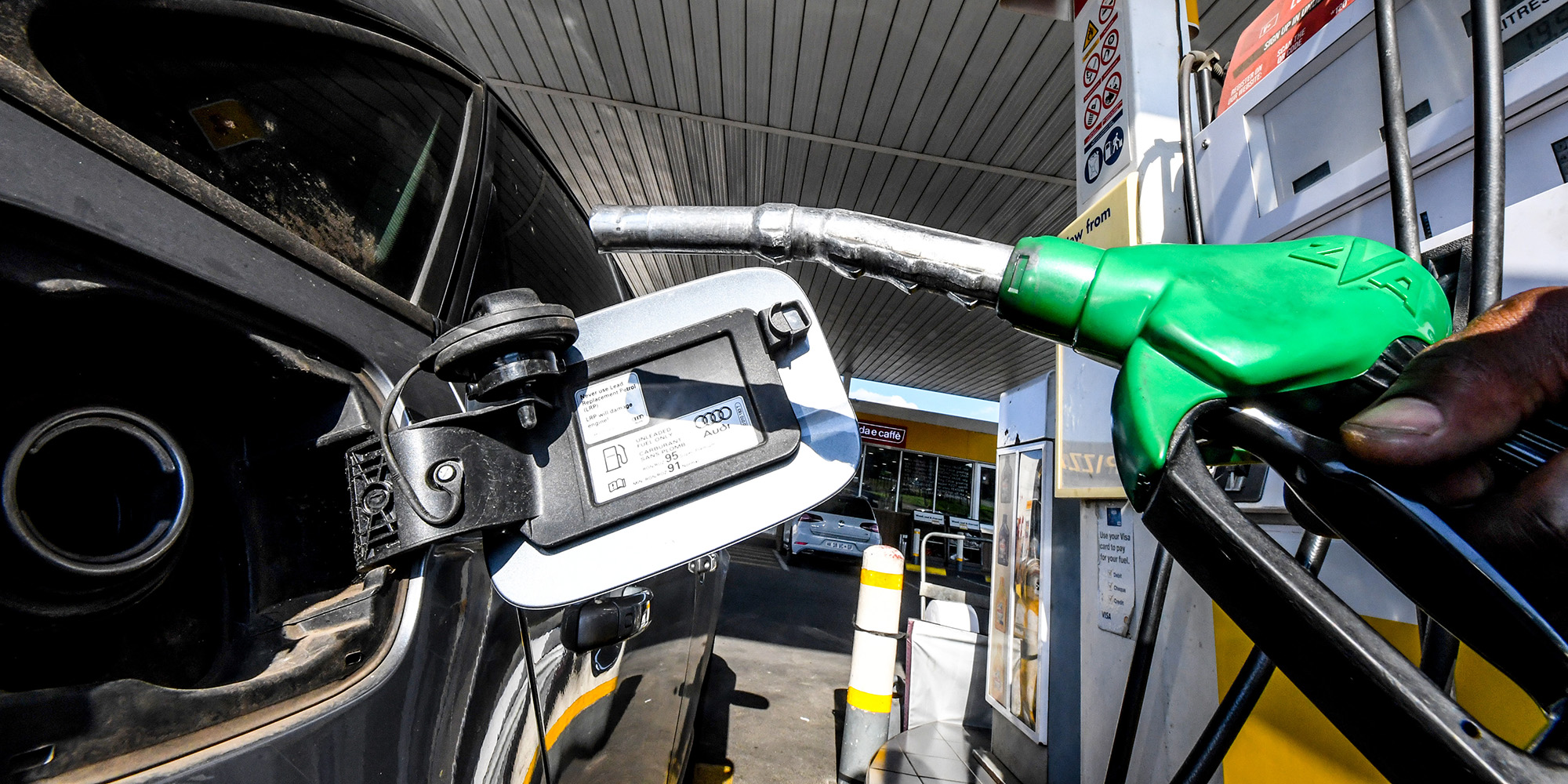
 Russia’s invasion of Ukraine on 24 February has triggered rapidly rising global oil prices that have upped the pressure in South Africa where the petrol price, after a series of increases, breached R20 per litre. (Photo: Gallo Images / Sydney Seshibedi)
 The words may have been different, but without fail the message was the same: knee-jerk responses amid a public outcry of rising petrol prices would undermine the sustainability of the domestic industry given the slim margins across the board.
DA MP Kevin Mileham’s comment on the associations’ “incredible self-interest” was supported by other MPs in a rare cross-party political agreement.
Friday’s meeting of the parliamentary mineral resources and energy committee came as the government announced an overall review of the petrol price – with more pressing mitigation of rising petrol prices under way.
Russia’s invasion of Ukraine on 24 February has triggered rapidly rising global oil prices that have upped the pressure in South Africa where the petrol price, after a series of increases, breached R20 per litre.
https://www.dailymaverick.co.za/article/2022-03-24-look-up-theres-a-political-asteroid-heading-our-way/
In an unusual move, the 2022 Budget did not raise the fuel levies and the Road Accident Fund (RAF) tax – the carbon tax component of the petrol price went up one cent to 10c a litre – to provide relief to consumers.
Levies and taxes account for about a third of the petrol price per litre, with the basic fuel price (BFP) set on parity pricing for oil imports. Administered prices under the Regulatory Accounting System include wholesale, distribution, retailers and entrepreneur margins, alongside zone differentials that set prices on geographic district and the slate levy financing cumulative petrol price under-recoveries.
That the government also is looking at ways to mitigate further fuel price hikes is on public record – even if the details are not.
“Work is being done; what is making the decision more urgent is the impact of the Ukraine Russia conflict, which is moving the price of oil faster than we have thought… A decision will be announced fairly soon,” said Finance Minister Enoch Godongwana during Wednesday’s economic ministerial Q&A in the House.
And he stayed on message, regardless of opposition questions, saying discussions between him and his Cabinet colleague, Mineral Resources and Energy Minister Gwede Mantashe, were at a sensitive stage.
In turn, Mantashe indicated current considerations included the strategic oil reserves of about 10 million barrels of oil. “We are looking into strategic fuel stocks because there is a crisis.”
In mid-March, Parliament’s mineral resources committee heard the department was looking at encouraging remote working, lower speed limits, but also price caps and limiting petrol purchases to 50 litres at a time.
Unlike other countries’ consideration to remove some taxes for a few months, South Africa was looking at providing sectoral support, according to Mineral Resources and Energy Deputy Director-General Tseliso Maqubela: “We think supporting public transport (like taxis) would work better.”
And to avoid future difficulties, South Africa had to find and produce its own oil.
On Friday, that call for domestic capacity was echoed – South Africa had to become a price setter, not a price taker – when MPs met the South African Petroleum Industry Association (Sapia), Liquid Fuel Wholesalers Association (LFWR), the Fuel Retailers Association (FRA), the South African Oil and Gas Alliance, and the South African Petroleum Retailers Association (Sapra).
Given that the petrol price is strictly regulated by the minister, said Sapia executive director Avhapfani Tshifularo, “there is little (we) can do to alleviate such price hikes without impacting the security of supply of petroleum products or jeopardising the sustainability of the industry”.
LFWA director Peter Morgan proposed using at least some of the commodity windfall to offset the petrol price spikes, and also to review the slate levy.
“While we understand the public frustration, we need to ensure that suggested revisions to fuel prices do not have unintended consequences.”
FRA board member Sbonelo Mbatha called for the scrapping of the RAF tax, about R2.18 per litre of petrol, in favour of a flat-fee motor insurance.
“Any attempt to reduce retailers’ margin… any attempt will render most service stations unsustainable. The industry already approaches 4,000 retrenchments due to hardships.”
Sapra director Vishal Premlall pointed out that in 2008 when the oil price was $140 a barrel, the petrol price was R11 per litre, but as the oil price stood at $120 a barrel, the petrol cost R21 per litre.
Between 2011 and 2021, per-litre petrol levies increased by 116%, the RAF tax by 173% and the basic fuel price by 49%.
Retailers already have been hit hard by the Covid-19 lockdown that has cut volumes they depend on, and cannot afford any cuts in their administered price margins.
The industry associations told MPs of their readiness to participate in consultations over the petrol pricing and related matters.
That would be in the long term as part of the government’s overall petrol price review, not any short-term measures.
But the focus right now is on April and May, according to the government in its efforts to mitigate the impact of global oil spikes sparked by Russia’s invasion of Ukraine. To date, there’s been no word. DM
[hearken id="daily-maverick/9303"]