




 Citigroup headquarters in New York, U.S., on Friday, Jan. 7, 2022. Citigroup Inc. was the first major Wall Street bank to impose a strict Covid-19 vaccine mandate: Get a shot or face termination. With its deadline fast approaching, the company is preparing for action.
 Representatives for JPMorgan and Citigroup declined to comment.
European bondholders of Russia’s sovereign debt had received no sign of the funds as of late Thursday, and S&P Global Ratings warned that the “technical difficulties” in getting the money to investors was increasing the risk of a default -- either this time around or in the future.
Russian officials have said if the payment in dollars is blocked, then it would instead send it in rubles. Russia has a 30-day grace period to meet the payment obligations.
“If funds are not accessible for investors or if a payment is made in a currency not stipulated in the terms of the obligation and we believe that the investor does not agree to the alternative payment, we could deem this a default,” S&P analysts said in a statement, downgrading Russia’s foreign-currency rating to CC from CCC-.
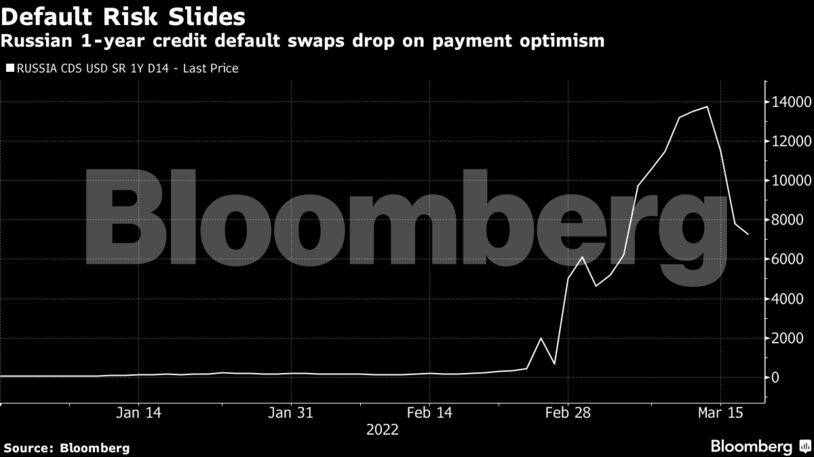
Nonetheless, JPMorgan’s move spurred optimism that the bonds may still be settled in dollars, sending the country’s bond prices higher across maturities. The implied probability of a default by Russia within the year inched lower to 57%, down from 59%, according to credit-default swap pricing. Last week it was as high as 80%.
“This seems to take a technical default off the table for now,” Kaan Nazli, a money manager at Neuberger Berman in The Hague, Netherlands. “However, there is still some uncertainty over corporate debt as only a number of companies have been given leeway.”
Citigroup is the payment agent for about four dozen bonds tied to Russian companies, according to data compiled by Bloomberg. Some of those companies -- including MMC Norilsk Nickel PJSC and Gazprom PJSC -- have successfully made coupon payments in recent days.
Read more: Norilsk Nickel Bondholders Receive Coupon Payment in Dollars
But, in other cases, coupon payments may not have gone through. Citigroup this week blocked a $19.25 million interest payment sent by EuroChem Group AG, a Russian fertilizer maker, according to a person familiar with the matter. The steel and mining company Severstal warned this week that Citigroup may refrain from processing a $12.6 million interest payment due on its dollar bonds.
The drama has thrust a spotlight on banks’ back offices. The Russian Finance Ministry said it had sent the order for a $117 million interest payment on March 14 to a correspondent bank that it didn’t identify, adding that it would issue a separate comment about whether the paying agent, Citibank’s London branch, has received the payment.
As a correspondent bank, New York-based JPMorgan processes and clears payments and other transactions for financial institutions. In its role as payment agent, Citigroup, also based in New York, collects coupon payments from bond issuers and distributes those funds to investors.