




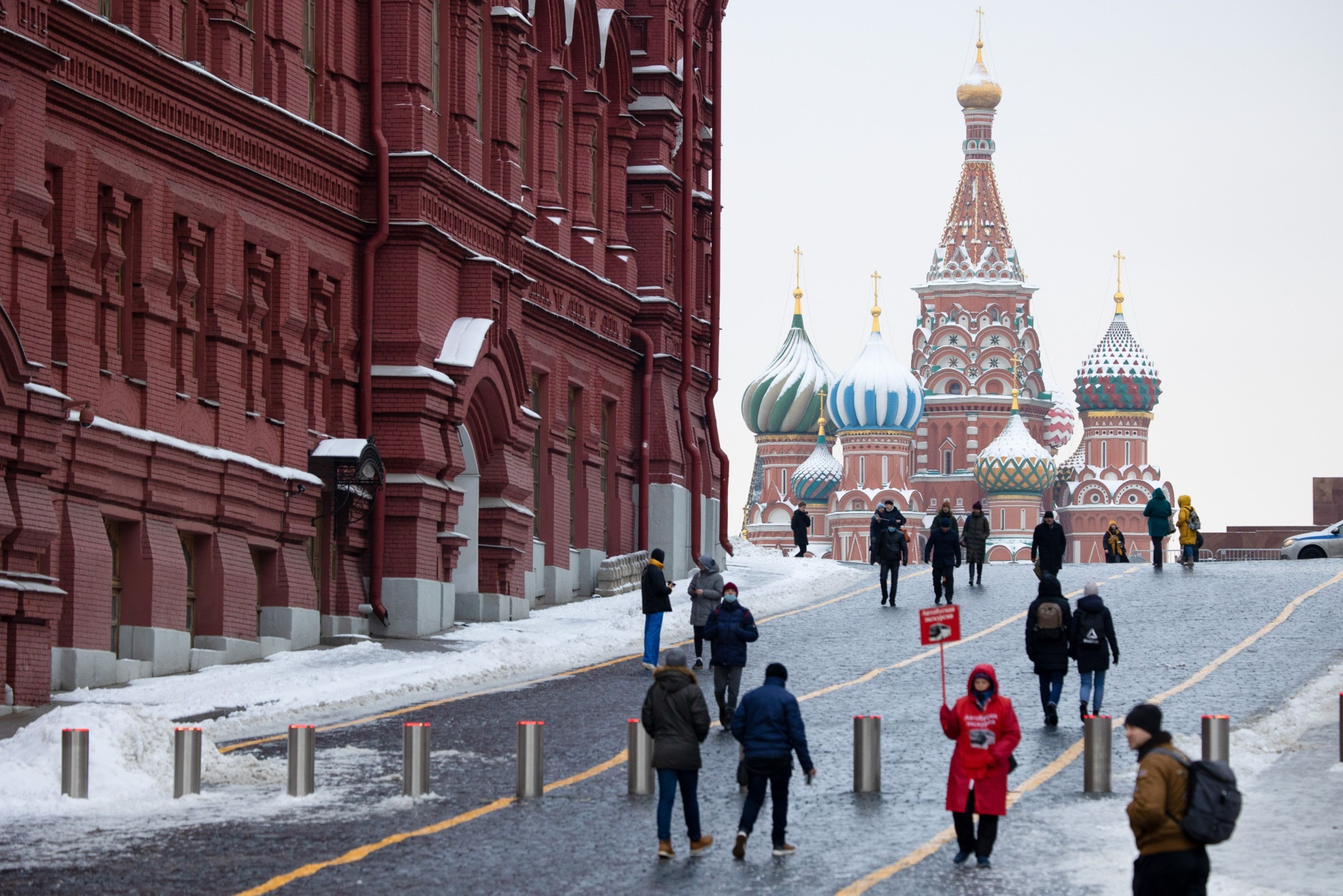
 Saint Basil's Cathedral on Red Square in Moscow, Russia, on Wednesday, Dec. 8, 2021. Russian markets brushed off reports that the U.S. and its allies are considering sanctions targeting the countrys banking sector should President Vladimir Putin invade Ukraine. Photographer: Andrey Rudakov/Bloomberg
 With Russia’s tenuous links to global financial markets snapping one after another, international investors can’t pull their money out as assets in the country go into freefall. Its foreign reserves are frozen, buyers are shunning Russian oil exports and corporate titans from Shell Plc to Apple Inc. are turning away.
“We can’t sell our Russian stocks,” said Russel Chesler, head of investments and capital markets at fund manager VanEck Associates Corp. in Sydney. “Even last week our brokers wouldn’t sell them when the markets were open, and this will just deteriorate things further for investors.”
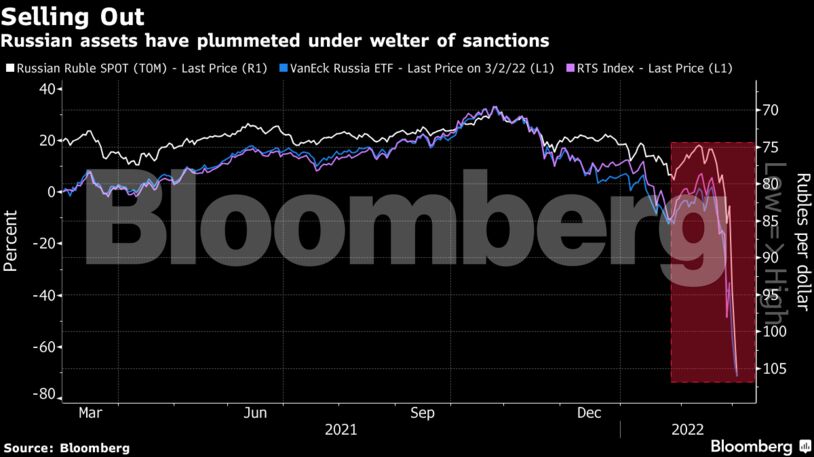
The expulsion of Russian bonds could be next. FTSE Russell said it is continuing to evaluate the impact of recent sanctions on Russian debt to its fixed-income indexes.
JPMorgan Chase & Co. said it was reviewing the inclusion of some debt from Russia, Belarus and Ukraine in its bond indexes while Intercontinental Exchange Inc. will remove debt issued by sanctioned Russian entities from its fixed-income indexes.
Bloomberg is also seeking feedback on the investability of Russian index members in global equity gauges following recent sanctions and seeks feedback by March 3. Bloomberg LP, the parent of Bloomberg News, is also the parent company of Bloomberg Index Services Ltd., which administers these indexes
The moves follow Russia’s decision to introduce capital controls and ban foreigners from selling securities locally, effectively shutting the exit for investors.
“Russian assets have become toxic,” said Marek Drimal, a London-based strategist covering Europe, the Middle East and Africa at Societe Generale SA. “The speed of events as they are happening is just mind-boggling.”
India and China
Russia’s removal from key gauges means other emerging markets may benefit from fresh inflows.
India and China could be beneficiaries, according to Vishnu Varathan, head of economics and strategy Mizuho Bank Ltd. in Singapore. Alan Richardson, a portfolio manager at Samsung Asset Management, said capital flows may pivot to Indonesia and Malaysia, which share similarities to Russia in terms of commodities.
Russia had a 1.5% weighting in the MSCI Emerging Markets Index, according to data compiled by Bloomberg. Its weighting in emerging markets with FTSE Russell was about 1.3%, the data show.
“The removal of Russia from key indexes will be a positive thing for investors given the uncertainty surrounding the economy and potential settlement risks,” said Naoki Fujiwara, chief fund manager at Shinkin Asset Management co.. “But in terms of overall impact, I don’t expect it to be big given the size of the Russian economy.”
While Russia has kept its local stock market closed since Monday, foreign-listed shares in Russian companies plunged this week. In an effort to support its market, the country announced Tuesday that it will deploy up to $10 billion from its sovereign wealth fund to buy up local equities.