




 A worker stands in front of a machine on a yarn production line at the Fujian Strait Textile Technology Co. factory in Putian, Fujian province, China, on Monday, Feb. 8, 2021. China may have got its control of Covid down to a handful of new cases per day, but the restrictions, quarantines and travel curbs to keep it that way have forced millions of factory workers to give up the idea of a traditional family gathering. Photographer: Qilai Shen/Bloomberg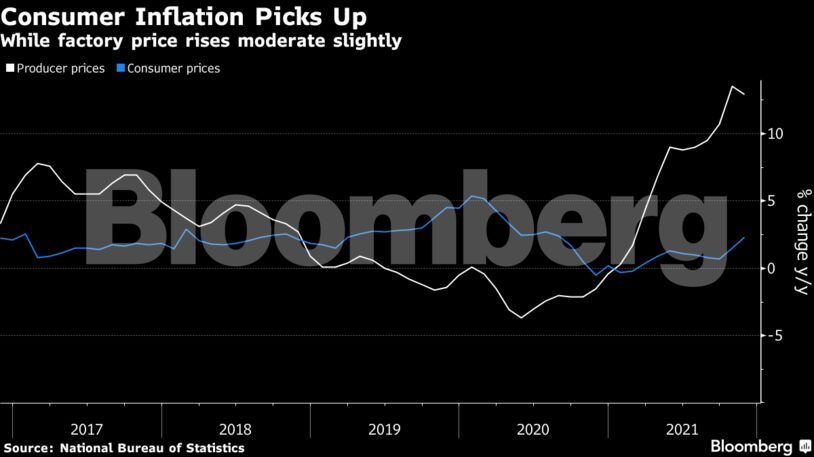
The slowdown is a sign that the government’s efforts to tame soaring commodity prices and deal with power shortages over the past few months are having an effect. If the price pressures continue to abate, it may provide more room for the central bank to add stimulus.
“There’s more space for monetary policy, as consumer inflation will likely stay mild in the first half of next year before rising further in the second half,” said Bruce Pang, head of macro and strategy research at China Renaissance Securities Hong Kong Ltd. Factory inflation will probably continue slowing in the coming months, while falling oil prices could balance out the impact of rebounding pork prices on consumer inflation, he said.
Pricier Food
Consumer inflation sped up, with much of that pickup driven by more expensive food. Vegetable prices jumped 30.6% in the month, although wholesale prices have started to come down. Meanwhile pork prices were much lower than this time last year, dropping 32.7%. Without that decline, consumer prices would have risen 3%.
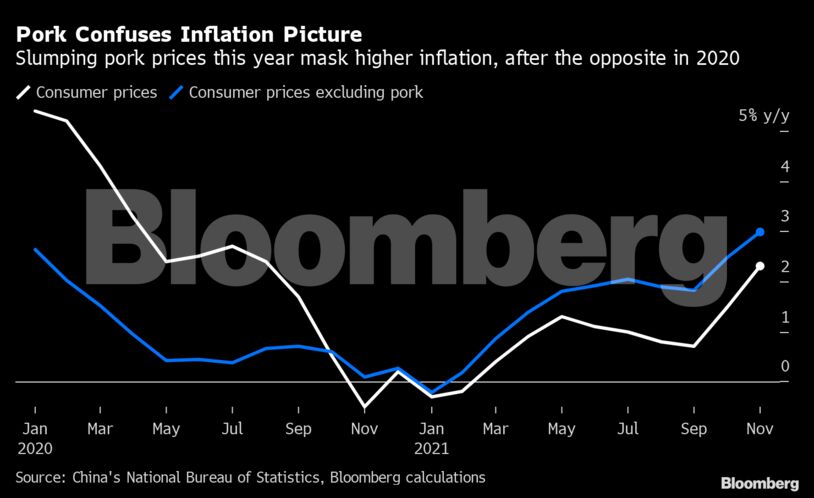
However, the cost of pork has started to rise again, with wholesale prices up almost 50% from the low in October.
“As policies to stabilize prices and ensure supply have stepped up, the rapid surge in coal, metal and other energy and raw material prices has been initially contained, leading to a slowdown in PPI,” Dong Lijuan, senior statistician at the NBS, said in a statement accompanying the release.
Core CPI, which excludes more volatile food and energy prices, rose 1.2%, as sporadic Covid-19 outbreaks likely continue to weigh on services consumption.
What Bloomberg’s Economists Say...
The data “won’t stand in the way of further easing by the central bank, which we think continues to place a greater priority on supporting growth.”
Eric Zhu, economist
See here for full report
The central bank acted to release 1.2 trillion yuan ($189 billion) into the economy, announcing Monday it would reduce most banks’ reserve requirement ratio by 0.5 percentage point from next week. While the central bank said this wasn’t the start of an easing cycle, financial markets are showing some expectation of further action.
The Communist Party’s top leaders also indicated earlier this week that their focus for the coming year is stabilizing macroeconomic conditions and signaled an easing of some property curbs next year, as a real estate downturn and sporadic virus outbreaks weigh on the economic outlook.
Comments
Scroll down to load comments...