




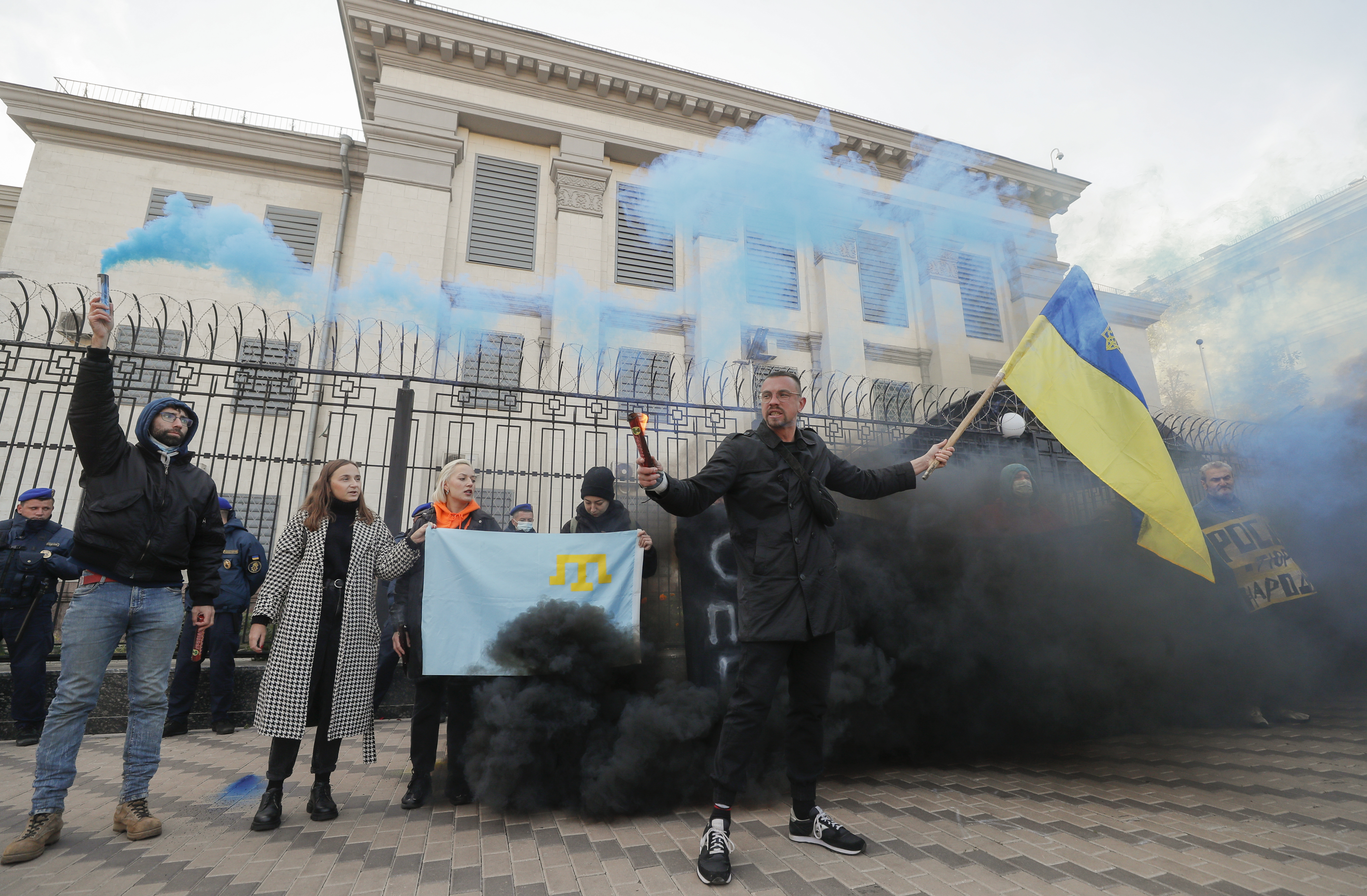
 epa09494773 Ukrainian human rights activists burn flares and smoke grenades during a rally in front of the Russian embassy building in Kiev, Ukraine, 29 September 2021. Ukrainians gathered in solidarity with Ukrainian political prisoners who were captured and condemned by Russia. At least 118 Ukrainian citizens are held in Russian prisons with politically motivated sentences as protestors said. EPA-EFE/SERGEY DOLZHENKO
 U.S. Secretary of State Antony Blinken was to brief his 29 NATO counterparts on Washington's intelligence on the group's eastern flank and in Ukraine, which is not a member.
Kyiv's aspirations for integration with the West triggered a major stand-off with Moscow earlier this century.
The Kremlin went on to annex the Black Sea peninsula of Crimea from Ukraine in 2014 and then backed rebels fighting government troops in the east of the country. That conflict killed 14,000 people, according to Kyiv, and is still simmering.
At a news conference before the NATO meeting, Blinken expressed alarm at the "unusual" Russian troop movements and "increasingly belligerent rheteoric" from Moscow.
"Any escalatory actions by Russia would be a great concern to the United States... and any renewed aggression would trigger serious consequences," he said.
"We will be consulting closely with NATO allies and partners in the days ahead... about whether there are other steps that we should take as an alliance to strengthen our defences, strengthen our resilience, strengthen our capacity."
Two Russian troop build-ups this year on Ukraine's borders have alarmed the West. In May, Russian troops there numbered 100,000, the largest since Russia's annexation of Crimea in 2014, Western officials say.
Moscow has dismissed as inflammatory Ukraine's suggestions that it is preparing for an attack, said it does not threaten anyone and defended its right to deploy troops on its own territory as it wishes.
'RUSSIA'S MALIGN ACTIVITY'
NATO Secretary-General Jens Stoltenberg said ahead of the talks that Russia's intentions were unclear.
"We see heavy capabilities, we see armoured units, drones, electronic warfare systems and we see tens of thousands combat-ready Russian troops," he added.
NATO members Britain and Germany echoed Blinken's warning.
"We will stand with our fellow democracies against Russia's malign activity," said British Foreign Secretary Liz Truss. "Any action by Russia to undermine the freedom and democracy that our partners enjoy would be a strategic mistake."
German Foreign Minister Heiko Maas said: "NATO's support for Ukraine is unbroken... Russia would have to pay a high price for any sort of aggression."
Adding to Western concerns, Belarus on Monday announced joint military drills with Russia on its border with Ukraine. While also a former Soviet republic, Minsk - unlike Kyiv - is a close ally of Moscow.
Belarusian President Alexander Lukashenko, whom the West accuses of seeking to divide the European Union by sending Middle Eastern migrants to the border of NATO members Poland, Latvia and Lithuania, warned Minsk would not sit on the sidelines in case of war. nL8N2SK4FI]
"It is clear whose side Belarus will be on," he said, referring to Moscow, whose financial and political backing helped him weather mass public protests in August 2020.
By Humeyra Pamuk and Sabine Siebold.
(Writing by Gabriela Baczynska, Editing by Andrew Cawthorne and Nick Macfie)