




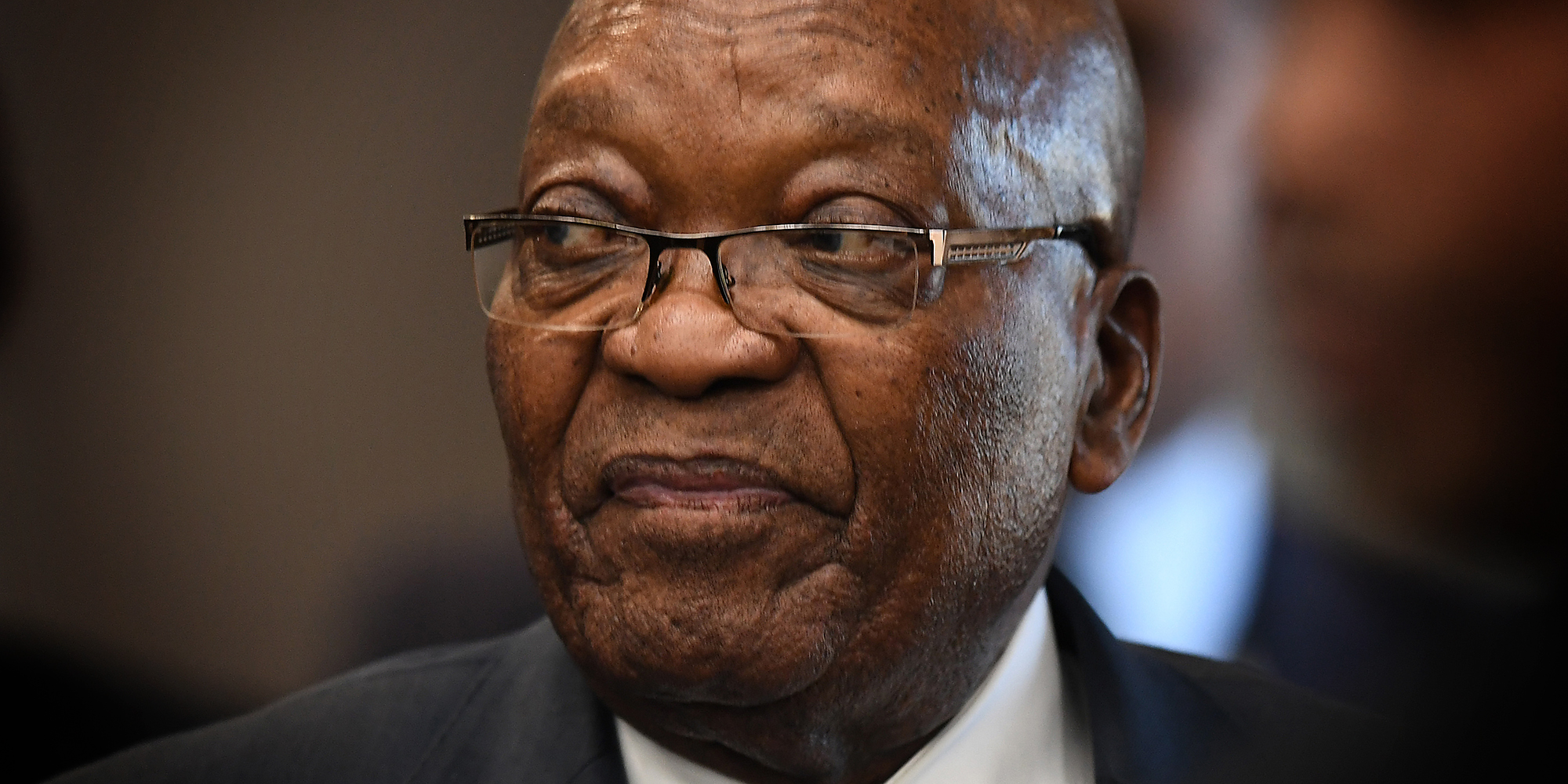
 Former South African president Jacob Zuma. (Photo: EPA-EFE/STR / POOL)
 The organisations were responding to a call by the Constitutional Court for both legal teams to make submissions on whether the court should consider international law in Jacob Zuma’s rescission application. In particular, the court called on the parties to file papers between 13 and 18 August that consider the role of the United Nations International Covenant on Civil and Political Rights (ICCPR), with specific reference to Articles 9 and 14.
This was after Zuma’s legal team approached the court to have his 15-month prison term rescinded, arguing that the sentence was an infringement on his right to a fair trial. His lawyers have also told the court that if the judges had considered international law, they would have made a different ruling.
The ICCPR says that an accused person should have an opportunity to challenge his sentence and conviction in a higher court – something Zuma could not do since the sentence was issued by the highest court in the land. Zuma’s lawyers have said this is evidence of the court acting outside international law, but the Helen Suzman Foundation and the Council for the Advancement of the Constitution say that Zuma’s team is misinterpreting the law.
The foundation submitted papers to the court on Wednesday in which it argues differently, saying that Zuma’s case “must be situated” in the correct context.
“In this case, the matter at hand has certain exceptional features that will frame later considerations,” the foundation says.
‘Zuma had his chance’
The foundation says Zuma had an opportunity to argue for the case to be dealt with at the high court before going to the Constitutional Court, but failed to make those arguments at the appropriate time.
“He expressly and clearly chose not to oppose the application or place any facts or legal defences before this court. So, he could have opposed the sanction of imprisonment, but didn’t.
“He repeatedly, expressly, unequivocally and with full knowledge of his rights, refused to oppose the commission’s application or place any facts or legal submissions before the court,” the foundation says.
The foundation also argues that South African law does allow for imprisonment in contempt proceedings, which should not be compared to criminal proceedings.
“None of these international human rights instruments precludes imprisonment by a court for refusing to comply with a court order, after a duly instituted court proceeding in accordance with existing procedures and laws. What is prohibited is arbitrary imprisonment, where this is not provided for by law.
“This is entirely consistent with how section 12 (of the Constitution) has been interpreted and applied generally, and was interpreted and applied by this court in Zuma in particular. This court set out clearly and deliberately what the ‘existing procedures and laws’ were in relation to civil contempt, and applied them to Mr Zuma,” the foundation said.
“In fact, the Europe Convention in article 5(1) specifically delineates, as an instance where deprivation of liberty is permissible, ‘detention of a person for noncompliance with lawful order of a court’. This is precisely why the court ordered Mr Zuma to be imprisoned.”
Meanwhile, the Council for the Advancement of the Constitution (Casac) has argued that while the court “is obliged to consider the Covenant”, it should be applied correctly.
“Casac submits that these articles are international guarantees against an unfair deprivation of liberty and preserve the right to a fair trial of a criminally accused person… Mr Zuma has not been convicted of a crime… He was imprisoned for civil contempt due to his flagrant disregard of an order compelling him to appear before the Commission of Inquiry into State Capture,” Casac argues.
Casac also argues that the case is “not about a conventional criminal trial”.
“Mr Zuma is a respondent in civil contempt proceedings and is not an ‘accused person’ as envisioned by section 35 of the Constitution. This court has endorsed the description of the Supreme Court of Appeal, describing these proceedings as a peculiar amalgam, because it is a civil proceeding that invokes a criminal sanction or its threat.” DM
Dianne Hawker is a News Editor at Newzroom Afrika.