




 People wearing protective masks walk past signage for Hong Kong Exchanges & Clearing Ltd. (HKEX) displayed at the Exchange Square complex in Hong Kong, China, on Wednesday, Aug. 19, 2020. HKEX posted a 1% gain in profit, benefiting from a spate of high-profile Chinese stock listings and a pick up in trading as the pandemic and political tensions stoked volatility. Photographer: Roy Liu/Bloomberg
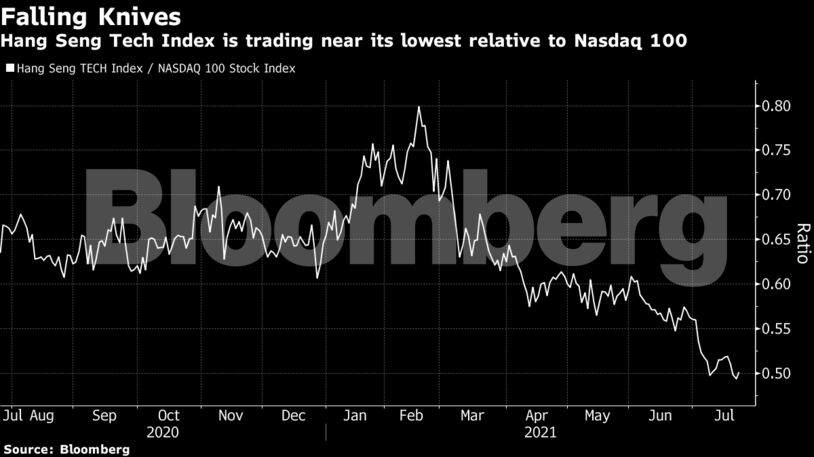
 The underperformance highlights regulatory risks for one of the fastest-growing sectors of China’s economy. Beijing’s bold moves to rein in the nation’s powerful tech firms such as Jack Ma’s Ant Group Co. and Didi Global Inc. have sent global investors fleeing on concerns over China’s tighter grips on data while relations with Washington remain difficult.
“The ongoing concern that medium-term earnings power may be dented by their data becoming more of a public good, and privacy becoming more of an issue, remains a headwind,” said Joshua Crabb, portfolio manager at Robeco Hong Kong Ltd.
Bank of America Corp strategists wrote in a note last week that the regulatory overhang is unlikely to dissipate anytime soon, instead recommending investors rotate into tech firms outside of China.
The index plunged as much as 5.4% on Monday as a selloff in Chinese private education companies deepened after Beijing announced a sweeping overhaul that threatens to up-end the $100 billion sector and jeopardize billions of dollars in foreign investment. New Oriental Education & Technology Group Inc. plunged as much as 40%, extending Friday’s record 41% fall.
Buyer Beware
Launched last year, the gauge tracks the 30 biggest Hong Kong-listed tech firms including giants like Tencent Holdings Ltd., Alibaba Group Holding Ltd. and Meituan. It was set in motion at a time when Chinese tech companies were looking to list closer to home as growing tensions between Washington and Beijing threatened to curtail access to U.S. capital markets.
The index took a fresh beating this month -- down 11% -- after China ordered to ban new users from downloading Didi’s app. Regulators are considering unprecedented penalties for the ride-hailing company following a controversial initial public offering, people familiar with matter have said.
While the forward price-to-earnings ratio for the Hang Seng Tech Index has slumped from a February peak, it is still trading at about 35 times estimated profits, compared with 28 times for the Nasdaq-100 Index and 43 times for the ChiNext, according to data compiled by Bloomberg.
| More |
|---|
| Why China and U.S. Are Clashing Over Stock Listings: QuickTake |
| China Is Said to Weigh Unprecedented Didi Penalty After IPO |
| Didi Shows Xi’s Brutal Power Over Stocks: What to Watch in China |
Bullish ETFs
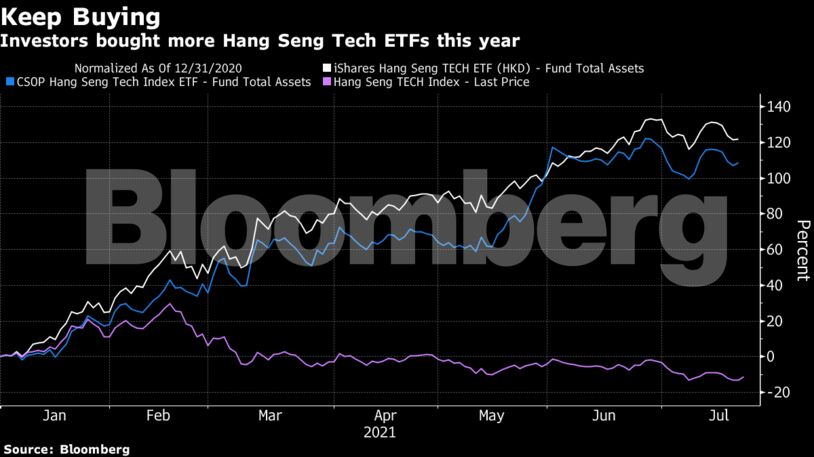
That hasn’t deterred some. Hong Kong’s two most popular exchange-traded funds this year are those tracking the tech gauge. The combined total assets of all such ETFs have more than doubled in size this year to $3.8 billion and the pace of investment into the products has accelerated since mid-May.
“Some long-term institutions may have started buying these Hang Seng tech ETFs. It seems that the more the index falls, the more ETFs they will buy,” said Alvin Ngan, analyst at Zhongtai Financial International Ltd.
While some see the uncertainty created by the ongoing crackdown as a buying opportunity, others remain wary amid questions over its duration and where it may head next. Jian Shi Cortesi, a fund manager at GAM Investment Management in Zurich, said her fund is underweight technology stocks and prefers sectors with policy support, such as network security.
“The Chinese internet names will find a bottom when investors see the conclusion” of tightening regulations, she said.
Comments
Scroll down to load comments...