




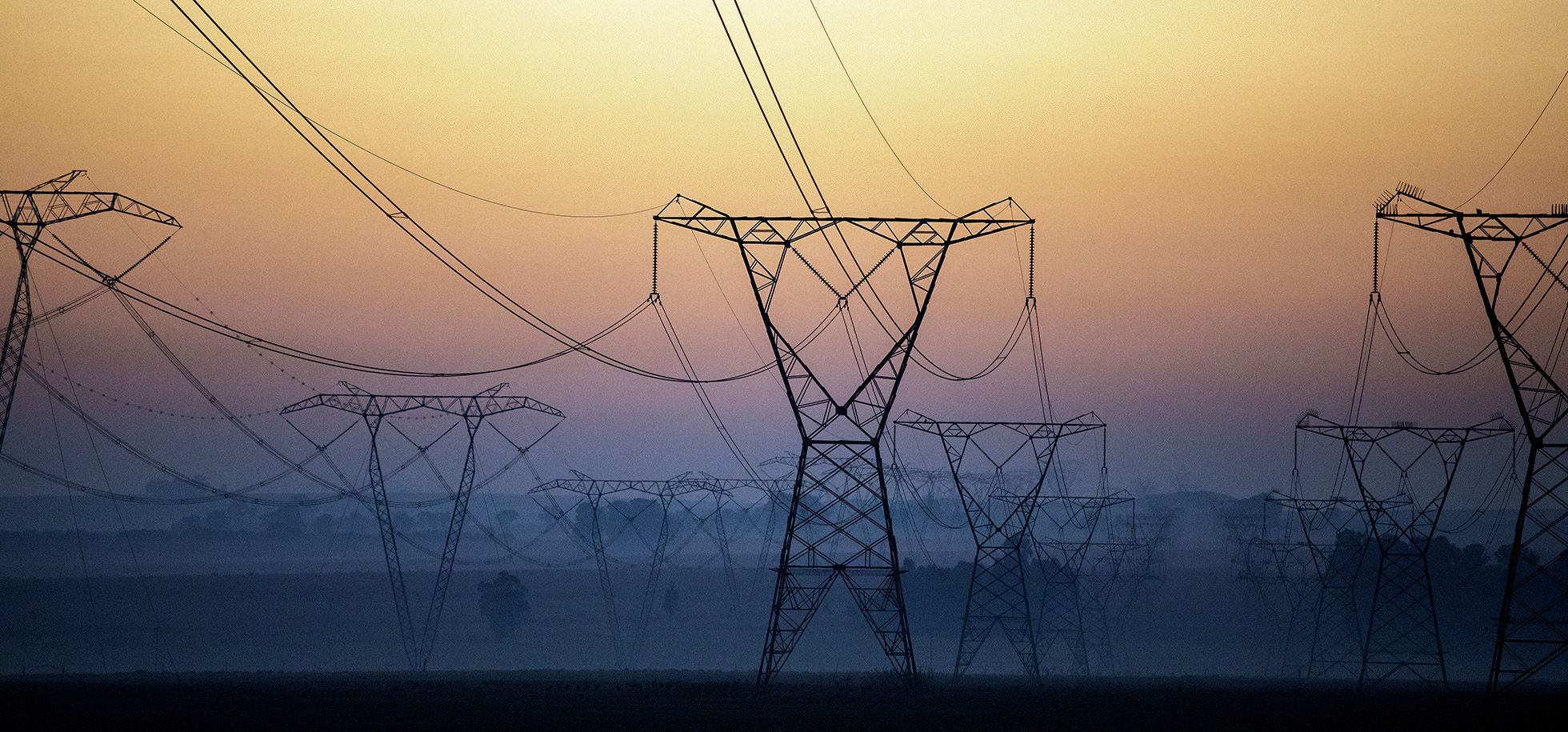
 epa07800621 Power lines run from one of Eskom's coal fired power stations near Villiers, South Africa, 29 August 2019. The national power supplier is considering selling coal power stations to help settle Eskom's massive debt-burden.
In a document released by Treasury the government should sell Eskom's coal-fired power stations, possibly through a series of auctions, which could earn the state 450 billions Rands (about 27 billion euros). The national power grid has been under pereasure over the past decade resulting in high prices for power and power outages. (Photo: EPA-EFE/KIM LUDBROOK)
epa07800621 Power lines run from one of Eskom's coal fired power stations near Villiers, South Africa, 29 August 2019. The national power supplier is considering selling coal power stations to help settle Eskom's massive debt-burden.
In a document released by Treasury the government should sell Eskom's coal-fired power stations, possibly through a series of auctions, which could earn the state 450 billions Rands (about 27 billion euros). The national power grid has been under pereasure over the past decade resulting in high prices for power and power outages. (Photo: EPA-EFE/KIM LUDBROOK)The project, called the Euro-Asia interconnector, will provide a back-up power source in times of emergency, said Israeli Energy Minister Yuval Steinitz, who was in Nicosia to sign a memorandum of understanding with his counterparts.
Cypriot Energy Minister Natasa Pilides said it marked "a decisive step towards ending the island's energy isolation, and consequently, our dependence on heavy fuels."
The cable will have a capacity of 1,000-2,000 megawatts (MW) and is expected to be completed by 2024, according to Israel's energy ministry.
With a length of about 1,500 km and a maximum depth of 2,700 metres, it will be the longest and deepest subsea electricity cable to have ever been constructed, it said.
Steinitz said the cable "will allow us to receive electricity backing from the power grids of the European continent in times of emergency and more importantly will also support our ability to significantly increase reliance on solar power generation."
The Israeli ministry said that the European Union has recognised the cable as a "Project of Common Interest" and was willing to partly fund it. (Reporting by Ari Rabinovitch and Michele Kambas; editing by David Evans)
Comments
Scroll down to load comments...