




 K.C. Chan, financial secretary of Hong Kong, left, and Chow Chung-Kong, chairman of Hong Kong Exchanges & Clearing Ltd. (HKEx), strike a gong to open the first day of trading after lunar new year at the bourse in Hong Kong, China, on Thursday, Feb. 11, 2016. Hong Kong stocks headed for their worst start to a lunar new year since 1994 as a global equity rout deepened amid concern over the strength of the world economy. Photographer: Xaume Olleros/Bloomberg
The city’s stock market is already undergoing change at a time when China’s tech giants hold growing sway, forcing the index compiler to act on a staid gauge overstuffed with banks and insurers. Hong Kong has become the preferred venue for a wave of Chinese megacaps to sell shares, including standouts like Kuaishou Technology, which surged 161% at its debut in early February after holding the world’s largest internet initial public offering since Uber Technologies Inc.
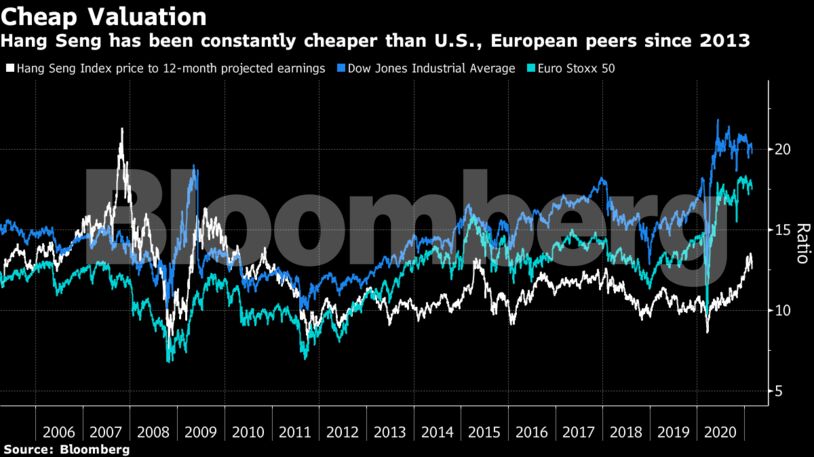
The announcement will also come on the heels of a record buying frenzy from mainland traders that propelled the HSI past the 30,000 point level in January for the first time since May 2019, led by heavyweights like Tencent Holdings Ltd. and Hong Kong Exchanges & Clearing Ltd. If the wide-ranging changes are approved, analysts say that the HSI, which in 2020 lagged global peers by the most in decades, could have more room to run.
“The valuation of the index will be pushed higher as more new economy stocks are expected to join under the changes,” said Dickie Wong, executive director of research at Kingston Securities Ltd. “This could also make the index more volatile.”
| Key changes under consideration | Existing conditions |
|---|---|
| Increase the number of constituents to between 65 and 80 | 52 members |
| Remove minimum listing history requirement for inclusion into index | Minimum of three-month listing based on market value rank |
| Lower weighting cap of individual constituents and align weighting cap of secondary-listed members to 8% | 10% for single stock; 5% for secondary-listed constituents |
| Select constituents by industry group to balance representation | Among 12 industries, telecoms, financials and IT covered 80% in terms of market capitalization as of Dec. 2020 |
| Maintain a certain number of constituents classified as Hong Kong companies | Weighting of Hong Kong firms in HSI fell to 42.2% in Dec. 2020 from 45.3% end 2016 |
As part of the proposed changes, Hang Seng Indexes is looking at ensuring that a certain number of benchmark members are classified as Hong Kong firms, which could dilute the influence of some of the largest stocks. The portion of mainland companies in the index by market value was 79% in 2020, according to the December consultation paper.
On Friday, Hang Seng Indexes added three companies to its index following its quarterly review, expanding the constituent count to 55 members from 52. The changes are effective March 15. The benchmark index was 1.3% higher as of 10:36 a.m. Monday in Hong Kong, with Meituan and Tencent Holdings Ltd. among leading gainers.
Launched in 1969, the Hang Seng Index started out with 33 constituents, rising to 38 in 2007 when it began to include H-share firms. Last year, Hang Seng Indexes added dual class shares and secondary listings to its index in a major revamp, allowing Chinese giants like Alibaba Group Holding Ltd. into the city’s benchmark.
Comments
Scroll down to load comments...