




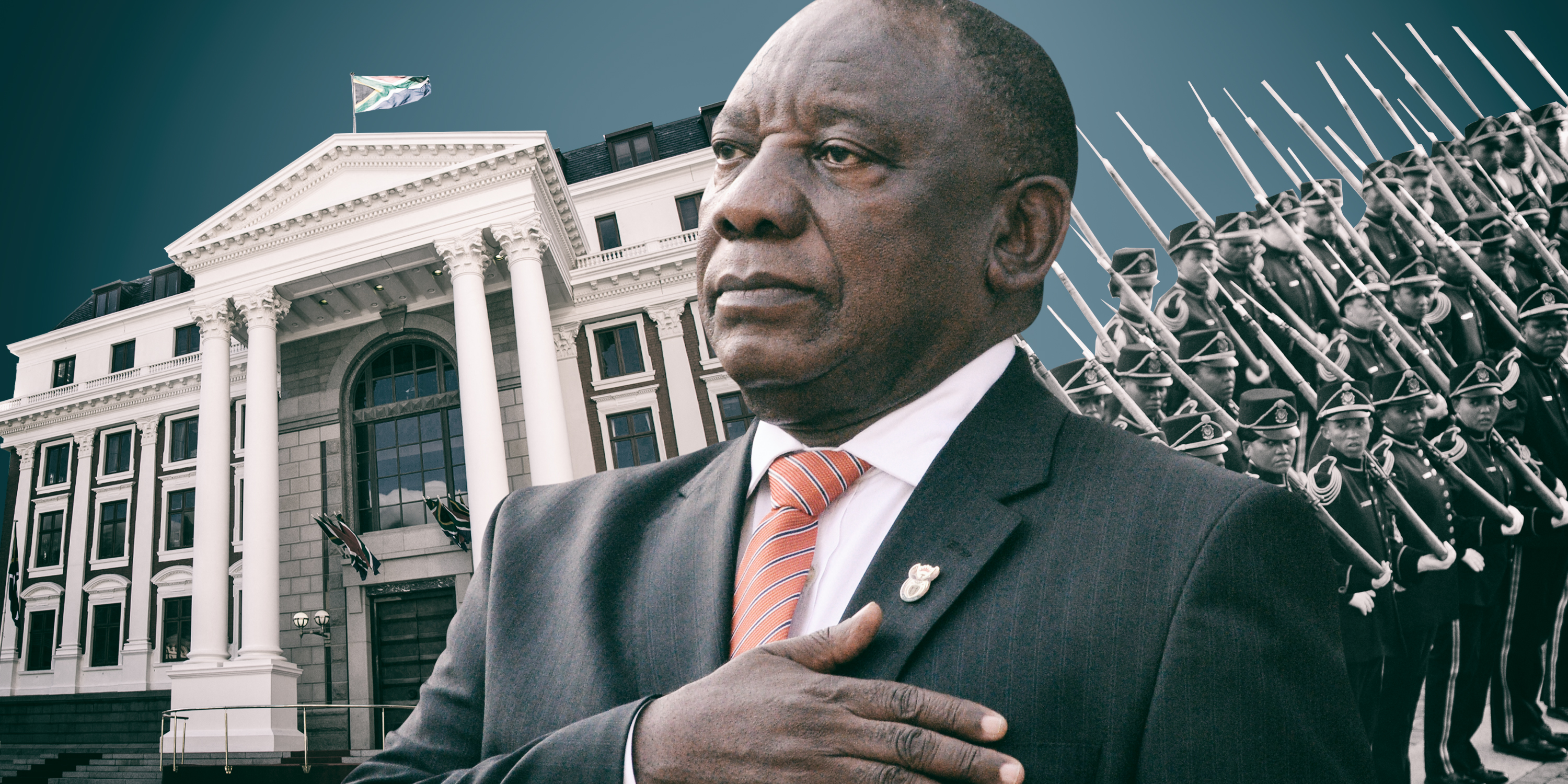
 (Illustrative image | President Cyril Ramaphosa. (Photos: EPA-EFE / ROGER BOSCH BRENTON GEACH / LEILA DOUGAN)
 President Cyril Ramaphosa took his fynbos, which rises after fierce fires, to Finance Minister Tito Mboweni’s aloe that survives dry spells.
But when the two politicians respectively in charge of South Africa’s government and the national purse haul out the analogy of hardy plants to emphasise resilience, it’s a sign of more tough times ahead. Regardless of the spin.
“(L)ike the hardy fynbos of our native land, we too have proven to be resilient in many ways,” said Ramaphosa on Thursday when he delivered the 2021 State of the Nation Address (Sona). Four months earlier in October’s Medium-Term Budget Policy Statement (MTBPS) Mboweni said, “(T)he country’s Aloe ferox is drought resistant, it can survive the harshest of circumstances and can certainly withstand a pandemic. Our little Aloe ferox has survived! It is recovering!”
Budget 2021 set for 24 February will reflect exactly how far that aloe recovery is – and how long a wait is expected for the re-emergence of the fynbos after the fire.
Floral analogies aside, Thursdays’ Sona was more of a report back on what Ramaphosa’s administration believes it has delivered since the 15 October 2020 Economic Reconstruction and Recovery Plan announcement and the 21 April 2020 Covid-19 stimulus package that despite the officially proclaimed R500-billion, has never quite added up as much of the stimulus was based on taxes permitted to not be paid and loans that needed approvals.
https://www.dailymaverick.co.za/article/2020-04-22-hard-lessons-of-hunger-for-the-governing-anc-and-a-multi-billion-rand-funding-hole/
But Ramaphosa sharply set out his administration’s four priorities.
“We must defeat the coronavirus pandemic; that is the primary aim in all we do. And second, we must accelerate our economic recovery. Third, we must implement economic reforms to create sustainable jobs and drive inclusive growth. And finally, we must fight corruption and strengthen the state.”
More detail emerged in the 6,805-word speech.
On vaccines, Ramaphosa said the first 80,000 doses of Johnson & Johnson vaccines for healthcare workers would arrive in South Africa next week. Over the next four weeks, another 500,000 vaccines will follow of a total of nine million Johnson & Johnson vaccines. Twenty million Pfizer vaccine doses will be delivered from the end of March 2021; 12 million doses have been secured from the Covax facility.
On economic recovery, localisation emerged as key. Channelling Trade and Industry Minister Ebrahim Patel, Ramaphosa emphasised master plans for the clothing, chicken, vehicle and sugar sectors alongside 42 products, including edible oils, fruit concentrates and steel products, for sourcing locally. Another 1,000 products are identified in a recent Cabinet-approved SMME-focused localisation policy framework that is also meant to stimulate domestic SMME development.
On jobs, it emerged that more than 430,000 job opportunities were “supported” by the end of January through the presidential employment stimulus; another 180,000 opportunities are in recruitment. Effectively, it has pushed the employment of class assistants and also focused on early childhood development.
“As a result of the relief measures that we implemented and the phased reopening of the economy, we expect to see a strong recovery in employment by the end of 2020.”
On infrastructure, Ramaphosa listed projects under way, such as two Gauteng housing and water infrastructure projects, while road rehabilitation of the N1, N2 and N3 highways are in the making. The R100-billion Infrastructure Fund would also, for example, fund 300,000 student beds in 2021.
“This will encourage greater investment by the private sector in productive activity. Key to this plan is a renewed commitment from government, business and organised labour to buy local.”
Given the often overwhelmed state stalling over service delivery, a special mention was given to Operation Vulindlela that brings together the National Treasury and the Presidency, where the infrastructure and project management offices are also located.
But Sona 2021 offered not much particularly new. As Freedom Front Plus leader Pieter Groenewald pointed out, Ramaphosa had, in 2019, already touted his local is lekker suit to encourage buying local as part of the job creation initiative.
“We are still there. He just talks; he doesn’t do,” said Groenewald as IFP spokesperson Mkhuleko Hlengwa said, “It felt like 2019, 2020 again.”
Hlengwa also cautioned against establishing yet more structures such as the proposed national water agency. That was a sign of trying to fix brokenness in the short term rather than dealing with the issue properly.
DA leader John Steenhuisen welcomed the monthly R350 Covid-19 grant extension to March 2021, and also expressed approval of the scarce skills list release next week. Not so rosy was the lack of detail on the promised renewable energy release and emergency power production.
“But there was no reform. It’s more power to the state, a lot of ‘soons’, ‘in progresses’ and ‘maybes’,” said the official parliamentary opposition leader.
ANC Chief Whip Pemmy Majodina was upbeat, who said the president was spot on in giving his account to Parliament. “The president is astute in laying out the details of progress.”
While governing ANC partner, labour federation Cosatu, welcomed the R350 Covid-19 grant extension and that of the Unemployment Insurance Fund Temporary Employer/Employee Relief Scheme.
But even as Ramaphosa confirmed healthcare workers vaccination would begin next week after the first 80,000 doses of the Johnson & Johnson vaccine arrived, Cosatu criticised the lack of progress and clarity on timeframes, procurement, logistics and the like.
“We cannot afford to end 2021 without having reached the 70% population immunity level because the economy cannot sustain periodic shutdowns,” the labour federation said in a statement that also called on the implementation of the National Health Insurance and more details on state-owned enterprises reforms.
Intellidex analyst Peter Attard Montalto said the Sona was “broadly as expected”, but at odds with economic growth outlook and corporate sentiment.
Business Leadership South Africa (BLSA) said it agreed with Ramaphosa’s priorities, but called for more clarity on the energy front, including bid window 5 for independent power timelines. “It was also right for him to focus his speech on reporting progress rather than making promises,” BLSA said.
“The momentum he (Ramaphosa) is describing is simply not happening on the ground, which does not serve investors well, as we saw in the disjuncture in rhetoric between miners and the president at the (Mining) Indaba. Nowhere is this seen more readily than in the localisation, master plan and tariff parts of the speech.”
That’s the bit of hope as the government has again extended the State of Disaster to 15 March, the anniversary of the disaster declaration. And 12 days later on 27 March, South Africa is set to mark one year in Covid-19 lockdown.
So, a bit of something for everyone. Or almost.
The proof will be in members of Ramaphosa’s administration actually doing their bit — from Home Affairs Minister Aaron Motsoaledi releasing, as promised, the scarce skills lists, and for Mineral Resources and Energy Minister Gwede Mantashe giving details on the additional 11,800MW of renewable energy.
So it’s back to Ramaphosa’s fynbos analogy.
“Like a wildfire that sweeps across the mountainous ranges where the fynbos grows, a deadly pandemic (Covid-19) has swept across the world, leaving devastation in its path. And yet, like the hardy fynbos of our native land, we too have proven to be resilient in many ways.” DM