



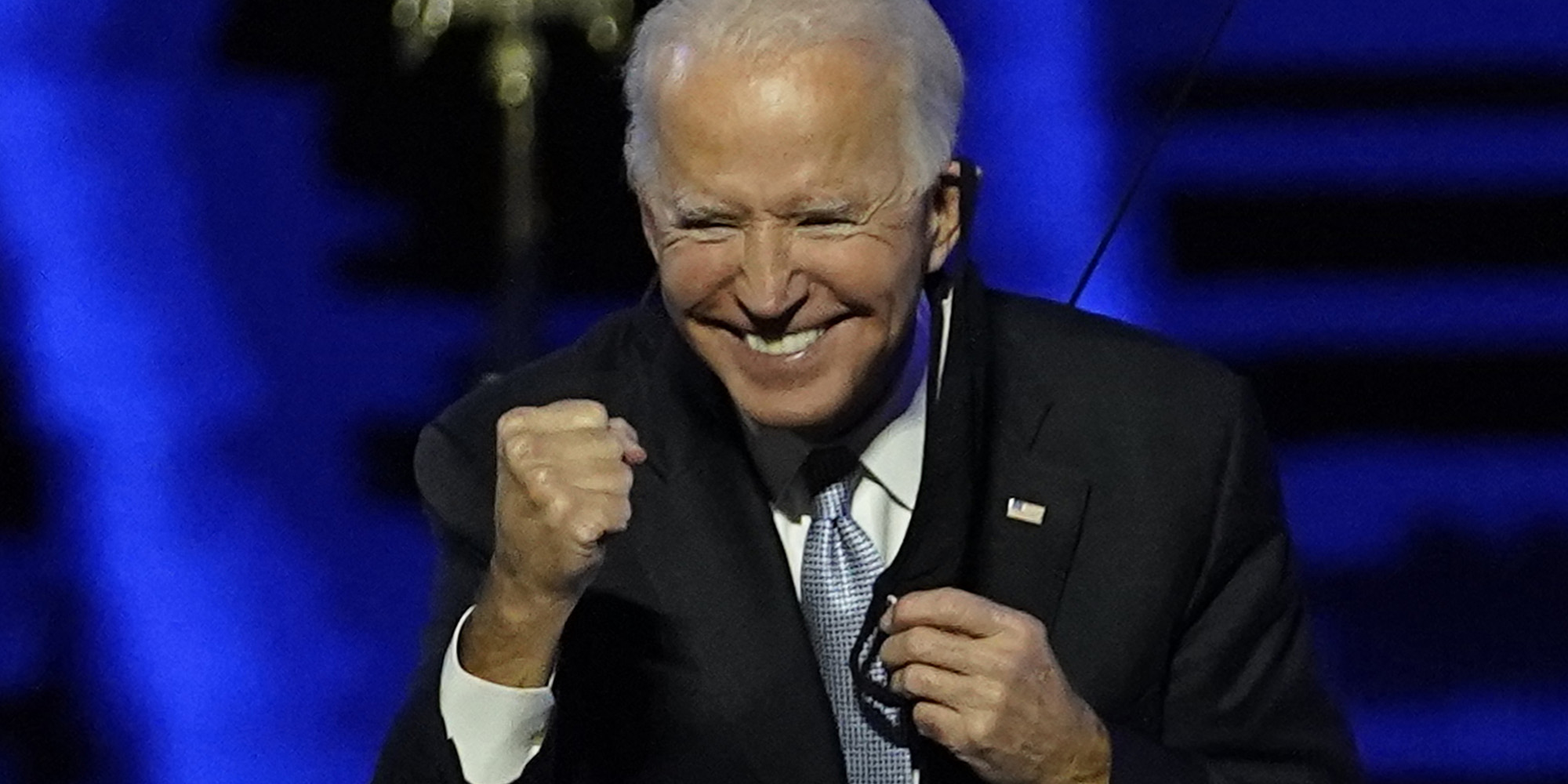
 President-elect Joe Biden. (Photo: EPA-EFE/ANDREW HARNIK / POOL)
First published in Daily Maverick 168 Weekly Newspaper
Back in 1927, Time magazine’s youthful co-founders – Briton Hadden and Henry Luce, friends from their time together at Yale University – of their four-year-old, weekly news magazine, decided there had been a major error in the weekly cover stories they had selected in that year. Despite his vast popular global adulation after his accomplishment, they had not put aviator Charles Lindbergh’s face on the cover of their magazine following his pioneering solo flight across the Atlantic Ocean from the United States to France.
To rectify that error in judgement – and in public relations – they came up with the idea of designating Lindbergh their “man of the year”, complete with his face as cover art and a splashy lead story on the aviator, the man now dubbed “The Lone Eagle”. With this edition’s success, the magazine’s leadership decided they would follow through on this idea annually. Eventually the appellation became person of the year, rather than just man of the year.
As the editors determined their selection criteria, the person of the year featured and profiled a person, a group, an idea, or an object that “for better or for worse ... has done the most to influence the events of the year”. That expansive definition of man of the year has meant that, along the way, both Hitler and Stalin have won the magazine’s accolade, along with the personal computer, the American worker, and even Dumbo the flying elephant, the protagonist of Walt Disney’s full-length feature cartoon. Dumbo had been picked in 1940 for the honour, until he was replaced at the last minute by President Franklin Roosevelt. Probably for the best.
On the frontlines
This year has been an extraordinary one for reasons all too obvious to anybody who has survived to read this article. Given the disasters that have befallen us in 2020, there are numerous possible choices for our international person of the year.
There are thousands of memorable persons worthy of acknowledgement and recognition. Let’s start with some of the easy ones.
First there are the thousands of “first responders” – the ambulance drivers, paramedics, emergency and intensive care unit technicians, nurses, doctors, along with the administrators and managers of all those established and temporary emergency hospitals (not to mention the many thousands more essential workers in their quotidian but indispensable jobs). In this, the year of the plague, all of these healthcare workers have risked their own lives and health, both to administer Covid-19 testing and then to minister to those already sick with the disease.
These people did their jobs, even as Covid-19 treatments were uncertain, the way the disease spread was unclear, and a real path to its cure, even now, remains unknown. In fact, many of these caregivers around the world have died in the course of their work, even as others continued on, regardless of the potential consequences to themselves.
Beyond that circle of the frontline caregivers, there have been hundreds, perhaps thousands, of other physicians, medical researchers and support staffers, working in a dozen or more nations, who have worked hard to develop vaccines to ward off the further spread of the disease, as well as to improve treatments for existing Covid-19 infections. Most of these people may never get international accolades or be featured in television newscasts, even as those research results will have profound, lifesaving effects.
Then there are brave individuals like Dr Anthony Fauci, the long-serving head of immunology at America’s National Institutes of Health, who have become the kind of leaders who arm a nation with the facts, without giving oxygen to false hopes or fanning the terrifying flames of eschatological fears, despite fierce pressure from political leaders to tone down their difficult truth-telling. Even as some people chose to believe in leaders who have preached the pernicious, fraudulent virtues of bleach or ultraviolet light, Fauci, and others like him, have continued to be there, speaking unvarnished facts to those in power – and to the powerless.
But then, too, there have been the legions of ordinary citizens – in China, Russia, Korea, Japan, the US, Britain, France, Germany, South Africa and beyond – who have volunteered as test subjects for as-yet-unproven vaccines, with every one of them doing so without knowing if the vaccine being tested might have dangerous side-effects, or even no effect at all against the disease. Regardless, they allowed themselves to be exposed to the disease and the vaccine, even though there was a chance an unproven vaccine might give them the disease rather than immunity. But they volunteered by the thousands anyway.
Providers of information
Then there are the broadcasters, journalists and media medical analysts who devoted their energies, skills, knowledge and talents to educating the public on Covid-19 and its dangerous implications for us all. Some field reporters risked their lives, going into those wet markets in Wuhan, China, in the early days of the pandemic, to file stories even as it was unclear if just doing their jobs was a death sentence.
Others went into overdrive to assemble the knowledge needed to make sense of the disease for the global public, dispelling the rumours and dangerously fraudulent news about the source of the disease, its spread, and its impact on those who caught it.
Some in the media, people like CNN’s Dr Sanjay Gupta and a growing roster of colleagues and special medical commentators, brought on board from around the US and elsewhere, did extraordinary work in communicating what the global public needed to know. Their efforts helped millions make sense of the disease and its consequences, and helped squelch inevitable rumours and fakery spread by con-men, snake-oil salesmen and not a few national political leaders who insisted the disease would vanish magically over the summer.
Meanwhile, more specialised scientific and medical periodicals like The New England Journal of Medicine, The Lancet, Nature, Science, and Scientific American devoted entire issues to the latest research, both in print and electronically, on the pandemic. In so doing, they kept a worldwide audience of laymen and specialists informed about this new plague and what needed to be done to deal with it.
Around the world, among political leaders, some, like New York Governor Andrew Cuomo and several other less media-savvy public figures helped mobilise national understandings and action, even as other political leaders chose, instead, to demonise science and medicine. Among the latter, of course, was US President Donald Trump and several Republican state governors. This behaviour has almost certainly increased the death toll among publics often unable to determine which politicians spoke truth, versus those babbling utter nonsense.
Beyond the impact of Covid-19 on the world, it is also possible to consider the vast, global impact of the racial redress movement, Black Lives Matter. This loosely coordinated body of like-minded people appalled at racial injustice has spread from its beginnings in the US to become a global movement, generating mass marches and other public protest activities — as well as political responses to the calls they have made.
But if the measure, per Time’s original precepts, was one of impact, not simply the betterment of humanity as with a Nobel Peace Prize, a case could even be made for this year’s honour going to the virus, given the astonishing impact as it has had on mortality, illness, the devastation to the global economy, and drawing virtually all the oxygen from the global public space. Yes, it obviously is not a person or even a living creature, but consider just what anyone or anything else has had by way of impact this year.
In sum, in an ordinary year, almost any of these individuals or groups would be powerful candidates to becoming the international person(s) of the year.
But this, of course, has not been a normal year.
The man who unseated Trump
While a serious case can be made for each of these candidacies, this year we will be going with the individual who defied conventional wisdom about sitting presidents and, instead, achieved what so much smart money believed was nearly impossible: unseating an amoral, bombastic, wannabe authoritarian, an incumbent president with his mobs of cult followers; and someone with only a passing acquaintanceship with the truth, who had ridden roughshod over a country’s political and social mores for nearly half a decade.
This now-defeated president’s ruinous administration had been on course for a disorganised response to Covid-19 and its nearly leaderless, halting response to the ensuing economic crisis. Beyond domestic damage, the international impact of this same president and his administration has been nearly as destructive as it drew back from engagement with allies and other friendly nations.
And so, on the basis of his astonishing victory over Trump in the US presidential election, the winner of international person of the year for 2020 is President-elect Joe Biden. The president-elect has had a lifetime of experience and service in politics. He was first elected to the US Senate when he was still several months shy of the minimum age for such an elected position and he then served for some 36 years, representing the State of Delaware.
Third time’s the charm
Twice before 2020, Biden had reached for his party’s presidential nomination, in 1988 and then again in 2008, but both times had to bow out without coming anywhere close to garnering even modest support. In 2008, however, he was selected by candidate Barack Obama as his vice-presidential running mate and a new door opened for Biden.
When Obama won the presidency, Biden proved to be a steadfast partner in that administration. He took on the difficult but crucially necessary tasks such as shepherding the complex and controversial economic emergency relief packages through Congress in the midst of the great financial crisis of 2008/09. During the eight years of the Obama administration, Biden became the confidential advisor and sounding board every president needs.
Still, seen by many as an overreaching, yet somehow curiously lightweight politician throughout his early and middle years, a number of personal circumstances eventually converged to temper and strengthen him for a final push towards the presidency in the midst of yet another national crisis.
Even before taking up his Senate seat, his wife and infant daughter had been killed in a horrific car crash that also sent his two seriously injured young sons to the hospital for lengthy stays. Then, in 1988, in the midst of his first presidential campaign, he suffered two brain aneurisms that very nearly killed him.
And, in the final years of his second vice-presidential term, his son, Beau, by now the attorney general of the state of Delaware, died agonisingly from a rare form of brain cancer. Mourning this loss, Biden realised the fire of any further ambition had been extinguished, opening the way for the ultimately losing candidacy of Hillary Clinton against Donald Trump.
Several years on, however, observing the growing national economic and epidemiological devastation, Biden, by then seemingly in political retirement, decided to make one final run for the presidency. At first, this third effort seemed doomed to the same defeat as previous ones, with poor finishes in the Iowa caucus and the New Hampshire primary.
But, in the South Carolina primary and then in primaries across the country, Biden bid began to catch fire, increasingly bolstered by growing revulsion over Trump’s rhetoric, policy incoherence and strident identity politics, the growing devastation of the pandemic and the ensuing economic crisis. The desire grew for a calm, authoritative, steadying hand. The Biden message became one of an adult coming to the rescue of a struggling nation – a response to the national need for someone with the human warmth and empathy to minister to a stricken nation.
A way out of misery
In the hard-fought 2020 general election campaign that followed, in contrast to the incumbent president’s increasingly disruptive, juvenile, bizarre, even delusional, behaviour, Biden (and his revolutionary choice of California Senator Kamala Harris, a woman with a bi-racial heritage, as his running mate) became the appropriate medicine for what ails the country. And, if the electoral results were any guide, his election was what the country wanted as well.
In the election of 3 November, Biden gained a record number of popular votes, capturing them in states thought to be well off the table for Democrats, and rolling back Trump victories in the 2016 election across the Midwest. Of course the nation’s judiciary has also helped enormously in protecting Biden’s victory (and democracy itself), refusing to accept any of the Trump campaign’s evidence-free claims of fraud and corruption in the electoral system.
Still not yet in office, what Biden has really offered the nation, even before taking his inaugural oath, is a chance. He held no public office in 2020, but he has now given Americans the chance to believe that a way out of their current misery is finally at hand and – together with a crew of similarly experienced adults – Biden would take the helm, just 20 days into the new year. By that time, there will be a coherent, cohesive, comprehensive national plan to deal with both the pandemic and the economic crisis. In fact, it is clear that Trump’s wild, delusional charges and wild rants are already in the rear-view mirror for a majority of citizens.
A sigh of relief heard across the world
Similarly, internationally, the feeling about the US and its leadership, except perhaps for those disappointed dealmakers in the Kremlin, has already begun to rebound from the nadir Trump drove it to, with both the US’s allies and friends. Expectations are that, in a Biden presidency, the US will make a return to the international community, resume full participation in that community, and embrace the very norms it once helped create as part of the post-war world.
Those hopes are already taking hold, along with a near-global sigh of relief. As The Economist wrote – commenting on Biden’s own statement that “America is back, ready to lead the world, not retreat from it” – “The happy gurgles of relief this elicited in Washington, DC, London, Tokyo and beyond may be imagined.”
Of course it all may yet go badly. The pandemic does not read the newspapers and it does not respect the borders drawn on a map. The economic revival could prove to be stubbornly resistant to measures pushed by President Biden. Or, a Republican-led Senate may yet make it impossible to achieve support for a more egalitarian economy and society, for reform in immigration laws and regulations, for a return to strong environmental protection and support for significant climate change legislation and norms of behaviour.
But all of those remain in the future. For now at least, Joe Biden has given Americans (or at least most of them, save for bizarre fringe groups like Michigan’s “Wolverine Militia”, the “Proud Boys”, and their ilk) hope that help is now finally at hand; and that waking up in the morning will no longer fill citizens with existential dread that some new, erratic, thoughtless decision or tweet shot off by a president at 3am may again send the globe spinning off to an entirely new, more dangerous orbit.
For this righting of the balance, Joe Biden is our international person of the year. His unlikely triumph is enough to earn him that honour. DM168
Comments
Scroll down to load comments...