




 Skyscrapers in the square mile financial district of the City of London, U.K., on Friday, Jan. 1, 2021. The U.K. completed its divorce from the European Union, leaving the bloc's single market and customs regime more than four years after the country voted for Brexit.
 “Europe has clearly won the battle for its own share trading,” Haynes said. The shift “is a spectacular own goal as Britain is now losing its very strong position in trading of European equities in London,” he said.
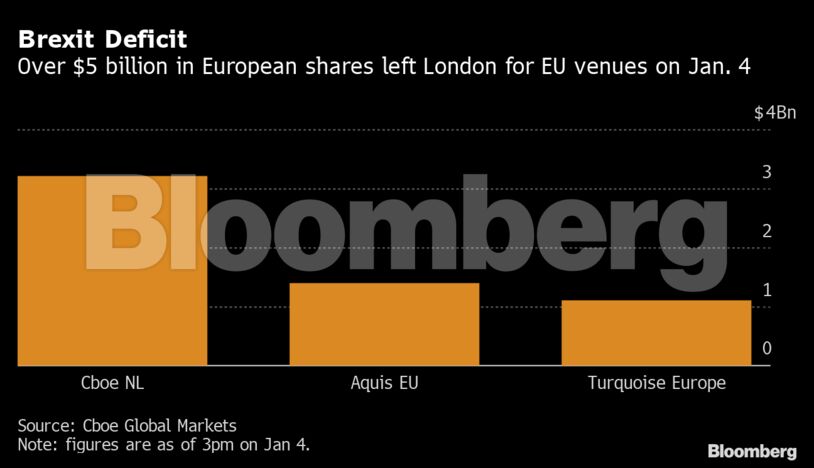
The City of London lost its rights to access the single market on Dec. 31 and the EU has not permitted investors inside the bloc to trade shares in companies such as Airbus SE and BNP Paribas SA from the U.K.
Haynes said he is pessimistic about the EU granting trading rights through the equivalence process, citing Switzerland’s troubles on the same issue in 2019. After Boris Johnson struck a Brexit trade deal on Dec. 24, the two sides outlined a March deadline for a memorandum of understanding around the regulation of financial services, a key driver of the U.K. economy.
“The talk of equivalence being granted in the next few months is in dreamland,” said Haynes. “It will take years if ever to get equivalence.”
Read more on how equivalence affects post-Brexit banking
“A deal is all well and good but when it comes to share trading, markets can expect an intense game of cat and mouse between EU and U.K. rule makers,” said Chris Hollands, head of Europe and North America at TradingScreen, a technology provider to asset managers.
Britain will change its rules to attract issuers and investors to the U.K. market but won’t necessarily be enough to bring EU share trading back to London, according to Haynes.
“This horse has bolted so far it’s now in a different stable,” he said. “To get it back you have to do something pretty revolutionary.”