




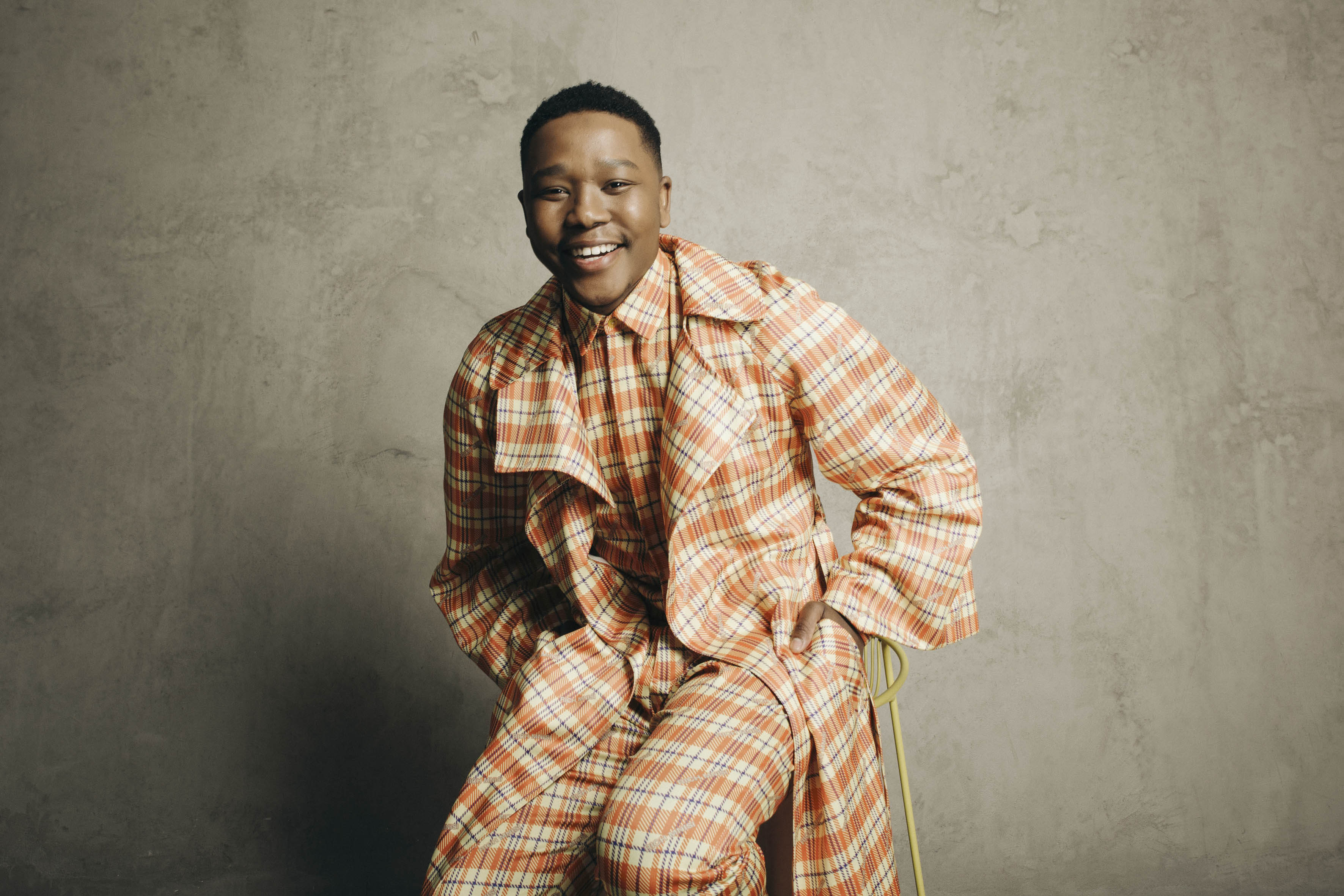
 Undated: Mavuso says he always knew the album would feature 12 songs. “It just had to be. Firstly, because it’s my third project, but I also think three is a special number", he says. (Image supplied)
 This story was first published in New Frame.
It is early October 2017. Soul singer Langa Mavuso stands before a modest crowd looking on to the sloping hills of Northam, Limpopo. Dressed in a black top and short dungarees with a pair of clip-on traditional Zulu earrings, iziqhaza, Mavuso belts out songs from his short but impressive catalogue. It’s his first time performing at the annual music festival Oppikoppi, and the defining moment comes towards the end of his set. With the crowd firmly in his grip – drunken bodies colliding and lips locking to the sound of his music – Mavuso performs a remix of Vivid Dreams, the first song on his debut EP. Produced by Johannesburg-based producer Illa N, the remix features languid guitar plucks, smooth rhodes chords and neck-snapping drums.
“My lover’s name is a secret,” declares Mavuso at the beginning of Vivid Dreams. For the most part, he has faithfully kept that pact of silence, often speaking around the hurt that inspired his best work. When asked about the subject of his songs, he says they are about a lover who has since died. He never names his dead lover.
Liminal Sketches, the breakout six-track EP that Mavuso released in 2016, dealt with themes of love and loss. In a previous interview, the artist said the project was an attempt at airing out an old wound.
“I wrote Liminal Sketches as a way of mourning a lover who passed a few years ago,” he told me during a Skype interview in 2017. “It was an attempt at catharsis. That was my way of interrogating how something so beautiful could find its way into your life and be taken away so easily.”
Three years later, the 26-year-old admits his debut album, Langa, has broken this pact of silence.
“This album is the end of the journey, the closing of the chapter,” he says now. It’s about finding a resolution to Liso’s passing. This is me saying: this is who I am. This is the pain I carry, and this is what grounds me. I was trying to find a resolution to Liso’s passing. I’ve come to the realisation that the end of love doesn’t always have to be painful. It can be transformative, healing even.”
The messy work of healing
Langa is an album dedicated to cataloguing healing. The first third of the album details the emotional and psychological toll of heartbreak. Calamities, the album opener, starts off with a string section and twinkling piano before segueing into a throbbing bassline and rattling kick drum. “Maybe this is karma,” starts Mavuso, later singing the refrain: “I’ve heard you’re messing around, messing around.”
Mvula, the third track on the album, is a meditation on the memory of fading love. “I knew when you broke it. I felt it. We lost it,” he sings over a looping piano melody. There are also references to the previous material on his debut album. Searching, the fourth track, contains lyrics lifted from Vivid Dreams. “I found love in an empty room, searched the scene, even looked [like] a fool,” he says over layered harmonies and finger snaps. Similarly, Love Lost features a vocal interpolation from Love Six, a song on his EP. “Screens fade to grey. You still hide in your buried grave,” he sings, lyrics that immediately bring to mind Love Six’s, “In the age of colour screens, people stare into boxes while colours fade to grey.”
“I’m surprised not that many people have noticed that,” he says. “Langa is in conversation with my earlier works. Because I’m discussing the same themes I did in previous works, I felt like I had to reintroduce the lover I’m speaking about to the audience.”
/file/dailymaverick/wp-content/uploads/201027_Langa-Mavuso_Supplied02.jpg "Undated: Mavuso’s discography is defined by restraint. That commitment to restraint – to only saying what needs to be said – is what holds his debut album together. (Image supplied)")
Capturing the journey of heartbreak
The album’s middle section is the most upbeat. Cheat Code opens with the noise of crackling vinyl static and atmospheric pad layers. From the start, Mavuso’s tone is confrontational. “Was it you in his backseat?” he asks, later singing that he’s “searching for a new love”. Panther, which features rapper Yanga Chief, is a trap-infused number produced by duo Noble Production, who have production credits with Rowlene, Lady Zamar and Beyoncé.
“I still feel the heartache, fucked up on champagne,” Mavuso sings in Cheat Code. The subject – indulging in your worst habits after a break-up – is well worn in R&B but works in the context of the album. The animating theme on the 12-track project is that no one outruns trauma: pain hollows you out and, if left ignored or unintended, the wound festers and the work of healing grows more difficult with every subsequent bad decision.
“That’s the point of the album. I wanted to be honest about my journey through heartbreak. So, the album is essentially made up of three parts: heartbreak, the mess that follows it and then arriving at a point of resolution or healing. The cover also alludes to that. It’s about reflection. John Baloyi [the photographer] captured that perfectly. But, yes, songs like Panther and All of You capture the ‘baddie phase’ that usually follows a break-up.”
A sense of restraint
Mavuso’s discography is defined by restraint. Despite the critical acclaim he received after the release of his first EP, Mavuso followed it up with Home, a two-track EP featuring Zoë Modiga. Next he released his breakout single Sunday Blues and then Mvula. That commitment to restraint – to only saying what needs to be said – is what holds his debut album together.
Much like the terse prose of American writer Raymond Carver, Mavuso’s album is short and direct, without the histrionics so common to R&B. Powerline, for example, describes an ill-fated relationship with the lines, “You are a mirage, a broken dream, a dying sun burning orange.” He later sings, “You drew me into your embrace, left your sweater at my place. And painted a picture I believed and now I’m wrapped in your fantasy.” The exacting prose captures the moment someone realises the fictions that drew them into a relationship were just stories.
Mavuso says he always knew the album would feature 12 songs. “It just had to be. Firstly, because it’s my third project, but I also think three is a special number. In Christianity, for example, you have the idea of God the father, son and holy spirit. I wanted something that mirrored three states of being.
“When I wrote Love Lost, I knew that would be the last song on the album. It was a fitting way to end the album because after the first two sections, there’s finally some sort of resolution. The journey starts with heartbreak but ends back at self.”
An end to ruin
The album’s penultimate song, I Wish, is a guitar-led number with Modiga. It’s a meditation on racial harmony, queer love and what the world would look like if it were unencumbered by the weight of history and oppression. Stylistically, the song is reminiscent of his 2017 EP, Home.
Speaking of the song, Mavuso says: “I Wish was the result of a conversation I had with Zoë and Manana”, a jazz and soul musician and arranger, born in eSwatini and based in Cape Town. “We were talking about life and music and, initially, I told them I wanted to create a song with them for old times because we used to sing together in a band at [the University of Cape Town]. We initially just had the refrain ‘I wish’ and built from that. Zoë’s verse speaks about happiness. I speak about the struggles faced by queer people with the line: ‘I hope the love I embrace won’t mean I die tomorrow.’ But I love how Manana brings us back to reality in his verse by saying this song won’t make it better. We actively need to organise to make the world better.”
Love Six, the album closer, opens with the lines: “I’ve got scars in my eyes. I’ve been wrestling the stars. The sunless skies are way too vast.” Indeed, it’s been an emotionally taxing four years for Mavuso. When I first interviewed him in 2017, he had just moved back to Johannesburg and dropped out of the University of Cape Town. “I left [university] because I was depressed. I’d been studying there, and I fell into a depressive episode. I think everything that I wrote about on Liminal Sketches finally caught up with me. There was no hiding from the grief anymore,” he said at the time.
But Mavuso did what any great artist would do: he went back into the ruin and used it to create an emotionally compelling piece of art. Langa is not just a collection of songs. In it, Mavuso uses his heartbreak and his anxieties about past and future love as the raw material to construct a path to his healing.
/file/dailymaverick/wp-content/uploads/201027_Langa-Mavuso_Supplied03.jpg "Undated: Langa is an album dedicated to cataloguing healing. “I wanted to be honest about my journey through heartbreak. So, the album is essentially made up of three parts: heartbreak, the mess that follows it and then arriving at a point of resolution or healing\", the artist says. (Image supplied)")
The album and its themes bring to mind a poem called Little Prayer by American poet Danez Smith:
let ruin end here
let him find honey
where there was once a slaughter
let him enter the lion’s cage
& find a field of lilacs
let this be the healing
& if not let it be. DM/ ML