




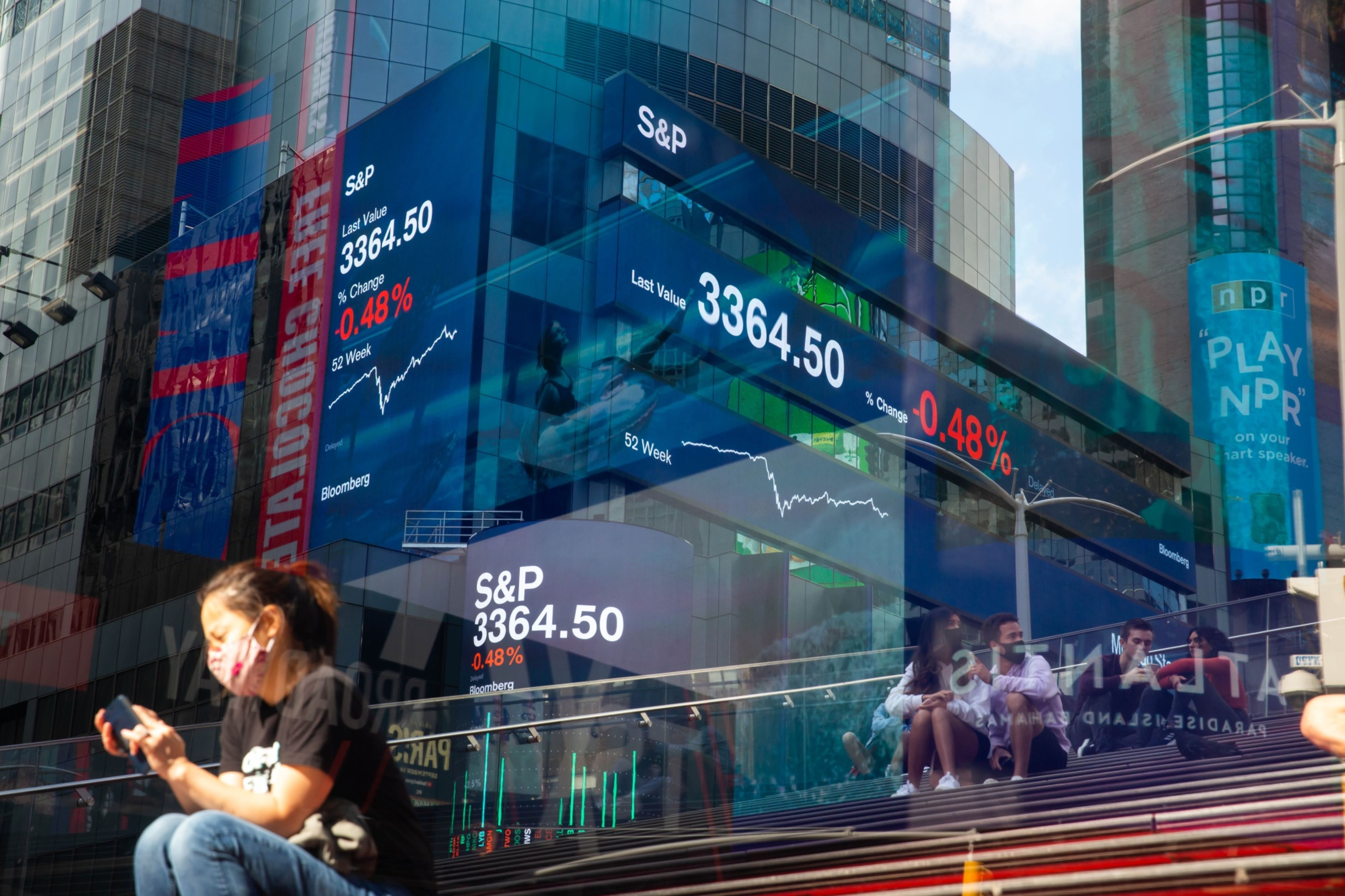
 Monitors display S&P 500 market information at Morgan Stanley's headquarters in New York, U.S., on Friday, Oct. 2, 2020. New York faced pressure as middle and high schools reopened, infection rates in virus hot spots rose further and the city's bond rating was cut by Moody's. Photographer: Michael Nagle/Bloomberg
 Contracts on the S&P 500 rose 0.2% as of 10:46 a.m. in Tokyo, erasing a loss of as much as 0.7%. Nasdaq 100 futures added 0.1%. The broader index is coming off its worst weekly rout since March, led by shares of megacap tech companies that reported solid quarterly results just days earlier.
Joe Biden’s steady lead over President Donald Trump kept open the possibility for a Democratic sweep of Congress that investors expect will lead to a flood of spending bills to jumpstart the economy that rising virus cases threaten to stymie. While Biden is also expected to raise taxes on high earners and increase regulation, his agenda also includes higher spending on infrastructure projects.
“Many investors fear that a Blue Wave on Election Day could happen, giving the Democrats’ unfettered power to implement their expansive and expensive agenda. Wall Street strategists, including yours truly, countered that the bearish impact of higher taxes and more regulations should be offset by more spending in the Blue Wave scenario,” Edward Yardeni, founder of Yardeni Research Inc., wrote in a note to investors Sunday.
There still exist worries that a Biden administration would be more open to throttling the economy in order to slow the spread of the virus, though it would also likely deliver a massive aid package to offset the financial pain. And investors may have to deal with a delayed or even contested result as millions of ballots were cast by mail and may not be counted by the end of Tuesday.
“There is a chance that we will wake up on Wednesday morning to a world with certainty and clarity, but we should probably be prepared to wake up to a world where at least we have some known unknowns,” Peter Tchir of Academy Securities wrote in a note Sunday.
While the Nasdaq 100 remains more than 25% higher this year, the buy-at-all-costs spirit that drove the rally is starting to fizzle as investors question sky-high valuations. With fears of further economic pain growing, pressure is rising on tech companies to deliver the profit growth needed to justify their lofty price-tags. Outlooks from Apple, Amazon and Facebook last week led sparked a sharp selloff in tech shares.
The virus continues to rage in parts of the U.S., threatening to overwhelm local health-care systems. The situation isn’t any less dire in Europe, where the U.K. reported more than 20,000 cases for a seventh straight day Sunday. Austria, Greece and Portugal followed the example of Germany and France on Saturday with expanded shutdowns for November. Belgium is set to enter a lockdown overnight, and Geneva will have a partial shutdown.
“Fears of businesses shuttering, and a rather fragile service sector could see the economy fall back from the summer strength,” Paul Nolte, a portfolio manager at Kingsview Investment Management, wrote in a note. “In addition to the election, this week will be chock full of economic data, culminating in the jobs report on Friday.”
Comments
Scroll down to load comments...