




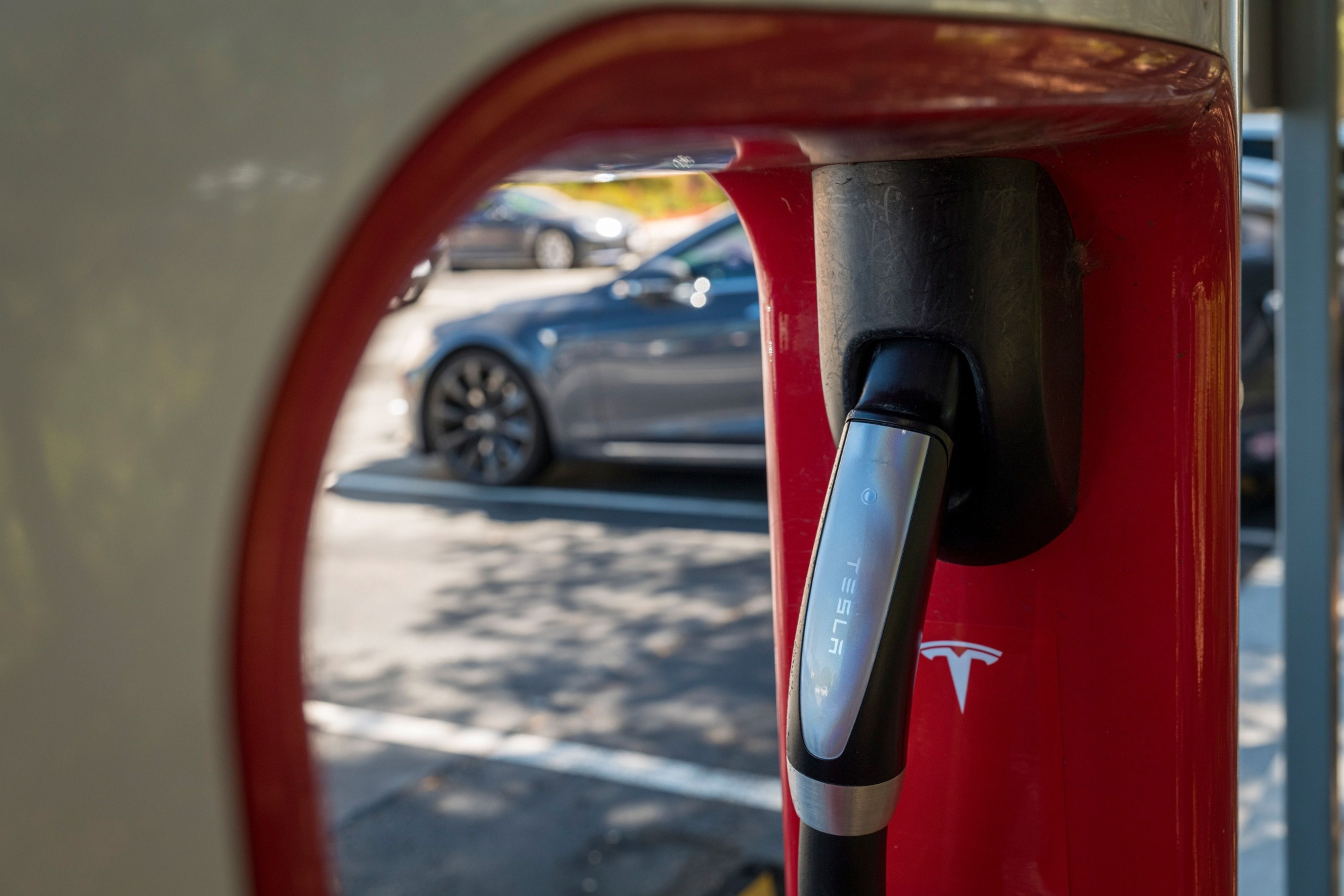
 A Tesla Inc. charging station in San Mateo, California, U.S., on Tuesday, Sept. 22, 2020. Tesla will provide a highly anticipated technology update when Elon Musk takes center stage at an event the chief executive officer has dropped hints about for months -- and which has helped propel the company's sky-high valuation. Photographer: David Paul Morris/Bloomberg
 “Our car-use cylindrical battery business, which is mainly for Tesla, turned profitable and that contributed a lot to the segment’s result,” Panasonic’s Chief Financial Officer Hirokazu Umeda said in a call after results.
The relationship between Panasonic and its high-flying customer has been contentious over the years. The two companies jointly operate a massive battery plant in the U.S., where Panasonic makes the cells, and Tesla strings thousands of them into battery packs for each car. But Elon Musk has sought additional suppliers to reduce Tesla’s dependence, while Panasonic has said it can’t supply the automaker on its own.
Last month, at Tesla’s Battery Day, Musk unveiled a push to lower the cost of batteries and signaled it will eventually produce its own cells. The news hammered shares of suppliers, including Panasonic, LG Chem Ltd. and Contemporary Amperex Technology Co.
Panasonic’s CFO said it will continue working with Tesla in developing the 4680 battery cell, which Tesla mentioned last month will be more cost-efficient. Panasonic also aims to improve profit margins from its Tesla business to around 5% over the next several years.
Key takeaways:
- Second quarter net sales fell 15% to 1.67 trillion yen
- Operating income forecast for the fiscal year remains 150.0 billion yen, compared with an estimate of 144.73 billion yen
- Net sales forecast for the fiscal year remains 6.5 trillion yen, in line with the estimate of 6.51 trillion yen
Comments
Scroll down to load comments...