



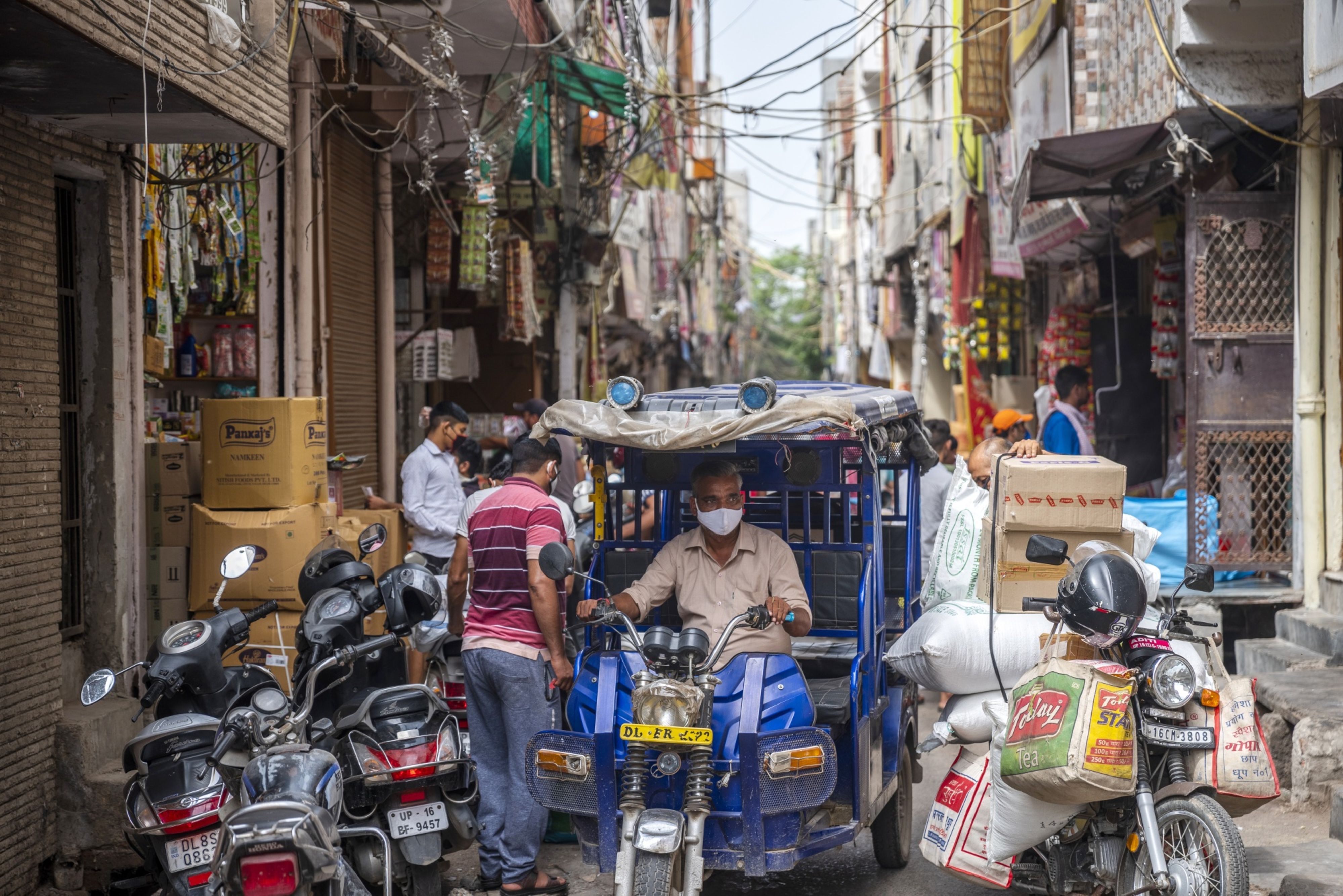
 An e-rickshaw driver wearing a protective mask navigates past a loaded up motorcycle at the Kondli Wholesale Market in Noida, Uttar Pradesh, India, on Tuesday, July 14, 2020. Indias wholesale prices fell for a third straight month, signaling muted price pressures in the economy despite retail inflation edging up. Photographer: Prashanth Vishwanathan/Bloomberg
Forecasts for GDP in the quarter through June range from a contraction of 15% to a decline of 25.9%, with a median estimate of -19.2% -- representing the worst performance since India started reporting quarterly data in 1996.
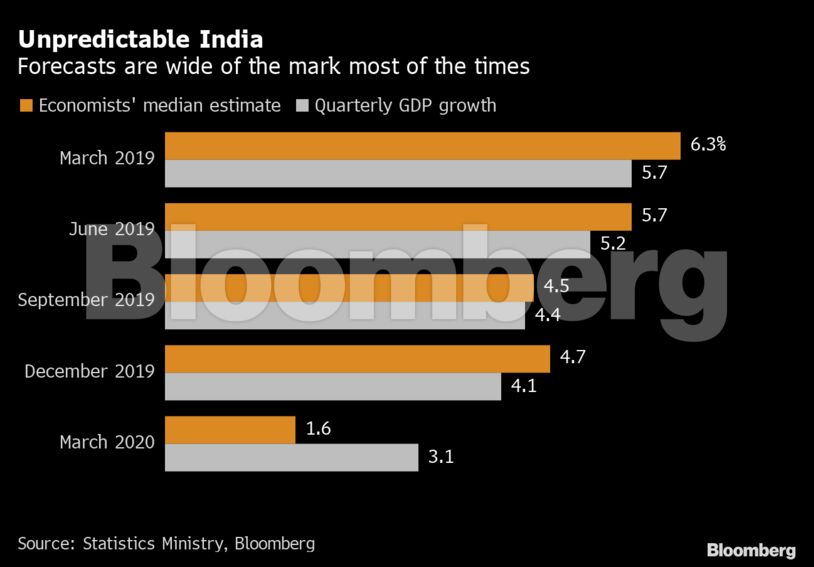
Measuring last quarter’s GDP has been the “most challenging exercise in a long time,” Sumedha Das Gupta, an economist at ICICI Bank Ltd., wrote in a report on Aug. 25. “Difficulty in gauging the extent of economic disruption under lockdowns may result in a starkly different number.”
The lack of field surveys add to the data complexities, with output in several sectors likely to be estimated and later revised once the hard numbers become available in coming months.
The data gaps could “imply imputation of value-added across major sub-sectors based on limited information from high-frequency indicators and thus prone to large revisions over time,” said Gaurav Kapur, an economist with IndusInd Bank Ltd. in Mumbai.
Incomplete price-level data, which are used as deflators to arrive at real growth, would also affect GDP numbers, he said.
Even before the pandemic, India’s GDP statistics have been a source of contention. A change in the methodology to calculate GDP introduced in 2015 made forecasting difficult, prompting some economists to use their own trackers of high-frequency indicators, which compare more closely with the old GDP series. Some are now relying on proxies to estimate output in the three months to June.
Read More: India’s Economic Statistics Have a Credibility Problem
Economists are already updating their forecasts based on numbers available from alternative sources, like companies and tax collection.
State Bank of India’s Soumya Kanti Ghosh revised his fiscal first-quarter GDP estimate to a 16.5% year-on-year decline, milder than the 20% contraction previously predicted, “though with the relevant caveats in the current uncertain scenario.”
Comments
Scroll down to load comments...