




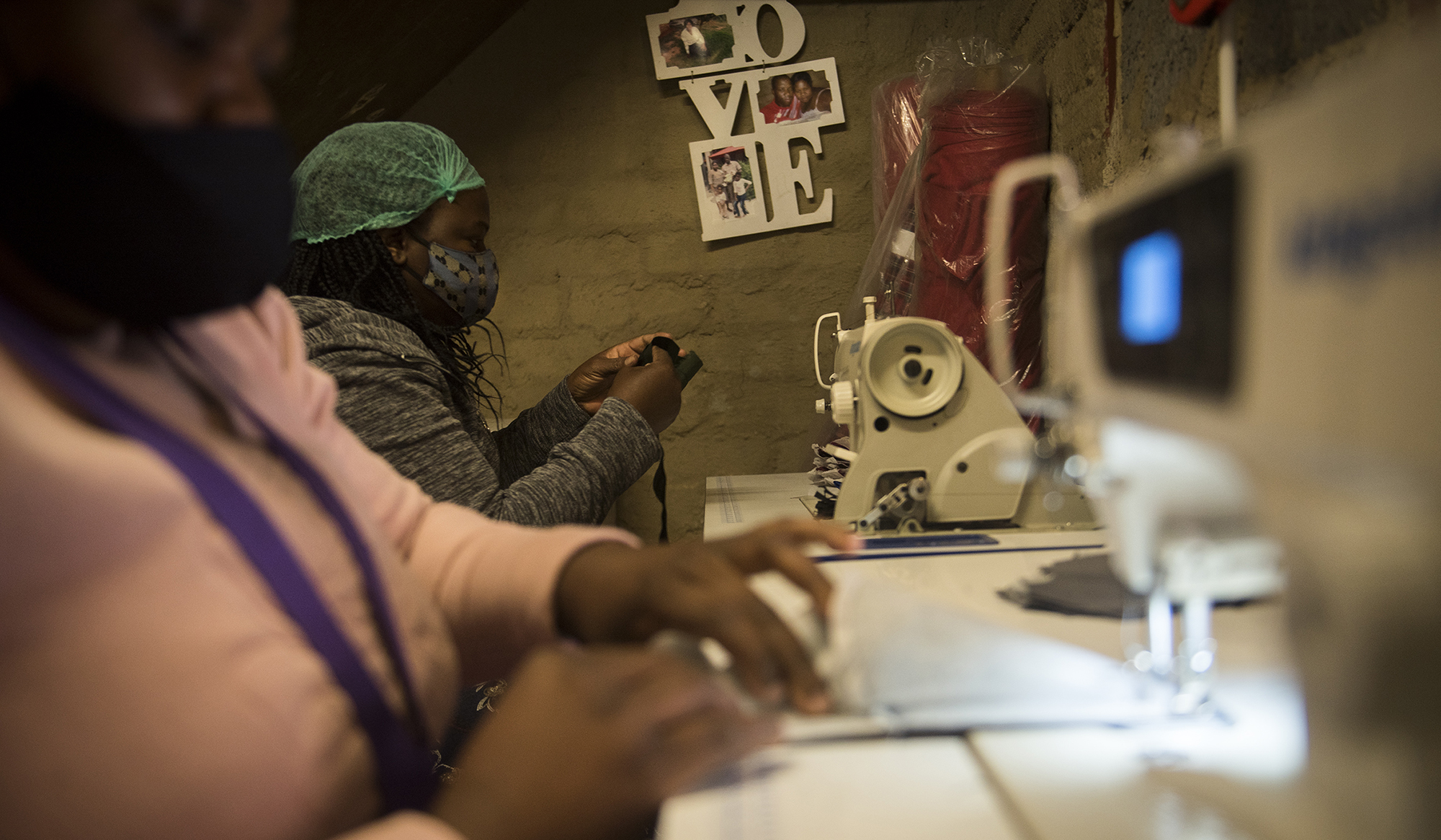
 Ponani Shikweni and Grace Chauke (green cap) sew masks. (Photo: Shiraaz Mohamed)
 Grace Mabuya worked at a stationery shop but lost her job shortly after the lockdown began. Like thousands of other South Africans, she fell victim to the pandemic — not from a health perspective, but financially.
/file/dailymaverick/wp-content/uploads/inset-1.jpg "Grace Mabuya, right, Austin Mashale, centre, and Paulos Komane, left, in Shikweni's garage which acts as their factory. (Photo: Shiraaz Mohamed)")
“I was worried. My husband is unemployed. We have two kids. We did not know where we were going to get food,” Mabuya said.
/file/dailymaverick/wp-content/uploads/inset-2-1.jpg "Temperatures are taken daily. (Photo: Shiraaz Mohamed)")
But despite the unemployment figures soaring in the country, Mabuya found work at a mask-making factory right on her doorstep in Eastbank in Alexandra, Johannesburg.
/file/dailymaverick/wp-content/uploads/inset-3.jpg "Ponani Shikweni records the temperatures of her staff in a register. The mother of three is cautious when it comes to the safety of her kids. (Photo: Shiraaz Mohamed)")
“Now that I have a job, I am able to help out in the house. It is winter, I am able to buy warm clothing for my children and also put food on the table.”
/file/dailymaverick/wp-content/uploads/inset-4.jpg "Grace Chauke prepares the masks for packaging. (Photo: Shiraaz Mohamed)")
Ponani Shikwene, 32, is an entrepreneur who sold blankets before the lockdown. She had an established business, supplying the Netcare group with pillowcases and going door to door selling blankets.
/file/dailymaverick/wp-content/uploads/inset-5.jpg "A view from above of Ponani Shikweni working on her sewing machine. The self-taught Shikweni provides training for her staff. (Photo: Shiraaz Mohamed)")
The hard lockdown effected by President Cyril Ramaphosa in March saw Shikwene’s business dwindle, but she saw an opportunity to help herself, others, and help flatten the Covid-19 infection curve.
/file/dailymaverick/wp-content/uploads/inset-6.jpg "Ponani Shikweni inspects a mask. (Photo: Shiraaz Mohamed)")
“After the president announced the lockdown, I thought about the vulnerable people in the community. I thought about those without masks. They need to protect themselves. When you wear masks, you protect me and I protect you from this corona. I later found out about a few ladies that lost their jobs because of the lockdown. I was sad,” Shikwene said.
/file/dailymaverick/wp-content/uploads/inset-8.jpg "Ponani Shikweni, left, and Paulos Romane, right, trim the strings of the masks to ensure they are of equal length. (Photo: Shiraaz Mohamed)")
Shikwene assembled a team of 25 people to work from her home. They were given hands-on training, from the correct handling of scissors to the cutting of fabrics — and also on the use of sewing machines.
/file/dailymaverick/wp-content/uploads/inset-9.jpg "Paulos Romane, who was unemployed, can now buy himself basic necessities. (Photo: Shiraaz Mohamed)")
/file/dailymaverick/wp-content/uploads/inset-10.jpg "Grace Mabuya, right, and Austin Mashale, left, pack the masks. (Photo: Shiraaz Mohamed)")
Today, working in shifts of two teams, they produce between 1,000 and 1,500 masks a day, working only when there are orders.
Paulos Komane, 28, who was unemployed before he began working for Shikwene said:
“I sat around doing nothing. It was frustrating, I was struggling to buy food and clothing. Now I am able to provide myself with what I need in order to survive. I feel good to be here. I am happy that I am working and I am happy that I am able to also help society by making these masks and protect our fellow South Africans.” DM