



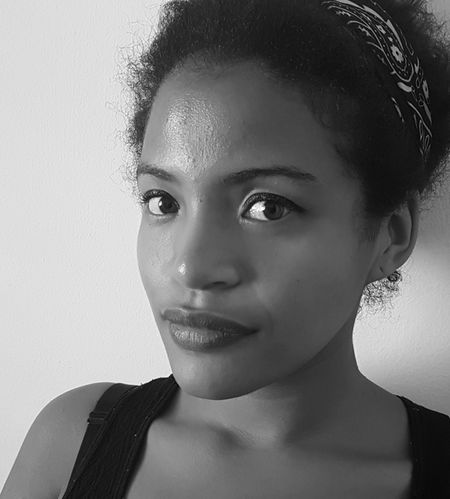
 Sune Payne. Photo: Leila Dougan
My favourite holiday growing up was Freedom Day — the countless images of snaked lines of hope, reflections of people who have the same skin colour as me, the rainbow pictures of a new hopeful South Africa and the stories my mother would tell me about running away from police in Manenberg in 1976, trying to protest for a better future. If you’d asked her, in that tiny makeshift voting station in Delft in 1994, if she knew 26 years later people would be arguing over roast chicken she’d probably have thought you were smoking something.
But 26 years later, in 2020, the build-up to Freedom Day doesn’t feel as free as it should. No playing of countless clips from our freedom fighters, no images of that glorious day. Where are the images of Mandela, Mbeki and De Klerk, where are the symbols of a new South Africa? Freedom Day 2020 feels cold and panicked as a result of the Covid-19 pandemic. The numbers of those affected are growing daily.
The brutality of the police, the general lack of thought and appreciation for human rights makes this Freedom Day feel like a slap in the face for every freedom fighter — dead, alive or struggling to cope with the psychological effects of apartheid. But, most importantly, this Freedom Day exposes what a lot of people have already known: Not much has changed for poor black South Africans. While people are complaining about Woollies cooked chicken, black women — mothers — are being arrested for trying to earn a living during this pandemic. Black men are getting assaulted and killed by police and the SANDF for being indoors; in their own homes they are murdered by a democratic police force.
As a country, collectively, we see images of people — often black, working-class people — who are treated differently to white people. Have the police beaten up a white man in Sandton who was in his living room- like they did Collins Xhosa in Alex? If the Green Point woman who tried to run away from police while running her dog — which is illegal under the current lockdown regulations — had been black she would probably have been arrested, tear-gassed and thrown in the back of a police vehicle. Depending on the mood of the officers, she might even have been shot in the back by a rubber bullet.
While we can argue over Bheki Cele and his dictatorial tendencies over walking dogs, we need to ask this Freedom Day: How equal are we? How equal is it that a white man can walk in the leafy suburbs without qualms, but when a black man goes to the shops to buy essential items he will get his goods confiscated, his money stolen by the police or worse, get assaulted and humiliated by the very same police who are supposed to be protectors?
This Freedom Day, I am reminded that, since 27 April 1994, black South Africans might have gained small victories but, when push comes to shove, there is a lot to be done. We as black people in South Africa, our own country, our home, need to be treated equally — within the police service, within government, in the private sector and within the economy.
After this pandemic — perhaps next Freedom Day — hopefully we will think back to this moment and recall that something good came of it and we gained a bit more equality. DM
This article is part of a series of reflections from Young Maverick writers about what Freedom Day - on April 27 - means to them.
Comments
Scroll down to load comments...