




 Oil tankers sit anchored off the coast of Long Beach, California, U.S., on Wednesday, April 22, 2020. Almost three dozen ships -- scattered in waters from Long Beach to the San Francisco Bay -- are mostly acting as floating storage for oil that's going unused as the coronavirus pandemic shutters businesses and takes drivers off the road.
 The massive glut won’t be cleared quickly, however, meaning West Texas Intermediate and global benchmark Brent crude are still at risk of further declines. In a sign of how severe the supply imbalance is, refiners are hunting for vessels to store gasoline and jet fuel, while an American pipeline operator is looking at ways to free up space on its conduits to store more crude.
With still no clear indication of when demand might recover, the market is set for a prolonged slump that will reshape the industry for years to come. Oil’s collapse will be followed by the weakest recovery in history, according to the World Bank, while consultancy Rystad Energy revised down its demand estimates for a fourth time since early March.
“It does look like, given the smaller trading ranges, that we are seeing a more stable environment,” said Michael McCarthy, chief market strategist at CMC Markets Asia Pacific. The start of production cuts is “very constructive” and the equilibrium price for WTI in the shorter term seems to be around $15 to $20 a barrel, he said.
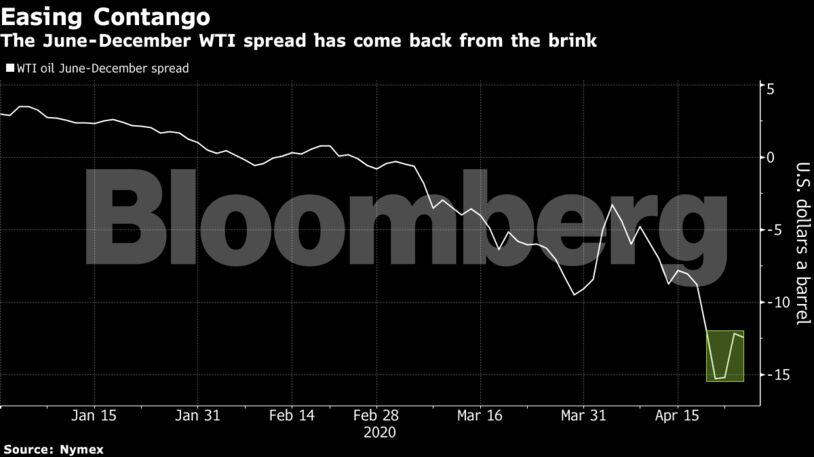
WTI crude for June delivery rose 5.7% to $17.44 a barrel on the New York Mercantile Exchange as of 10:33 a.m. in Singapore. The contract is down 30% for the week. The premium of the December futures over June narrowed to near $12 a barrel from higher than $15 earlier in the week, indicating concern over the glut is easing slightly.
Brent crude for June settlement climbed 3.4% to $22.06 a barrel on the ICE Futures Europe exchange after advancing 4.7% on Thursday. It’s down 21% so far this week.
While the reopening of China’s economy may aid demand, the nation’s inventories have risen to a point that will make it difficult to maintain current import levels, Sanford C. Bernstein & Co. said in a note. China’s combined commercial and strategic reserves have reached around 1.3 billion barrels, more than 1.15 billion barrels in the U.S., it said.
See also: Biggest Oil ETF ‘Almost Unanalyzable’ After Ditching Disclosures
Oil markets are also having to grapple with a wave of volatility spurred by exchange-traded funds. At least four brokerages -- including INTL FCStone Financial Inc. and Marex Spectron -- are restricting the ability of clients to enter into new trades in the most active oil benchmarks in a bid to curb losses.
Producers and refiners are also starting to declare force majeure in what could be a wave of broken contracts. American shale explorer Continental Resources Inc. told at least one refiner it couldn’t make an oil delivery after the price rout, while the trading unit of Petroleos Mexicanos said it couldn’t import gasoline from at least one U.S. company.
| Other oil-market news |
|---|
|