




 A pedestrian wearing a protective face masks walks by closed cafes and tapas bars at night in Madrid, Spain, on Sunday, April 12, 2020. Italy, Spain and France reported a slowdown in new coronavirus cases, allowing governments in Europe to look for ways to safely ease lockdowns that are strangling the regions economy.
 While the demand picture looks more promising week on week, a comparison to last year shows the extent of the damage Covid-19 has had on industry. In Europe’s major power markets the four-day Easter weekend consumption was the lowest for at least five years, according to energy consultants Wood Mackenzie Ltd.

Following is a list of some of the impacts that grid and energy companies in the region are reporting:
Italy
Italy’s reported cases of the virus dropped to the lowest since March 13 -- a sign that the nation’s tight lockdown is paying off. The government is considering plans to ease containment measures that are due to last until at least May 3. The rules ban movement within the country, shutter virtually all non-essential businesses and allow people to leave home only for work, health or emergency reasons.
The country’s drop in power demand has been one of the most stark in Europe, down 28% last week compared to a year earlier, according to Entsoe, the grid industry group. Peak power demand was 4.2% lower on Wednesday from a week earlier, widening the slump that last week was showing signs of easing, data from network operator Terna SpA show.
Germany
Power demand in Germany has been less affected than other nations with use 13% lower last week compared with a year earlier. The nation will be among the first in Europe to ease measures with Chancellor Angela Merkel moving forward with plans to slowly start returning Germany to normal, allowing some smaller shops to reopen next week and children to begin returning to school in early May. Most of the restrictive measures will remain in place at least through May 3 and many aspects of public life will be limited for weeks and months to come.
Peak power consumption fell for the third week with a drop of 3.3% on Tuesday from a week earlier, according to data from Agora Energiewende. Demand has fallen 9.8% over the past three weeks, the data show.
Spain
Spain reported the biggest increase in the number of confirmed coronavirus cases in a week, pushing the total above 180,000, according to Health Ministry data. Even still, it’s starting to focus more on how to relax restrictions imposed under a national state of emergency.
Power consumption grew by 1.2% on Wednesday from a week earlier, according to Red Electrica Corporacion SA, as the country began easing its lockdown restrictions allowing some business including construction and manufacturing to restart work. Demand has weakened 15% over the past four weeks and is down 25% from a year earlier, one of the biggest year-on-year slumps in Europe.
One consequence of the lower Spanish demand has been low-cost nuclear plants having to reduce output by about 20% mainly at weekends, according to RBC Europe Ltd. This might have a negative impact on Iberdrola SA and Endesa SA, the bank said.
U.K.
There are signs that the power demand slump may be starting to ease in Britain with National Grid Plc data showing a 3.8% drop on Wednesday from a week earlier. Consumption was 21% lower last week compared to a year earlier and the nation’s grid operator warned it expects to see an impact for months to come. Demand is already closer to levels seen in the summer months of July and August, it said in its Summer Outlook report.
The U.K. is expected to extend its nationwide lockdown even as pressure builds on the government to map out a strategy for easing restrictions amid signs the country may soon be past the peak of the pandemic.

France
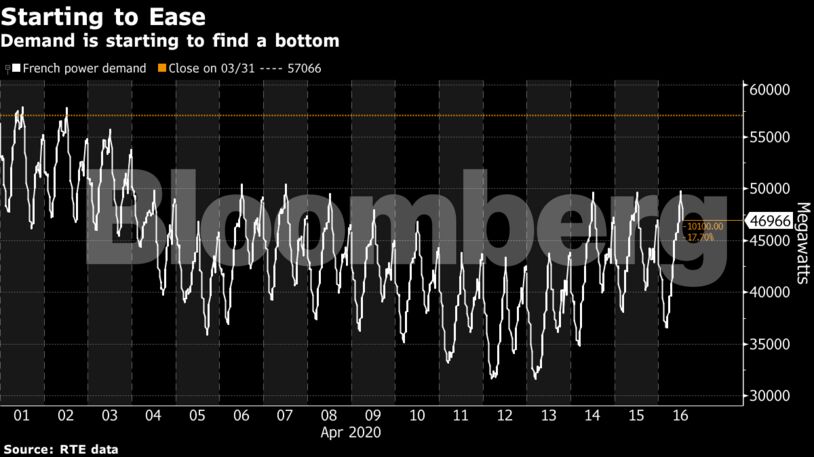
In France, the slump in demand has forced Electricite de France SA to cut its production targets from its nuclear power plants by more than a fifth this year. Illness of staff has meant that maintenance works haven’t been carried out. The company will close stations in the summer to conserve fuel for winter.
Demand has slumped 24% from a year earlier and French industry is operating at about half of its capacity, a lower level than in neighboring European countries, according to the government.
Consumption was 1.6% lower on Wednesday compared with a week earlier, Reseau de Transport d’Electricite SA data show, indicating that the situation isn’t worsening.
| Read more |
|---|
|