




 A tanker truck drives past a pump jack in the Permian Basin area of Loving County, Texas, U.S., on Saturday, Dec. 15, 2018. Once the shining star of the oil business, gasoline has turned into such a drag on profits that U.S. refiners could be forced to slow production in response. Photographer: Angus Mordant/Bloomberg
 “This OPEC deal is great and good but it doesn’t help us over the next thirty days,” Rebecca Babin, senior equity trader at CIBC Private Wealth Management, said by phone. “Even with the OPEC agreement, the size and timing of it is not enough to alleviate potential storage issues in the near term.”
Inventories from America to Europe and Singapore have all ballooned this week, sending some localized crude prices below $10 a barrel. The glut is looking so severe that the Trump administration is considering paying American companies to leave crude in the ground.
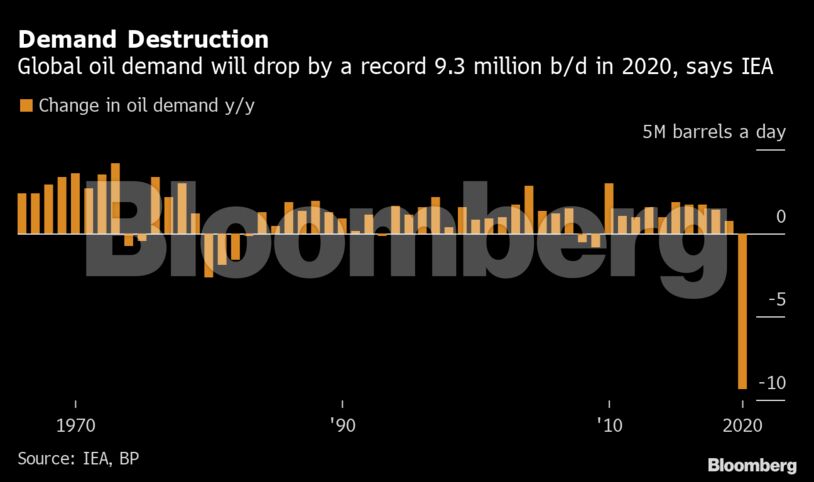
The stockbuilds come as the International Energy Agency said 2020 may be the worst year in the history of the oil market as lockdowns globally lead to the biggest hit to demand ever.
All the while physical oil prices, particularly in Europe, are trading far below those of futures. Key North Sea crude swaps are trading at the biggest discount to the headline Brent futures price in almost a decade. The critically important Dated Brent benchmark, which shapes the price of millions of barrels, was assessed by S&P Global Platts at $18.08 on Wednesday, with cargoes across Europe trading at a discount to that value.
As real crude prices and futures markets dislocate, some investors are eyeing a bottom in WTI, with almost $700 million flowing into a key ETF so far this week.
In response to the market downturn, U.S producer ConocoPhillips said it will cut North American output by more than one-fourth and halt all fracking in the continent.
“What will be the most important determinant for oil markets in the short term is how quickly governments relax social distancing measures,” boosting consumption, said Rystad Energy AS’s head of analysis Bjornar Tonhaugen.
| Prices: |
|---|
|
Indian refiner Bharat Petroleum Corp. is seeking to cut its crude oil imports from Saudi Arabia by half in May as the world’s biggest lockdown hurts demand for fuel in the country. It follows a plunge in consumption in the U.S. last week that saw gasoline demand at barely 5 million barrels a day.
“Our tanks are almost full, and we also have some cargo already in transit,” Ramamoorthy Ramachandran, director of refineries at BPCL said.
| Other oil-market news |
|---|
|