




 The Energy Charter Treaty reforms largely follow the template reforms that have become commonplace in recent investment practice, the weaknesses of which existing arbitral practice has already laid bare. (Image: Licensed under the Creative Commons Attribution / Wikimedia)
The U.S., Brazil and Canada will contribute an additional 3.7 million barrels in nominal production reductions as their output declines, and other Group of 20 nations will cut 1.3 million more. The G-20 numbers don’t represent real voluntary cuts but rather the impact that low prices have already had on output, and they would need months, or perhaps more than a year, to take effect.
“Combined with demand uncertainty due to the pandemic and the fact the market does not know the path for cuts from U.S., Brazil and Canada, suggests prices should only move modestly higher in the medium-term,” Bart Melek, head of global commodity strategy at TD Securities, said in a note.
The OPEC+ deal came after days of brokering by U.S. President Donald Trump, who spoke by phone to Mexican President Andres Manuel Lopez Obrador, followed by a three-way conference call with Russian President Vladimir Putin and King Salman of Saudi Arabia. The Saudis are ready to cut oil production further if needed when the OPEC+ alliance meets again in June, Prince Abdulaziz bin Salman, the oil minister, told reporters on a conference call on Monday.
Trump on Monday morning asserted in a tweet that the cut would be closer to 20 million barrels per day, without getting into specifics.

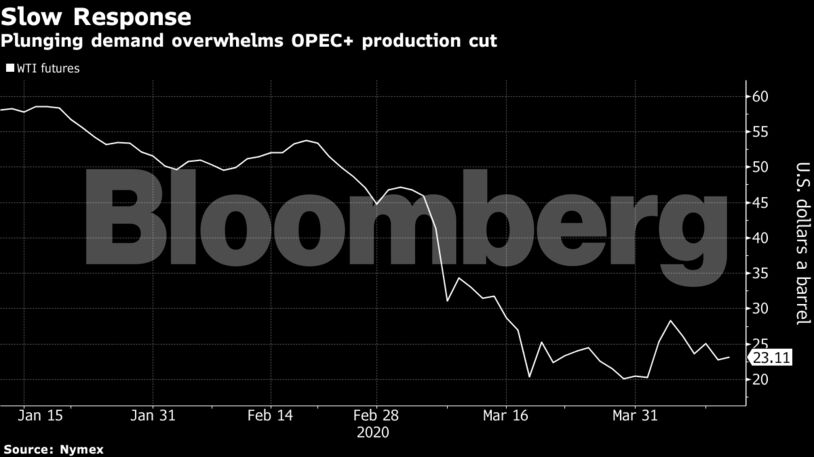
West Texas Intermediate for May delivery rose 27 cents to $23.03 a barrel on the New York Mercantile Exchange at 1:17 p.m.
Brent for June delivery was 58 cents higher at $32.06 a barrel on the ICE Futures Europe exchange. The contract jumped as much as 8%, or $2.51, earlier.
Saudi Aramco reduced pricing for all its grades to Asia, signaling the state company’s intention to defend sales in its biggest market even while paring output.
“The global market remains very oversupplied, and Aramco is still prepared to fight for its market share,” said Ole Sloth Hansen, head of commodities strategy at Saxo Bank A/S in Copenhagen.
Oil prices have been in freefall since the middle of February as some of the world’s biggest economies went into lockdown to try to stop the coronavirus from spreading. Whether the OPEC+ deal will be enough to steady a market where demand losses may amount to 35 million barrels a day and storage space is rapidly running out. Goldman Sachs Group Inc. called the agreement “historic yet insufficient.”
The voluntary reductions by OPEC+ would only lead to an actual production cut of 4.3 million barrels a day from first-quarter levels, assuming full compliance by core-OPEC and 50% by other participants in May, Goldman said in a note. The bank sees demand losses in April and May averaging 19 million barrels a day.
| For more on the deal |
|---|
|
“The scale of production cuts is a move in the right direction, but considering how badly demand is affected, it was never going to be significant enough to push the market closer to balance,” said Edward Bell, senior director for market economics at Emirates NBD PJSC in Dubai.
“Is Russia going to cut production by 2.5 million barrels a day in two weeks? That’s a pretty steep ask.”
Comments
Scroll down to load comments...