




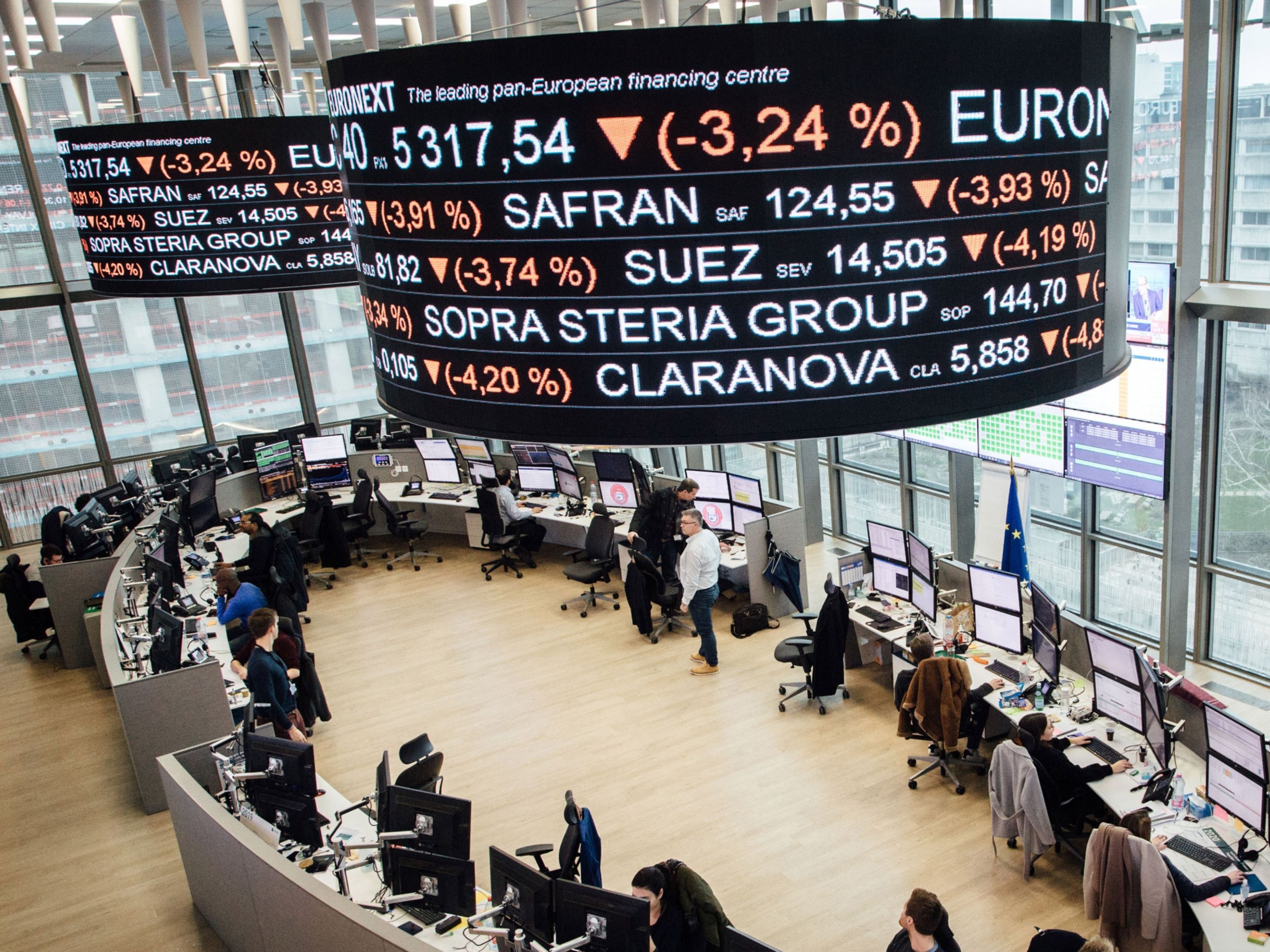
 Company trading price movements are displayed on digital screens hanging inside the Euronext NV Paris stock exchange in the La Defense business district of Paris on Feb. 28, 2020. Photographer: Cyril Marcilhacy/Bloomberg
 Hyper-turbulent financial markets continued their wild ride as investors try to assess the likely extent of the economic damage after countries around the world moved to combat the virus spread by virtually shutting down all social activity. The Dow Jones Industrial Average’s loss from its record reached 30%.
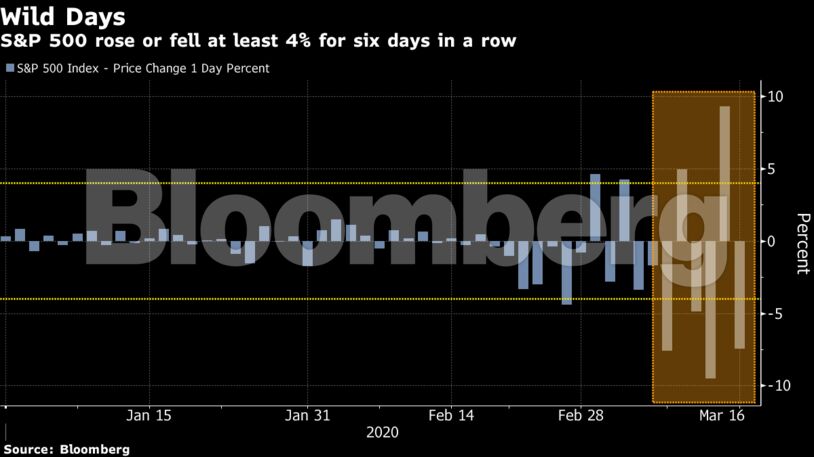
Here are some of Monday’s key moves across major assets:
- All 11 groups in the S&P 500 fell at least 2%, with banks bearing the brunt of the rout, down 8%.
- The highest quality U.S. corporate bonds gave up gains, following relative outperformance when the crisis first struck.
- Brent crude dipped below $30 a barrel for the first time since 2016.
- Treasury yields retreated across the curve with moves most pronounced on the short end.
- Shares tumbled in Asia and Europe, where the continent is now reporting more new virus cases each day than China did at its peak as more countries lock down. The Stoxx Europe 600 Index plunged 6.1% led by travel and construction shares.
- The yen surged, the Swiss franc rallied and the dollar fluctuated.
- Oil resumed losses. Gold failed again to capitalize on the rush to havens and reversed an earlier gain to tumble.
- Bonds declined across most of Europe, where a measure of market stress hit levels not seen since the 2011-2012 euro crisis.
The Fed and other central banks have dramatically stepped up efforts to stabilize capital markets and liquidity, yet the moves have so far failed to boost sentiment or improve the rapidly deteriorating global economic outlook. An International Monetary Fund pledge to mobilize its $1 trillion lending capacity also had little impact in markets.
The problem is, bad news keeps stacking up. The New York Fed’s regional gauge of factory activity plunged. Ryanair Holdings Plc said Monday it will ground most of its European aircraft while a consultant said the pandemic will bankrupt most airlines worldwide before June unless governments and the industry step in. Nike Inc. and Apple Inc. announced mass store closings.
“In normal circumstances, a large policy response like this would put a floor under risk assets and support a recovery,” Jason Daw, a strategist at Societe Generale SA in Singapore, wrote in a note. “However, the size of the growth shock is becoming exponential and markets are rightfully questioning what else monetary policy can do and discounting its effectiveness in mitigating coronavirus-induced downside risks.”
The yen rebounded from Friday’s plunge after the Fed and five counterparts said they would deploy foreign-exchange swap lines. Australian equities fell almost 10%, the most since 1992, even after the Reserve Bank of Australia said it stood ready to buy bonds for the first time -- an announcement that sent yields tumbling. New Zealand’s currency slumped after an emergency rate cut by the country’s central bank.
Meanwhile, China reported Monday that output and retail sales tumbled in the past two months.
| Read More |
|---|
| CDC Says U.S. Gatherings of Over 50 People Should Be Put Off |
| The Fear Is G-7 Cannot Match the Crisis Response of the Past |
| Mnuchin Says He Doesn’t Expect U.S. Recession From Coronavirus |
These are the main moves in markets:
Stocks
- The S&P 500 fell 8.7% as of 1:56 p.m. in New York.
- The Dow Jones Industrial Average plunged 9.1%
- The Stoxx Europe 600 Index lost 4.9%, paring a drop that reached 10%.
- The MSCI Emerging Market Index declined 6.3%.
- The MSCI Asia Pacific Index decreased 3.7%.
Currencies
- The Bloomberg Dollar Spot Index rose 0.2%.
- The euro gained 0.5% to $1.1162.
- The Japanese yen strengthened 1.8% to 105.94 per dollar.
Bonds
- The yield on two-year Treasuries sank 14 basis points to 0.35%.
- The yield on 10-year Treasuries declined 22 basis points to 0.73%.
- The yield on 30-year Treasuries declined 22 basis points to 1.31%.
- Germany’s 10-year yield climbed seven basis points to -0.47%.
Commodities
- West Texas Intermediate crude fell 9.2% to $29.05 a barrel.
- Gold weakened 4.3% to $1,463.30 an ounce.
- Iron ore sank 2.5% to $86.10 per metric ton.