




 The rebounding Chinese economy coupled with
indications that the US Federal Reserve will not raise interest rates for the rest of 2019 is welcome relief for emerging economies. (Photo: EPA-EFE/WU HONG)
The rebounding Chinese economy coupled with
indications that the US Federal Reserve will not raise interest rates for the rest of 2019 is welcome relief for emerging economies. (Photo: EPA-EFE/WU HONG) Read: Central Banks Coordinate to Boost Global Dollar Liquidity (1)
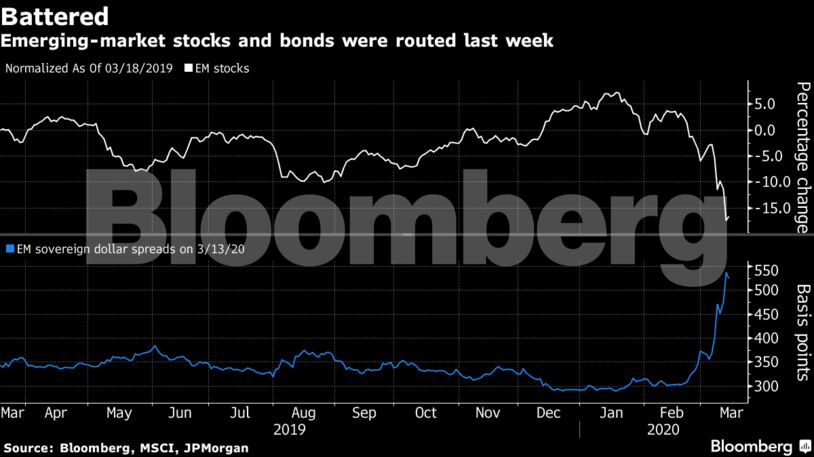
Emerging markets ended last week on a positive note, but it was small consolation. In the five days through Friday, MSCI Inc.’s index of developing-nation stocks crashed 12%, the most since the 2008 global financial crisis. The Mexican and Colombian pesos each depreciated more than 8% against the dollar to record lows, battered by Brent oil’s slide below $35 a barrel. Average sovereign dollar-bond spreads blew out by 122 basis points to levels not reached in more than a decade.
Asia Rates Bonanza
- Indonesia, the Philippines and Taiwan are set to decide on interest rates
- Bangko Sentral ng Pilipinas and Bank Indonesia are expected to add to the global wave of easing, with Bloomberg Economics forecasting they will each deliver a 25 basis-point rate reduction
- The collapse in oil prices will ease pressure on Indonesia’s current-account deficit and Philippine inflation, giving authorities room to lower rates
Economic Data
- Trade data are due from Indonesia on Monday and Taiwan on Friday
- China’s industrial output declined 13.5% in January to February from a year ago while retail sales fell 20.5%, it reported on Monday. The data was worse than economists had expected
- The People’s Bank of China added 100 billion yuan ($14 billion) into the banking system via the one-year medium-term lending facility, keeping the rate unchanged at 3.15%
- The move follows the PBOC’s widely-expected announcement late Friday that it will trim the amount of cash some lenders must hold in reserve
- The cut, which was also effective from Monday, will free up about 550 billion yuan of liquidity into the financial system.
- The Philippines will report remittances data on Monday. The funds are a key support for the currency, which is starting to lose its resilience to the global sell-offs, as stocks sink into bear-market territory
- South Korea is due to release producer-price inflation data on Friday
Russia, Turkey, S. Africa
- Turkey and South Africa will make interest-rate decisions on Thursday. Turkey’s central bank is expected to cut by 50 basis points to 10.25%, which would extend its easing since July to almost 1,400 basis points, a Bloomberg survey of economists show
- The South African Reserve Bank is expected to reduce its key rate to 6% from 6.25% by most economists surveyed by Bloomberg, though Goldman Sachs Group Inc. says a cut of 50 basis points is possible
- The country releases its inflation numbers for February on Wednesday
- Russia’s monetary authorities decide on interest rates on Friday, with almost all analysts surveyed by Bloomberg forecasting that they will hold at 6%
- Nigeria, Africa’s biggest oil producer, publishes February inflation data on Monday, with economists expecting the yearly rate to have climbed to 12.3%, from 12.1% in January
Brazil Rates
- Brazil’s central bank may cut its key interest rate when it meets on Wednesday, although any additional easing was put into question by the market collapse. Swap rates spiked a day after Congress overturned a presidential veto on a welfare benefit, raising concern about the outlook for Jair Bolsonaro’s reform agenda
- Chile’s fourth-quarter GDP data will probably flag a contraction linked to protests that took place last year, according to Bloomberg Economics
- Colombia will publish economic activity for January on Friday, though a positive reading may do little to ease concern about lower oil prices and record weakness in the peso. The currency is the worst performer in emerging markets this year
- In Argentina, investors will be watching for February budget data as the government continues to work toward the restructuring of about $69 billion of foreign bonds