




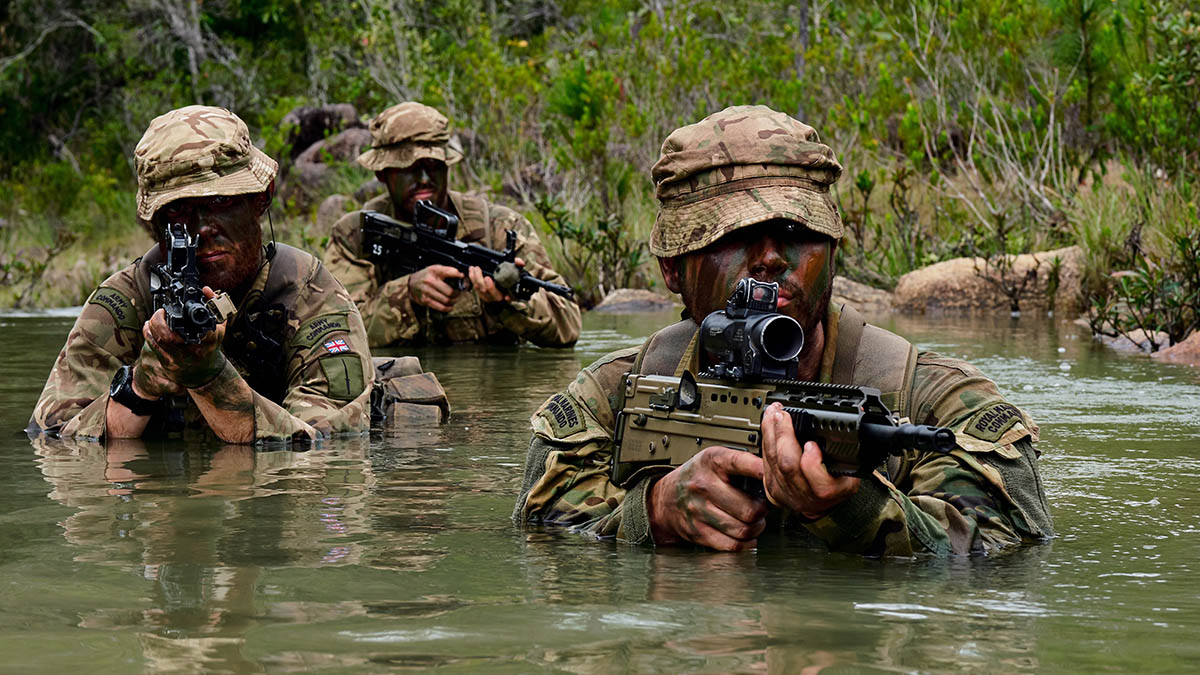
 Royal Marines training in Belize, February 2019 (MOD)
UK troops are conducting live-fire military exercises in one of the world’s most biodiverse countries which contains “critically endangered” species and rare archaeological sites. They are also authorised to conduct exercises in at least one protected forest area.
Belize, which is roughly the size of Wales, receives no payment for hosting these operations that involve thousands of British soldiers each year.
An environmental audit carried out by the UK Ministry of Defence (MOD) shows that nearly 380,000 of Belize’s 2.3 million hectares are now available to the British army for jungle warfare training.
The MOD says this is “larger than the entire area of land owned by the MOD in the UK (240,000ha) and is larger than Wiltshire, the home of the Salisbury Plain Training Area.” The audit was published in 2017 in Belize only and does not appear in full on any UK government website.
The audit evaluates the environmental footprint of British army exercises in Belize, measuring the impact of detonating grenades, firing mortars and 105mm artillery rounds, as well as driving armoured vehicles and “machine-gunning from helicopters flying at between 100-200ft”.
It finds that this level of military activity poses a risk to nature as well as historical sites, warning that “all training areas are rich in archaeology, including significant Mayan ruins and artefacts”. It warns that Mayan monuments face a “direct adverse effect” from live firing.
The MOD has published only a short article covering the audit, in an obscure magazine, which is subtitled “Considering the environment”. This article fails to mention live firing or the use of explosives and machine guns in Belize.
/file/dailymaverick/wp-content/uploads/Pic-1-Public-consultation.jpg "The British army holds a ‘public consultation’ in the capital of Belize, Belmopan (Photo: MOD).")
‘Economic benefits’
There are questions concerning the extent to which Belize’s public benefits from the use of their land by Britain’s military and whether they were properly consulted about it. British commanders held two public meetings in Belize to gain local approval for the military exercises. Although 150 people attended one meeting in San Felipe, only two showed up at the other event in the capital, Belmopan.
The agreement governing the British military presence, which was renewed in 2018 and lasts for 15 years, makes no mention of any British payments to the Belizean government or private landowners.
The Ministry of Defence confirmed to Declassified UK: “As part of the treaty with the Belizean authorities governing the operation of British forces, the British government does not pay for the land it uses.”
Belize is a poor country where almost half of all its children live in what Unicef calls “multidimensional poverty” and average incomes are £3,557 (US$4,720), around one-eighth of those in the UK.
The MOD claims that its activities contribute to the Belizean economy, telling Declassified: “The British Army presence in Belize generates employment for a large number of local staff in a variety of roles that directly contribute to the local community and economy.”
The commander of the Belize Defence Force (BDF), Brigadier General David Jones, said in 2016 that British soldiers “can be a very good income earner for the government and the BDF in that we can gain revenue from training foreign forces here”. He added that the soldiers benefit Belize by renting vehicles, paying for hotels and buying food.
However, the MOD’s own audit found that British spending in the local economy is negligible. UK troops spend no more than £1.25-million, which is equivalent to 0.1% of the country’s gross domestic product (GDP). A further £1.3-million expenditure was generated by local annual salaries for 113 Belizean civilians employed in 2017 at the main British base at Price Barracks, just north of Belize City.
Overall, the audit finds that the British military presence is having only “minor positive effects” on Belize’s economy, amounting to £2.7-million, equivalent to 0.23% of the country’s GDP. In comparison, tourism contributes around 38% of Belize’s GDP, with visitors spending £387-million in 2018, according to the Belize Tourism Board.
The issue of Belize’s land being used by foreign entities at low prices has historically caused protests. In the 1980s, Coca-Cola was forced to sell 90,000 acres in the Rio Bravo area of the country after local campaigners highlighted that the land had been bought for less than $9 an acre.
The British army in Belize
The British Army Training Support Unit Belize (BATSUB), located at Price Barracks, is manned by 12 permanent staff and provides military training to UK and international troops.
The value of Belize, according to the army, is that it “provides challenging terrain and an austere environment, giving the British army a world-class training environment. It is used to teach our soldiers how to survive, live and fight in the jungle environment”.
Britain has had a military presence in Belize since the slave trade in the 18th century. When Belize became independent from the UK in 1981, a British garrison stayed behind as the UK remained officially responsible for Belize’s “external defence” until 1994.
British troops continued to use Belize for jungle warfare exercises, special forces training and naval gunnery until 2011, when training was scaled down and the main barracks was “mothballed”. The move was reported to have saved the MOD £9-million per year and came at a time of austerity in the UK, with cuts to most state funding.
However, in 2013 the British army began considering “options to intensify the levels of jungle training” in Belize and reached an agreement with the Belizean government in 2015 to reinstate five training exercises per year involving 1,050 troops.
A further expansion for up to 11 annual exercises was proposed by Britain and approved by Belize in 2016, involving 1,650 personnel (Belize, by contrast, has only approximately 1,500 soldiers of its own).
Then in 2017, Britain successfully asked Belize’s government for access to even more land for military exercises, totalling 13 sites across the country where as many as 3,750 troops a year would train in a series of six annual operations.
By January 2019, British officials said in a declassified email that their military objectives in the Caribbean included a focus on “developing our footprint in Belize”, raising the prospect that the amount of land available to UK forces could grow further.
The British government provides little information about which countries’ militaries are involved in exercises in Belize. The audit states that activities include three “small international exercises, mainly conducted by discreet forces”. These are assumed to be special forces.
The British army website states only that “a number of UK and Belize international partners conduct training in Belize”. Last June, the government told parliament that the US, Netherlands and Norway have used BATSUB facilities and were planning to train there in the coming year.
The MOD refused Declassified UK’s requests for further information on which countries are taking part in military exercises and the nature of the training programmes.
/file/dailymaverick/wp-content/uploads/Pic-2-Live-firing.jpg "A British army sign written in English and Spanish warns that live firing will take place in Belize (Photo: MOD).")
A ‘live firing range’
British wildlife expert Chris Packham has said he is “particularly drawn to the potentially positive aspects of the reactivation of military training in Belize”, writing in the foreword to the MOD’s Sanctuary magazine that “Reduction of illegal logging and hunting and protecting the endangered scarlet macaw, a rain forest icon, would be an enormously beneficial aspect of the British Army’s renewed presence.”
The largest of the British military training sites, at 105,000 hectares, is in the Rio Bravo Conservation Area. This is the “largest private reserve in Belize” and is a protected forest. Conservation group Programme for Belize, which manages Rio Bravo, notes that the management regime for the conservation area corresponds to a category VI protected area as designated by the International Union for Conservation of Nature (IUCN).
Rio Bravo is home to the “highest density” of rare jaguars in Belize and the endangered harpy eagle. It forms a key part of the Mesoamerican biological corridor running through Guatemala and Belize. Programme for Belize was set up by donations from funders including Coca-Cola and allows Belizean soldiers to conduct “enforcement interventions” against illegal loggers.
Video: British marines train in Belize in 2019 (MOD)
However, the British army’s actions in Belize go far beyond anti-poaching patrols. The audit notes that “Rio Bravo is proposed for use as a live firing range (including mortars subject to approval), dry training area, and for riverine training”. This includes “live firing of small arms, machine guns and grenades from troops on the ground plus machine-gunning from helicopters flying at between 100-200ft.”
The audit also notes that Rio Bravo “has been historically used by BATSUB for live and dry training”. This is despite the MOD recognising in the audit that the area is “designated as Rio Bravo Conservation Area”.
In addition, the MOD is aware that “live ammunition will result in damage to vegetation within the nominated ranges from direct impact and ricochet from ordnance”, however, it claims plants will grow back quickly and the damage will only be short term.
The audit identifies “an increased risk of an uncontrolled wildfire starting as a result of live firing … This could result in loss of habitat, soil erosion and long term change to vegetation communities.” However, the MOD claims that “ecologically sensitive and arboriculturally important areas” in places such as Rio Bravo will be placed “out of bounds” as a mitigation measure, and no training will take place in “areas with the highest biodiversity value”.
/file/dailymaverick/wp-content/uploads/Pic-3-Mayan.jpg "British soldiers sit upon a Mayan site in Belize (Photo: MOD)")
Mayan monuments
There are also risks that military activities could adversely affect Mayan heritage sites, which are among Belize’s most popular tourist attractions. Soldiers have been told to make “attempts” to inform tour operators when conducting live firing near tourist attractions, in order to minimise the impact.
Mayan monuments could be damaged by artillery blasts as well as vandalism from troops, the MOD audit notes. It warns: “The magnitude of the direct adverse effect is considered to be major as these sites are of national and sometimes international importance and their resource finite. The effects of such disturbance would be long-term.”
To mitigate the impact on Mayan heritage, the UK military claims it will tell troops not to loot or damage such sites. The audit claims that: “As a part of initial briefings, all troops should be made aware that taking portable artefacts is illegal.”
However, Joel Wainwright, a professor of geography at Ohio State University and an expert on Belize, warned that Britain has a poor historical track record of respecting Mayan culture.
British settlers colonised Mayan ancestral forests in the eighteenth and nineteenth centuries and then used African slaves to cut precious timber, particularly logwood such as mahogany. Almost all profits were repatriated to England, he told Declassified UK.
Commenting on the revelation that British soldiers are not paying Belize to train in the country, Professor Wainwright said: “For anyone familiar with the history of colonialism here, the free access to Belizean territory by the British military is striking. The claiming and plunder of Belize’s forests was the foundation of the British colonial project, so the legacy of colonial rule is unmistakable.”
Phil Miller is staff reporter and Matt Kennard head of investigations at Declassified UK. They tweet at @PMillerinfo and @DCKennard. Follow DeclassifiedUK on Twitter at @declassifiedUK. Miller produced a short documentary that was selected for the Belize International Film Festival 2019.