




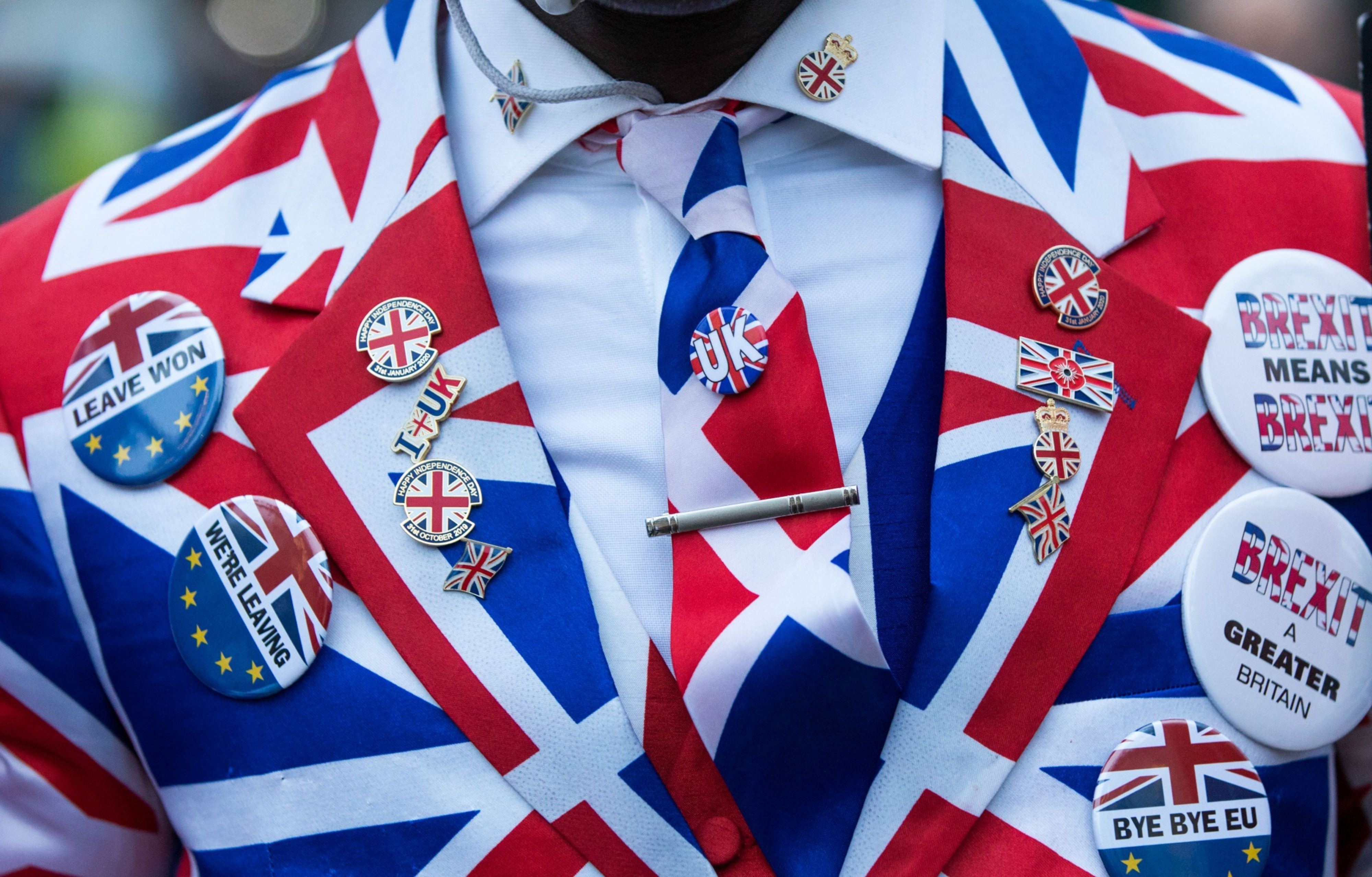
 A Brexit supporter wears badges on a Union Jack suit on Parliament Square in London, U.K., on Friday, Jan. 31, 2020. . Photographer: Chris Ratcliffe/Bloomberg
 The prime minister will again emphasize that in brokering a Canada-style free-trade accord, there’ll be no alignment with EU standards, European law courts will have no jurisdiction over the U.K. and he’ll make no concessions, the official said. He’ll also make it clear that the National Health Service is not up for grabs in any trade talks.
In suggesting that the premier would accept a loose arrangement like Australia’s partnership with the EU, Johnson’s team is effectively threatening to walk away without a formal trade deal. That would force the U.K. and EU to do business on World Trade Organization terms in most areas, with tariffs on goods, while processes would be agreed to reduce some regulatory barriers.
Tough Talk
Johnson’s speech is set to fire the starting gun on what will be 11 months of hard bargaining. After three years of bad-tempered talks on the U.K.’s political withdrawal, the early signs indicate that the parties could struggle to avoid a cliff-edge change in their trading arrangement come 2021. European Commission President Ursula von der Leyen has previously said it will be “impossible” to sign off on a full deal before Johnson’s hard year-end deadline.
“The idea of being able to negotiate and agree a proper new trade agreement, and getting it ratified, in 11 months is nothing less than absurd,” Erik Nielsen, chief economist at UniCredit Group, said in a note Sunday. “We think they’ll go for a bare-bones trade deal by the end of the year simply to avoid the imposition of tariff barriers.”
Read: What a Canada deal could mean for Britain
Foreign Secretary Dominic Raab reinforced the point that there won’t be close alignment on regulations in the free-trade deal. Speaking on Sky News, he said he expects both sides to live up to commitments to get a Canada-style deal.
Separately, Irish Prime Minister Leo Varadkar agreed that type of deal is possible. At the same time, “if we’re going to have tariff-free, quota-free trade, there needs to be a level playing field,” he told the BBC’s Andrew Marr in an interview on Sunday.
The prospect of a Canada-style deal with the U.K. received a guarded welcome from Varadkar on Friday. The U.K. is geographically much closer than Canada and can’t be allowed to undermine the EU, he said in Dublin.
The EU and Canada negotiated for seven years before signing their trade deal, known as CETA, in October 2016. It took almost another year before its provisional application began.
Read more: Britain Leaves the European Union, But Brexit Is Far From Over
Also Friday, BMW AG served a reminder that Britain’s formal exit from the EU didn’t necessarily mean that “Brexit was done.” Citing uncertainties over Britain’s future trade relations, the German car company said it was putting work on the next version of a Mini model on hold. The Mini is currently built in England and the Netherlands.
Read: Fish Are Chips in Post-Brexit Trade Bargaining
--With assistance from Tim Ross.