




 (FILE) - A close-up image showing a Mastercard credit card on a computer keyboard in Frankfurt, Germany, 10 September 2016 (reissued 22 January 2019). Media reports state Mastercard has been fined 570 million Euros by EU competition authorities over excessive fees. EPA-EFE/MAURITZ ANTIN
 A growing number of businesses embraced the so-called cashless movement, arguing that it improves safety at stores and eliminates risks associated with employees taking cash to the bank. In 2017, Visa Inc. upped the ante by offering 50 restaurants that agreed to ditch cash a $10,000 reward to spend on marketing and point-of-sale technology.
Read Mastercard’s ‘guiding vision’ for a world beyond cash
But the movement has faced criticism from advocates for low-income consumers who say a store’s decision to stop accepting cash can exclude people who don’t have access to credit and debit cards.
“There’s a rising tide of businesses that refuse to accept cash and will only accept credit or debit,” Councilman Ritchie Torres, who sponsored the bill, said on Thursday. “We in the council have real concerns that an increasingly cashless marketplace could have a real-world discriminatory effect on low-income communities, especially communities of colour, that lack access to credit or debit.”
The vast majority of stores still accept both cash and card -- with 92% of Square Inc.’s sellers in New York City accepting both forms of payment, according to a 2019 study by the payments company.
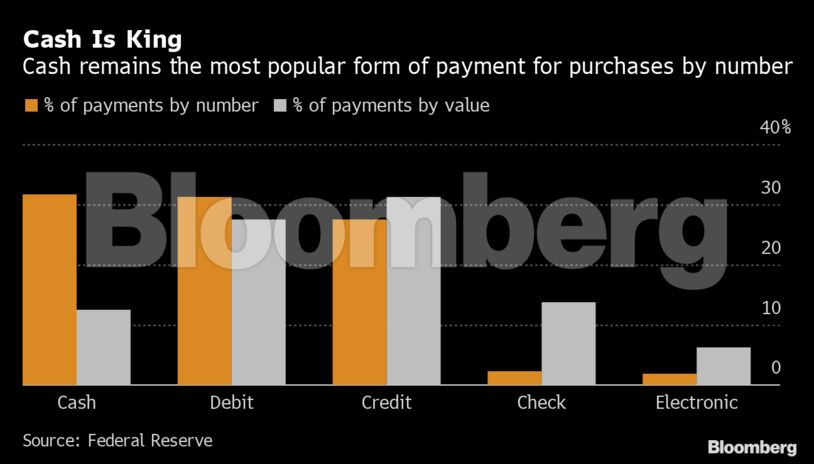
That’s because cash remains the most popular payment method for purchases in the U.S., accounting for 32% of all purchases, according to data compiled by the Federal Reserve. Debit and credit cards are close behind, accounting for 31% and 28% of purchases, respectively.
The New York City legislation won’t come without costs, Felipe Chacon, an economist at Square, said in an interview. “There are real costs to moving physical money around, and that will have an impact,” Chacon said. “It will either show up as a hit to profit or it will show up on whatever they’re charging as a price increase.”
Still, the trend away from cash and paper currency is undeniable. Spending on the networks of Visa, Mastercard, American Express and Discover has continued to climb in recent years, reaching a record $18.7 trillion in 2018, according to data compiled by Bloomberg Intelligence.
Visa respects “those who still wish to accept or pay with cash, while simultaneously using this as a moment in time to help expand access and help everyone -- from merchants to underbanked consumers and municipalities -- better realize the many benefits of digital payments,” the company said in an emailed statement.