




 The Oriental Pearl Tower, center left, Shanghai World Financial Center, center, and the Shanghai Tower, center right, stand among other buildings in the Lujiazui Financial District along the Pudong riverside in this aerial photograph taken above Shanghai, China, on Monday, April 2, 2018. China's sprawling local government financing system needs "crucial" reforms to increase consumption, build prosperity and encourage economic rebalancing, the International Monetary Fund said. Photographer: Qilai Shen/Bloomberg
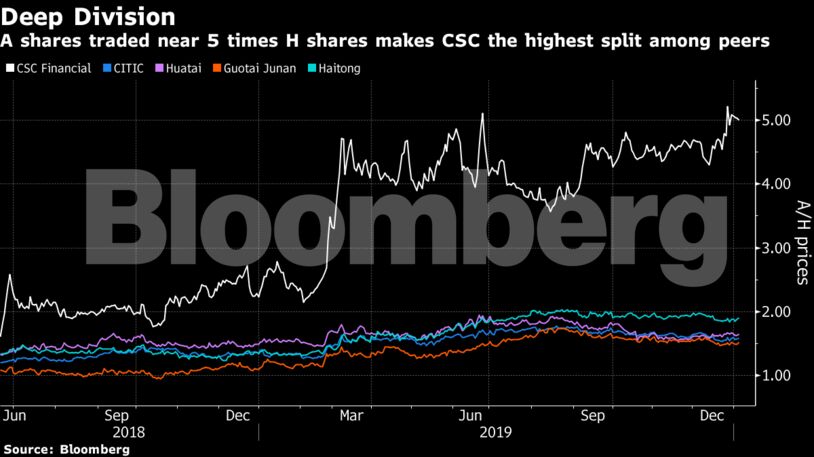
While the large gap in part can be ascribed to CSC’s low free float in Shanghai, it also underscores the divergence in analysis between the mainland and Hong Kong. Domestic investors are betting brokerages such as CSC will benefit from a wave of consolidation in the fragmented industry, increased monetary policy stimulus and recovering markets. The institutional investors who hold sway in Hong Kong give short shrift to the myriad of small Chinese brokers, which rely in large part on mom and pop traders for their revenue.
“Chinese brokers still have room to rise, bolstered by the optimistic sentiment, which will benefit CSC,” said Liao Chenkai, an analyst at Capital Securities in Shanghai. “But its A shares have already been overvalued.”
Read More: China Wants to Create a Brokerage Giant
Listed in Shanghai in 2018, CSC has benefited from being relatively newly listed and its shares also have a free float of just 7% compared with 61% for its Hong Kong H shares, according to data compiled by Bloomberg.
Its A-H premium is seven times that of rivals such as Citic Securities Co., but it now faces a number of headwinds. CSC, based in Beijing, posted a 3.8 billion yuan in net income in the first nine months of 2019, compared with 10.5 billion yuan for Citic, the largest broker.
CSC didn’t immediately reply to an email seeking comments on its A to H premium.
The stock fell 1.7% in Shanghai as of 10:06 a.m. on Wednesday, while it lost 1.3% in Hong Kong.
May Zhao, the deputy head of research at Zhongtai Financial International Ltd., said that a potential increase in the free-float of shares in CSC could start weighing on the stock.
Its largest shareholders, Beijing State-owned Assets Management Co. and China Investment Corp., will be free to sell as much as 66% of the 5 billion shares they hold in June 2021, corporate filings show.
Citic also holds a 5% stake in CSC. The larger rival announced in June it would offload its stake over the coming six months, something that has yet to happen. The Beijing-based broker said last year that it’s considering more acquisitions after snapping up rival Guangzhou Securities Co. for $2 billion in December 2018.
Citic was not immediately available to comment.
In a rare call last March, rival Huatai Securities Co. cut its rating on CSC Financial to sell, calling the stock “overvalued.” As measured by price to book, the A shares are valued at 5.40, compared with an average 1.62 in a Bloomberg gauge of China-listed brokers.
While the warning dinged the stock, a rally along with other brokers late in the year almost doubled its price. Bloomberg’s gauge of Chinese brokers climbed nearly 40% last year compared with 22% for the Shanghai’s benchmark index.
According to Zhao, an A to H premium of 10% to 15% is a “more reasonable range” for the sector.
“I think the gap will eventually be bridged,” she said. “With A shares coming off or H shares picking up.”
Comments
Scroll down to load comments...