




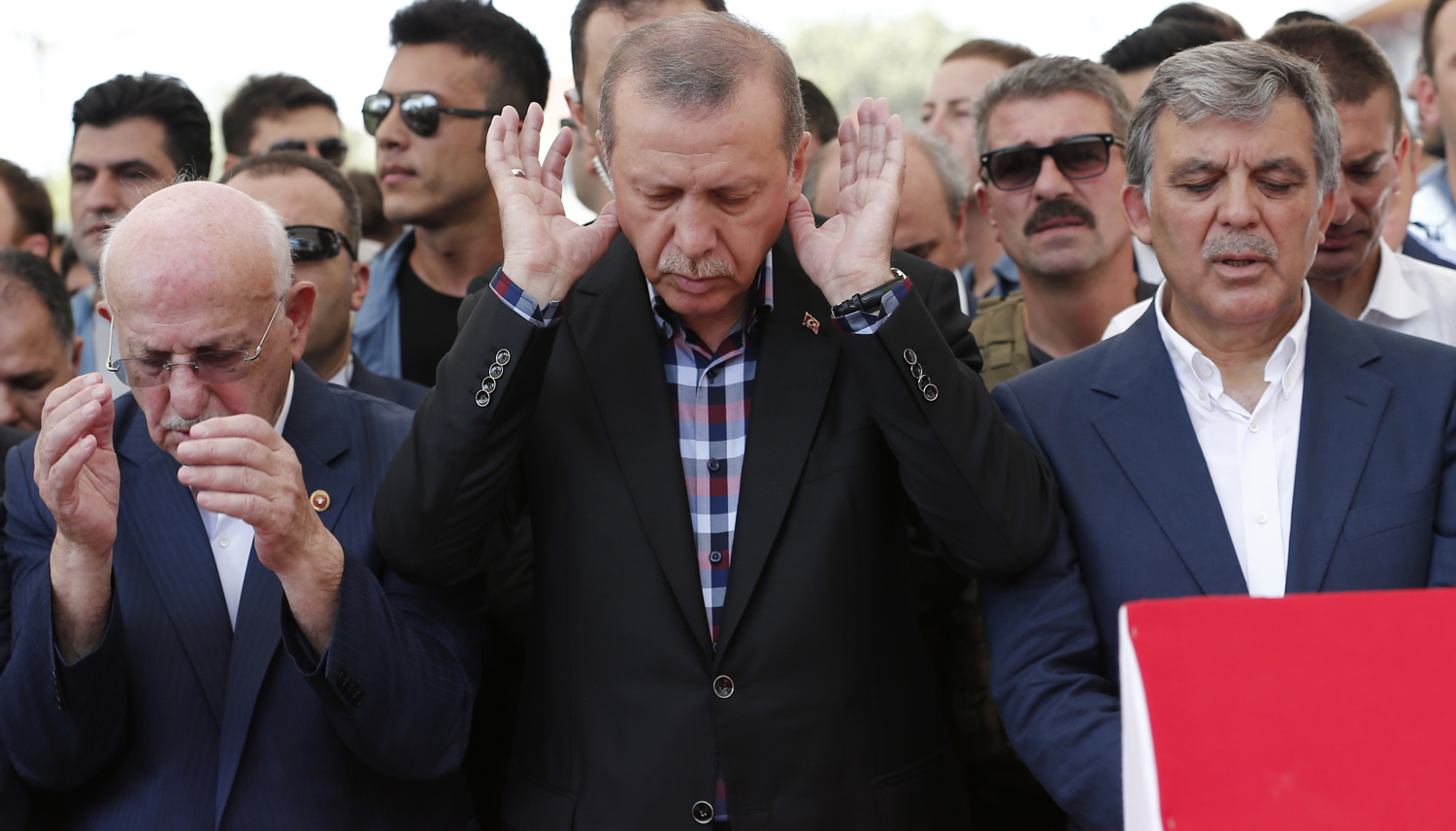
 epa05429130 (L-R) Turkish parliamentary speaker Ismail Kahraman, Turkish President Recep Tayyip Erdogan and former president Abdullah Gul pray near by coffins of victims who were killed in a coup attempt on 16 July, during the funeral at Fatih Mosque, in Istanbul, Turkey, 17 July 2016. Turkish Prime Minister Yildirim reportedly said that the Turkish military was involved in an attempted coup d'etat. Turkish President Recep Tayyip Erdogan has denounced the coup attempt as an 'act of treason' and insisted his government remains in charge. Some 104 coup plotters were killed, 90 people - 41 of them police and 47 are civilians - 'fell martrys', after an attempt to bring down the Turkish government, the acting army chief General Umit Dundar said in a televised appearance. EPA/SEDAT SUNA
The resolution asserts that it is U.S. policy to commemorate as genocide the killing of 1.5 million Armenians by the Ottoman Empire from 1915 to 1923. The Ottomon Empire was centered in present-day Turkey.
Turkey accepts that many Armenians living in the Ottoman Empire were killed in clashes with Ottoman forces during World War One, but contests the figures and denies that the killings were systematically orchestrated and constitute a genocide.
The Democratic-led House of Representatives passed the resolution by an overwhelming 405-11 in late October. But a vote in the Senate, where President Donald Trump's fellow Republicans hold a majority of seats, had been blocked several times by Republican senators.
Turkey and the United States have been at odds over a number of issues including their disagreements on the Syrian civil war and Ankara's purchase of Russian weapons that Washington says is not compatible with U.S. and NATO systems. (Reporting by Humeyra Pamuk; editing by Jonathan Oatis and Chizu Nomiyama)
Comments
Scroll down to load comments...