




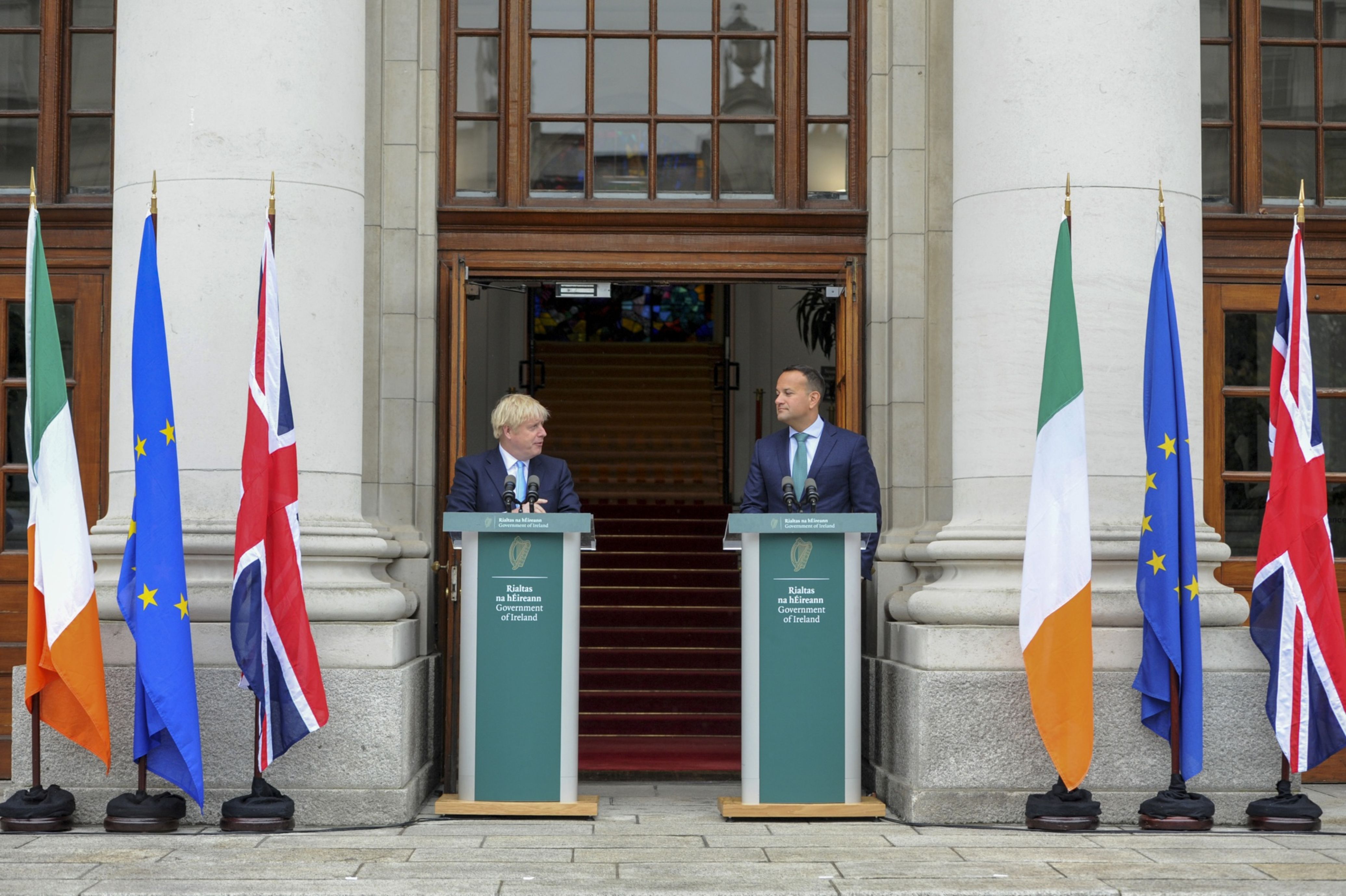
 Irish prime minister Leo Varadkar pictured during a press conference with British prime minister Boris Johnson in Irish Government Buildings in Dublin Ireland today 09 September 2019.Photograph: Aidan Crawley
 Unlike any of the big lurches in sterling that preceded it, the news that caused this dramatic leap had nothing to do with goings-on in Westminster. It all boils down to some remarkably positive words from Varadkar. He can now “see a pathway to a possible deal” – and he thinks it possible to reach that deal in the week before the European Union’s summit on Brexit.
Both sides agreed not to release any details. But in comparison with the negativity that preceded it, the latest development justifies the optimism. Leo Varadkar is now the single most important player in the Brexit drama.
The entire issue of Brexit at this point boils down to the problem of the Northern Irish border. It is impossible for the whole of the U.K. to leave the EU’s customs area without turning this border back into a customs border. That, in turn, would require physical infrastructure, something Ireland has refused to countenance. This is reasonable given the commitments made by the U.K. under the Good Friday Agreement, which resolved Northern Ireland’s long-lasting “Troubles.”
This effectively makes Varadkar the EU's chief arbiter of whether any deal is acceptable. That’s because the other EU countries would feel obliged to support a continuing member, rather than give way to a member that is leaving. To do otherwise would send a dreadful message to other smaller countries that might consider leaving.
Varadkar has been studiously cautious. He said almost nothing positive about the proposal to resolve the issue that Johnson published last week. As even the Northern Irish business community said the plan was worse than the “backstop” proposal put forth by Johnson’s predecessor Theresa May, which Parliament voted down, this wasn’t surprising. And earlier this week, after Johnson spoke with Angela Merkel, Germany’s chancellor, the briefing from Downing Street could scarcely have been more negative.
In this context, with an obstacle that seems almost impossible to surmount, and with no obvious previous attempt by Johnson even to try to surmount it, such positivity from Varadkar is extraordinary. It really does suggest that there is a game-changer. The fact that neither side has leaked the new proposal is also healthy, as it suggests that they have something worth discussing.
Sterling’s move therefore makes sense. There is plenty more downside if the U.K. crashes out of the EU without a deal; but the chance that it could reach an agreement by the end of this month, the best available outcome at this point, had seemed impossible. With deep negativity toward the pound, it was therefore primed for a big move in response to any genuinely positive news.
The crucial question if the pound is to retain its gains: What on earth is Johnson proposing? Let us assume that he is dealing in good faith. If so, at this point, it is hard to see what could spark such positivity from Varadkar other than a customs border through the Irish Sea. This would settle all of Dublin’s concerns; it would be simple and relatively easy to enforce. But it would also entail a further split of Northern Ireland from the rest of the U.K. Many in the mainland would have little problem with this, but the idea is anathema to the unionist community in Northern Ireland itself, and to many enthusiastic Brexiteers on the mainland.
Until now, the Democratic Unionist Party – the main unionist party in Northern Ireland – and Conservative Brexiteers have exercised a veto over all attempts to break the deadlock this way. If Varadkar reaches a deal with which he is satisfied, would these parties then move to block it?
According to at least one foreign exchange analyst, they may no longer have that power. George Saravelos, currency strategist at Deutsche Bank, points out that the U.K. is currently slated to leave the EU without a deal on Oct. 31. If any deal to result from the Johnson-Varadkar talks were vetoed in Parliament, the U.K. could then only avoid a potentially disastrous no-deal exit by asking the EU for an extension – and that extension could be vetoed by any single EU member.
In other words, potential rebels, in Britain and Northern Ireland, could be told: Take this deal and live to fight another day, or take responsibility for the chaos of a no-deal exit. Such an exit would hurt the U.K. much more than the rest of the EU.
That makes parliamentary rebellion far harder this time than it was earlier in the year. It also justifies the currency market’s positive reaction. But the currency volatility won’t go away just yet. It is still hard to believe that this intractable issue can be finessed and, to quote Varadkar, “there’s many a slip between cup and lip.”