




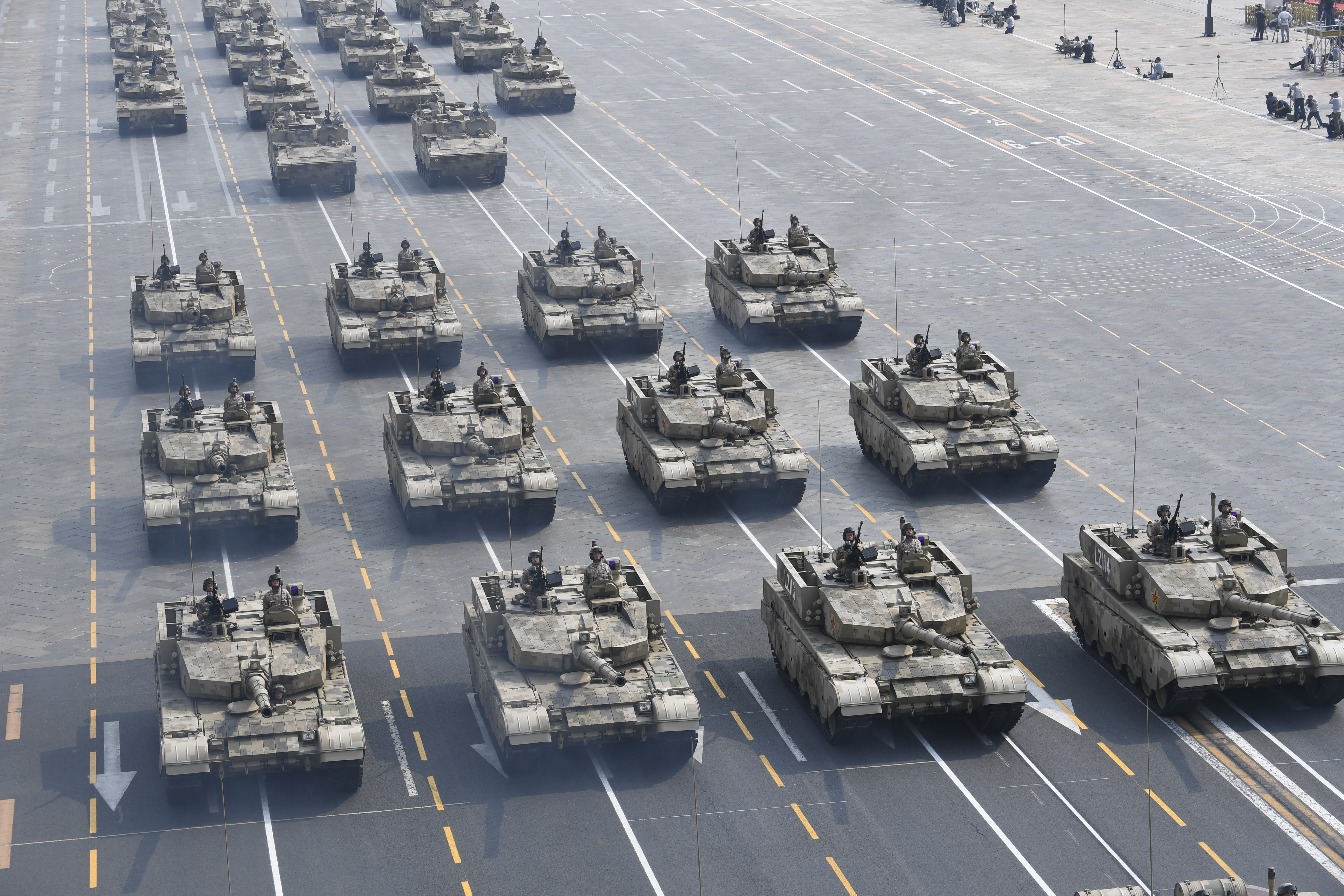
 A handout photo made available by Xinhua News Agency shows tanks rolling past Tiananmen Square during a parade celebrating the 70th Anniversary of the founding of the country in Beijing, China, 01 October 2019. China commemorates the 70th anniversary of the founding of the People's Republic of China on 01 October 2019 with a grand military parade and mass pageant. EPA-EFE/XINHUA NEWS
 On Tuesday 1 October, China celebrated the 70th anniversary of the proclamation of the People’s Republic of China, after decisively vanquishing the Kuomintang government under Chiang Kai-Shek, with the kind of parade and related celebrations you can only pull off when a government really seems to have total control over things, right down to the colour and fluffiness of every last pom-pom. An estimated 150,000 marchers took part. They were mostly members of military units in their matched, bemedalled uniforms, and the marchers included army units that had taken part in UN peacekeeping efforts in various parts of the globe.
That number of marchers was more than the staff complement of many nations’ entire military establishments. Kim Jong-Un (and Donald Trump, no doubt, as well) must have been seething, writhing, and drooling with envy over this monster mega-parade, what with all that goose-stepping, the quick-time marching, the elaborate floats representing all parts of China, the gleaming assault-rifle-bearing troops, and all the heavy weaponry that could roll past the reviewing platform. (There was even a drone craft that appeared to be a reverse-engineered version of the US craft recently brought down over the Persian Gulf.)
Beijing road repair crews will be very busy for weeks to come. Those really heavy-duty military vehicles can chew up the asphalt like nobody’s business. Just ask Donald Trump, whose own plan for a phalanx of tanks rolling down the Washington, DC streets for the Fourth of July was foiled by the city’s public works people.
Particularly important to foreign military observers, among the plethora of the military hardware on display were some (presumably) recently developed MIRV (multiple independently targetable reentry vehicle) missiles (reportedly equipped with 10 independently targetable warheads), carried on mobile platforms. Jets flew overhead, military music seemed to be on a thunderous, continuous loop throughout the march-past, and the head of everything in China, President Xi Jinping, reviewed all of it. Beaming.
His address was heard by the assembled throng – and it was also carried electronically to many, many millions more. Not surprisingly, Xi echoed the goals set out by the Communist Party’s recent 18th party congress for China to become a “strong, democratic, civilised, harmonious, and modern socialist country” by 2049. He praised his country’s continuing, rapid growth and economic progress, its achievements in overcoming the “century of humiliation” at the hands of foreign nations, its current military prowess, and its total commitment to a united China. (Were you listening carefully to that last bit, all you good folks living in Hong Kong, Xinjiang, Taiwan and Tibet?)
But perhaps the most intriguing aspect of the Chinese leader’s speech came in Xi’s extolling of Mao Zedong – but not the others who had followed “The Great Helmsman” as the country’s leader, not even Deng Xiaoping. Deng was, after all, the man who had (rather forcibly) brought political and social calm back to the country after the chaos and excesses of the Cultural Revolution. He gave new life to China’s monolithic governing political party as a national stabilising force, after those years of near-chaos. But, crucially, he was also the leader who created a real space for economic freedom, summed up in his often-repeated credo, “To be rich is glorious.”
This mix of policies gave birth to the Chinese economic miracle so admired today. (There remains a longstanding debate about why China, probably the world’s most technologically and militarily advanced nation up until at least the European Renaissance, had managed to fall so far behind the competition 200 or 300 years later, such that by the age of European expansion, Chinese navies and armies were no match for those of the marauding Westerners, nor, eventually against a rapidly modernising Japan at the close of the 19th century.)
Seemingly reinforcing Xi’s neo-Maoist turn of thought, in reviewing the massive parade, Xi wore a dark Mao jacket with its distinctive high collar — rather than the standard-issue dark suit/white shirt/suitable necktie he has been wearing in virtually all his international appearances. If “clothes maketh the man”, there were some not very subtle messaging efforts going on with Xi’s sartorial choices. Mao and his image had once been ubiquitous in China, and among the politically “woke” throughout the rest of the world. (My authentic Mao pin is still somewhere on my desk among the detritus of political memorabilia.) Mao had starkly fallen from real favour for some years, but now, apparently, here he was, at the centre of things.
All of this has followed the incorporation of Xi’s thoughts on politics and economics into the Chinese Communist Party’s constitution at the most recent party convention. Even more important, perhaps, has been a change in the party’s rules to allow Xi to stay in charge, essentially for as long as he wants, just as long as he stands for his unanimous election by his party every so often – perhaps even until he gives Robert Gabriel Mugabe a real run for his longevity money.
Still, there can be no gainsaying the extraordinary economic gains achieved by China since Deng’s course corrections, the accession of China into the network of trade rules of the World Trade Organisation some years later, and the boom in foreign and domestic investment in Chinese manufacturing over the past 30-some years. Chinese manufacturing – whether by foreign companies, by local subsidiaries, or, increasingly, locally established companies – has aggressively moved up the value chain with many of its products.
They have been aided by the availability of capital from state-owned or state-guided banks, and increasingly, too, investments by government in education, R&D, and modern infrastructure. Much of this has come rather directly from the standard developmental state playbook which calls for a competent bureaucracy giving attention to national infrastructure, the amassing of savings-driven investment capital, and some strong government guidance in directing attention to economic growth sectors.
This playbook was actually set out by post-war Japan (which built on its earlier, wartime experience in its “colony” of Manchukuo), then taken up by the “four little dragons” – South Korea, Taiwan, Singapore, and Hong Kong –and then, still later, by other Southeast Asian nations. (Taiwan insists it is the real deal as a nation-state, even as Beijing insists it is simply a breakaway province whose fate must be to return to the motherland.)
Size matters, of course, and the current impact of China comes in part because it is a vast nation of more than a billion people with its own equally vast domestic market, as well as the now-immense productive capability to generate those enormous export streams absorbed by the world. (To be truly fair about it, the developmental state also derives from the earlier ideas of policy wonks like Alexander Hamilton and Friedrich List, and even the much earlier French mercantilists.)
This 70th anniversary comes at a crucial point in China’s trajectory, however. In 1949, following years of precarious existence in mountains and caves on the fringes, during the Kuomintang government’s 15-year struggle against the Japanese invasion and occupation of half the country – that had itself come after decades of political decay, regional warlordism, and yet earlier foreign interventions – the Communist Party and its army eventually defeated the Nationalists. They were then forced to flee to their last redoubt on the island of Taiwan. The Communist Party and army had been “lucky” in being able to draw on large supplies of weaponry captured from the munitions stores of the defeated Japanese, as well as from Russian supplies.
In the years immediately following that victory, the People’s Republic of China proceeded to deploy a large army in support of North Korea’s invasion of the South, thereby earning the enmity of the US that remained until that breakthrough moment of President Nixon’s visit to Beijing. Meanwhile, until the economic volte-face of the Deng reforms, the country had remained largely impoverished, following the failures of the “Great Leap Forward” and the political, social and economic chaos of the “Cultural Revolution”, largely wasting many of the 30-plus years that had followed the 1949 victory. The government and party, nevertheless, did gain a strong mystique that inspired revolutionaries around the world, despite its cruelties and failures.
This vast, national 70th-anniversary celebration had been meticulously designed to cast a global spotlight on China’s very real, very impressive economic successes since those earlier, failed experiments. (By contrast, the recent 30th anniversary in this same year of the Tiananmen Square occupation in Beijing by pro-democracy, human rights campaigners, and then the violent crushing of that effort by police and military forces, had received no official acknowledgement at all.)
But sometimes fate has a way of playing a trick. The poet Robert Burns was right:
“The best laid schemes o’ mice an men
Gang aft agley
An’ lea’e us nought but grief an’ pain
For promised joy.”
For many weeks now, demonstrators in Hong Kong have been protesting against aspects of Chinese sovereignty over their city. Hong Kong had been ceded by China to the British in 1847 (and then, that original cession had been expanded twice more). The British and China eventually negotiated the full reversion of the colony in 1997, under the condition that Hong Kong’s existence would demonstrate a guarantee of two economic systems, but one political one, for a half-century more, thereby ensuring the city’s prominence and prosperity.
Many in the island city, however, had become increasingly worried about a gradual erosion of those basic principles and this had triggered, first, the yellow umbrella movement of 2014, and then, more troublingly, vast demonstrations this year against a proposed new extradition law, urged on by the city’s governing authority. This proposed law would allow certain accused persons to be extradited to China proper for trial – where the presumption among many Hong Kong people is that the legal protections now part of Hong Kong law would be much more easily ignored in a trial elsewhere.
The clumsy, high-handed public explanation of this proposed action provoked repeated demonstrations by, at the minimum, hundreds of thousands of people. Increasingly, the demonstrations have evolved away from a focus on just the extradition law to more general anger or a broader dissatisfaction with the city’s circumstances. Thanks to international broadcast media, the scenes of Hong Kong’s street battles now play globally, nearly every day, on television screens and computers.
Then, on 1 October, just as many millions in China were marching or celebrating the anniversary, the Chinese world was captured by the split-screen moment. On one side of the TV screen, in Beijing, the troops, missiles, and tanks were streaming past the reviewing stand where Xi Jinping was standing proudly. Simultaneously, on the other half of the screen, viewers could watch the police in Hong Kong battling demonstrators around the city, using water cannons, tear gas, pepper spray and other crowd control techniques, and at least one demonstrator was shot at point-blank range by the police (admittedly after the man had apparently struck at a policeman with a stout wooden pole). There has also recently been broadcast video footage of army reinforcements not too far away, waiting, just in case.
In a heartbeat, the image of greater China as a place of ever-growing prosperity, great peace, contentment, and tranquillity has faded, replaced by unanswered questions about its treatment of political dissidents, as well as ethnic and religious minorities such as Falun Gong adherents or the Uighurs in the northwest. And, of course, there again were all those questions about the future of Hong Kong – and even, lingering in the background, the entire country’s future political shape – back on the front burner, just as Xi Jinping was taking his metaphorical victory lap for those 70 years of Communist Party success.
All of this leads to a question that occupies the minds of many around the world. Is this Chinese system (especially Xi’s expansive version of it through mechanisms such as the Shanghai Cooperation Council and the Belt and Road Initiative, and the gobs of investment, aid, and trade that follow from them) to be the global future?
Do the undoubted Chinese economic growth and infrastructural successes – even with flaws such as the demographic and pension bombs arising from the earlier one child per family rule, or the speculative building boom of what are now ghost cities as investment hedges against the financial pressures of old age – outweigh the cost of those tight controls on individual freedoms? Or is the expression of that urge, as seen in Hong Kong now and in Tiananmen Square 30 years before, poised to affect in as yet unknown ways the larger body politic of China and thus the country’s future shape?
And beyond those questions, simply by virtue of China’s growth trajectory and its drive to create a military that can compete toe to toe (and its efforts to claim the high ground in the new world of cyber-warfare) with the US, will these exertions be sufficient to make the rest of the 21st century – and beyond – the Chinese century?
Concurrently, will the US be able to pull out from its current tailspin of chaotic politics sufficiently that it can creatively challenge this frequently mooted, supposedly inevitable, future ascendancy of China? These are questions that should occupy leaders in the West. Some deep reading into the catastrophic events stemming from the rise of Wilhelmine Germany at the beginning of the 20th century and the effects of its challenge to Britain should be required now for anyone who would lead, in order to avoid tragic pitfalls and miscalculations.
If scholars like Graham Allison are correct, China and the US are heading toward a war neither wants, as an outcome of the so-called “Thucydides’s Trap”, that deadly pattern of structural stress that results when a rising power such as China (or pre-World War I Germany) challenges a ruling one such as the US (or the earlier UK).
Or as the Greek historian Thucydides himself had said of the war in the fourth century BCE that he had chronicled, “It was the rise of Athens, and the fear that this instilled in Sparta, that made war inevitable.” It is also useful to remember that neither Athens nor Sparta ultimately prevailed in the end, both were overtaken by a yet newer power, Macedonia, until that kingdom, too, came under Rome’s conquest.
Present dominance is no guarantee of permanent success. DM