




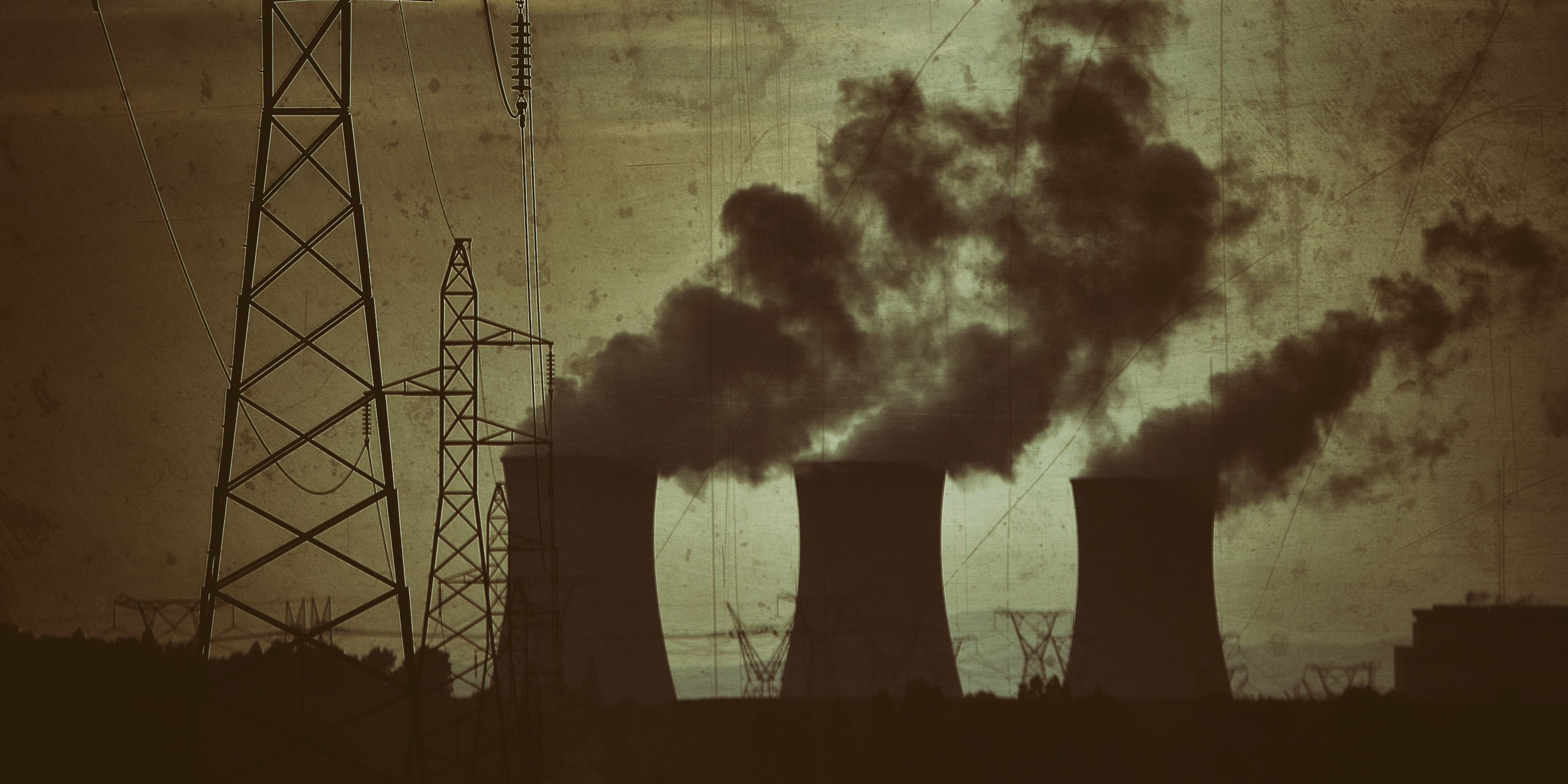
 The cooling towers of an Eskom coal-fired power station near Johannesburg. (Photo: EPA/Kim Ludbrook)
 In late March 2019, Eskom pushed South Africa to the edge of economic collapse when it ran out of money and could not meet its debt servicing and contractual liabilities. The power utility had banked on a R7-billion disbursement from a R33.4-billon loan by the Chinese Development Bank that did not arrive.
The crisis was averted through a commercial bridging facility until Finance Minister Tito Mboweni used the emergency provisions of the Public Finance Management Act to release R17.6-billion for Eskom, of which R5-billion was paid over in early April.
None of that emerged until Mboweni filed the required statutory report with Parliament on the last possible day, just before the Easter long weekend.
In line with the national legislature’s constitutional responsibility of accountability and transparency, the existence of the report was published in the Announcements, Tablings and Committee Reports under the heading “Report to Parliament by the Minister of Finance on the use of funds in terms of Section 16(1) of the Public Finance Management Act, 1999”. Getting an actual copy was a little trickier, but doable.
Again, in May, obscurity surrounded the funding of Eskom to ensure it could pay the interest on what now appears to have grown to be a R440-billion debt.
On Thursday 16 May, word emerged that Eskom had now received some of the Chinese Development Bank loan — R4-billion, according to two insiders familiar with the matter — and also the second tranche of R8.5-billion from the Public Finance Management Act emergency allocation.
On Friday 17 May, Eskom finally issued the Johannesburg Stock Exchange News Service (Sens) announcement that, Daily Maverick has reliably learnt, had been pledged to political bosses to appear by the previous day. The Sens officially confirms the R4-billion instalment from the Chinese Development Bank — significantly less than the R7-billion Eskom had expected by March from the bank’s loan facility of about R34-billion specifically concluded in July 2018 to conclude the Kusile and Medupi power station build.
Eskom, approached for comment, kept its answers non-committal. With regards to the R8.5-billion second tranche of the Public Finance Management Act emergency allocation, Eskom said on Thursday 16 May:
“Government has announced an allocation of R17.6-billion, therefore Eskom will utilise this as and when required”, adding that it would be used “as required for capital and interest repayment on Eskom debt”.
And a question on whether Eskom would achieve going concern status by the end of its financial year in June 2019 received this response:
“Following the finalisation of the audit and the appropriate approvals, Eskom will announce the date of the release of its annual results.”
Eskom’s R12.5-billion injection in May is carrying it for now. About R9.5-billion remains available from the R23-billion allocated in February’s budget — R4.1-billion from the R17.6-billion emergency Public Finance Management Act itself and the overall balance of R5.4-billion.
But, then, that’s it. And it’s not enough to ensure going concern status after Eskom’s financial year-end in June, giving rise to serious speculation that the power utility would need an additional bailout. Coincidentally, those financials may not look too rosy; in November 2018, at the entity’s interim results presentation, the power utility indicated an expected R11.2-billion loss for the financial year.
Already the government has been embarrassed by Eskom, and had to walk back its Budget pledge that the R23-billion would be used to “financially support Eskom during its reconfiguration”, as Mboweni explained then.
Talk of a debt swap, by which government would take over Eskom debt on to its books, is resurging. Eskom had lobbied strongly for such a R100-billion debt swap in the run-up to February’s Budget, but was ultimately unsuccessful. Asked on 16 May about discussions on a debt swap, Eskom replied:
“The overarching issue for Eskom and government is to find and implement a sustainable financial solution.”
DA MP Alf Lees told Daily Maverick Eskom’s cash flow still remained under severe pressure.
“It has to find the cash from somewhere,” he said, adding that this would most likely be from government, and thus taxpayers.
“It (Eskom) remains the biggest threat to South Africa’s finances… People say unemployment is the biggest problem. Without Eskom there will not be employment of any sort.”
Rating agency Moody’s, in its South Africa research report of 15 May, acknowledged domestic strengths such as a large pool of domestic investors and a diversified economy that could insulate the country from shocks. But it also pointed to the need for policy change.
“Without policy response to strong spending pressures, weakening tax performance and slow nominal growth, debt burden will increase to over 70% of GDP (gross domestic product), including guarantees to Eskom Holdings SOC Limited… by fiscal year 2023,” said Moody’s, adding that “highly leveraged state-owned enterprises including Eskom remain a source of risk for South Africa’s fiscal strength”.
But Eskom is not only a financial chasm, it’s also one that is mired in politicking. And the political manoeuvring unfolds not only in the governing ANC and its alliance partners such as Cosatu — in February President Cyril Ramaphosa publicly guaranteed Eskom’s unbundling meant no retrenchments — but also among those looking to leapfrog into the green economy.
City Press on Sunday talked of a “green fund” that would not only source between R150-billion and R200-billion for green initiatives to reduce carbon emissions, but also support Eskom in its unbundling.
The politics could mean a haphazard approach that will not resolve the fundamentals.
Politically, the unbundling of Eskom is unpalatable, even with reassurances of no retrenchments. It’s an acute consideration given unemployment increased to 38% on the broad definition that includes those who have given up even trying to find a job, according to Statistics South Africa earlier in May.
Perhaps that is why no details have emerged on breaking up the power utility into distribution, generation and transmission, of which the first new entity was expected by mid-2019, according to Budget documentation.
Politically also unpalatable is going green. Trade unions across labour federations, including the ANC’s partner Cosatu, are critical of the independent power producers (IPPS) and argue that they represent elite interests while negatively impacting on Eskom, from tariff pricing to capacity.
Ramaphosa’s brother-in-law, Patrice Motsepe, is not only active in mining, but also IPPs — and in February publicly dismissed claims of conflicts of interest. The National Union of Metalworkers of South Africa (Numsa) has gone to court over IPPs.
In May, ANC National Executive Committee (NEC) economic transformation sub-committee chairperson Enoch Godongwana argued for prescribed assets, or regulation to force pension funds to invest in defined areas, such as coal, from which Nedbank and Standard Bank announced their exit.
In an interview with Carte Blanche he said the banks’ refusal was “an invitation for prescribed assets” as it was the government of the day that determined policy, not individuals. Prescribed assets as a policy intervention popped up in the governing ANC’s 2019 election manifesto, sparking concern alongside its reiteration of the nationalisation of the South African Reserve Bank.
Eskom needs quality coal to ensure stable electricity supply, but there are insufficient new coal mines and, in perhaps an ironic twist, South African coal is increasingly exported due to better prices abroad.
Meanwhile, it seems the latest Integrated Energy Plan draft update dates back to 2017, while the government has to finalise the August 2018 draft Integrated Resource Plan, which deals with electricity supply and management.
According to Intellidex analyst Peter Attard Montalto’s post-election brief on 16 May, Eskom remains a central ideological battleground.
“There is a huge sense of urgency around Eskom and the need for a second iteration bailout…” he wrote.
“Unbundling and private participation, however, is much more uncertain and will be a longer and more fraught (as well as expensive) process.”
The reality is that Eskom is more than R400-billion in hock, with almost R300-billion of that against government guarantees. The exact numbers, however, depending on who gives them. Mboweni, in his report to Parliament in April 2019, says Eskom is R419-billion in debt, with R281-billion drawn against government guarantees. Eskom, in its Friday 17 May Sens announcements, talks of R440-billion debt of which “R273-billion nominal value is government guaranteed”.
Regardless of numbers, if Eskom at any stage defaults on any of its loan repayments, it will lead to the immediate repayment of billions leveraged against government guarantees. That kind of money is not available in the public purse. Nor are the additional tens of billions should the repayment of Eskom debt trigger a complex cross-default call-in of government-guaranteed debt across state-owned enterprises (SoEs).
Ramaphosa, in what could be seen as a post-election opening move on Eskom, on Wednesday 15 May attended the Goldman Sachs conference. Saying the power utility was too large to be allowed to fail, he said the government had a “credible” business plan for the power utility — without actually providing details.
“It (the plan) has been tested and evaluated. It is credible and can be implemented and it is already being implemented,” said Ramaphosa, according to Fin24.
“We have also got to look at the debt and address the issue of debt, which is exactly what we are doing now with Treasury (and) with our lenders… We are not going to allow Eskom to fail because if Eskom fails this economy fails, this country also fails, so we are not going to allow that.”
But Ramaphosa’s comments are neither new nor indicative of a policy change, even if a big-bang Eskom announcement may be reserved for his State of the Nation Address scheduled for 20 June 2019 to set the tone of his new administration. Eskom’s threat to South Africa emerged more than 18 months ago under then finance minister Malusi Gigaba, reiterated by Mboweni as recently as February 2019.
The devil, as always, is in the detail.
The speculation over Cabinet positions and factional ANC jockeying is distracting and obscures what is central — not who holds what position, but a determination by Cabinet to put shoulders to the wheel, and all shoulders to the same wheel.
The first signal as to how the factional chips will fall is expected on Tuesday at the special ANC caucus in Parliament following Monday’s special ANC National Executive Committee (NEC) and Sunday’s meeting of the Top Six officials. But only when Cabinet is actually announced will it be clear whether Ramaphosa has had the political backbone to act in line with his message of heading a clean-up — in both party and state.
Eskom will be central in any clean-up, because without fixing Eskom, there’s little to be done for South Africa. DM