




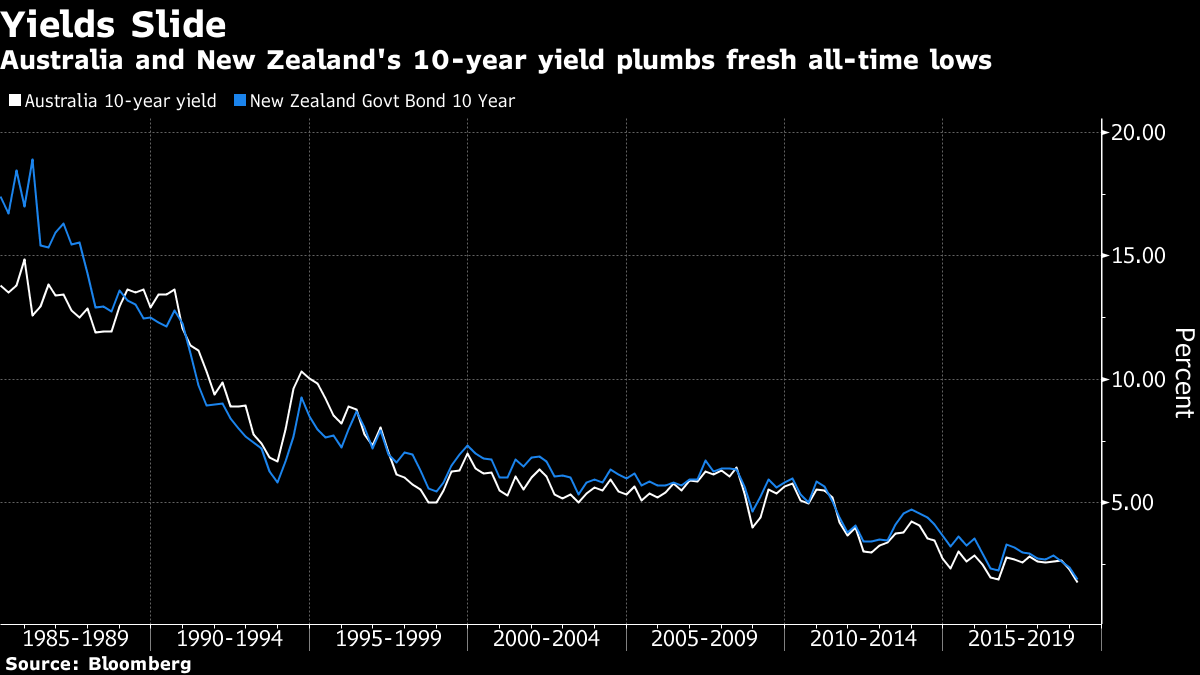
Bond yields in Australia and New Zealand dropped to record lows on Monday, after a closely-watched part of the U.S. curve inverted for the first time since 2007 on global growth woes.
Trading volumes in Treasury future were more than double the norm in the Asian morning, while Japanese sovereign bonds rallied.
“Bond markets globally, along with dovish central banks, have been telling us a slowdown is on the way,”
Jeffrey Halley, senior market analyst at Oanda Corp., said in Singapore. “Some parts of the world will be better equipped than others to handle this. The U.S. can at least cut rates and apply monetary tools, while things could be worse for Europe and Japan, where they cannot.”
Yields in the U.S. have led a global decline amid bets that a recession and a Fed rate-cutting cycle are coming. The spread between yields on three-month U.S. bills and 10-year notes inverted for the first time on Friday since the financial crisis amid reports showing economic weakness in France and Germany, while an index of American manufacturing slowed.
“Data is deteriorating globally,” said
Tano Pelosi, portfolio manager at Antares Capital in Sydney. “ It’s very unlikely that the Fed will hike again for some time.”
Yields on Australia’s
10-year bond fell as much as eight basis points to 1.756 percent, while New Zealand’s dropped to 1.899 percent, a record low in data compiled by Bloomberg starting in 1985. In Japan, the benchmark yield fell 1.5 basis points to minus 0.095 percent.
Australian bonds, which are sensitive to global growth sentiment, have rallied since central bank Governor Philip Lowe pivoted to a neutral stance last month from a long-held view the next move in rates would be up. The
local yield curve flattened further, with the difference between three and 10-year yields narrowing by 2 basis points to 38 basis points. DM