



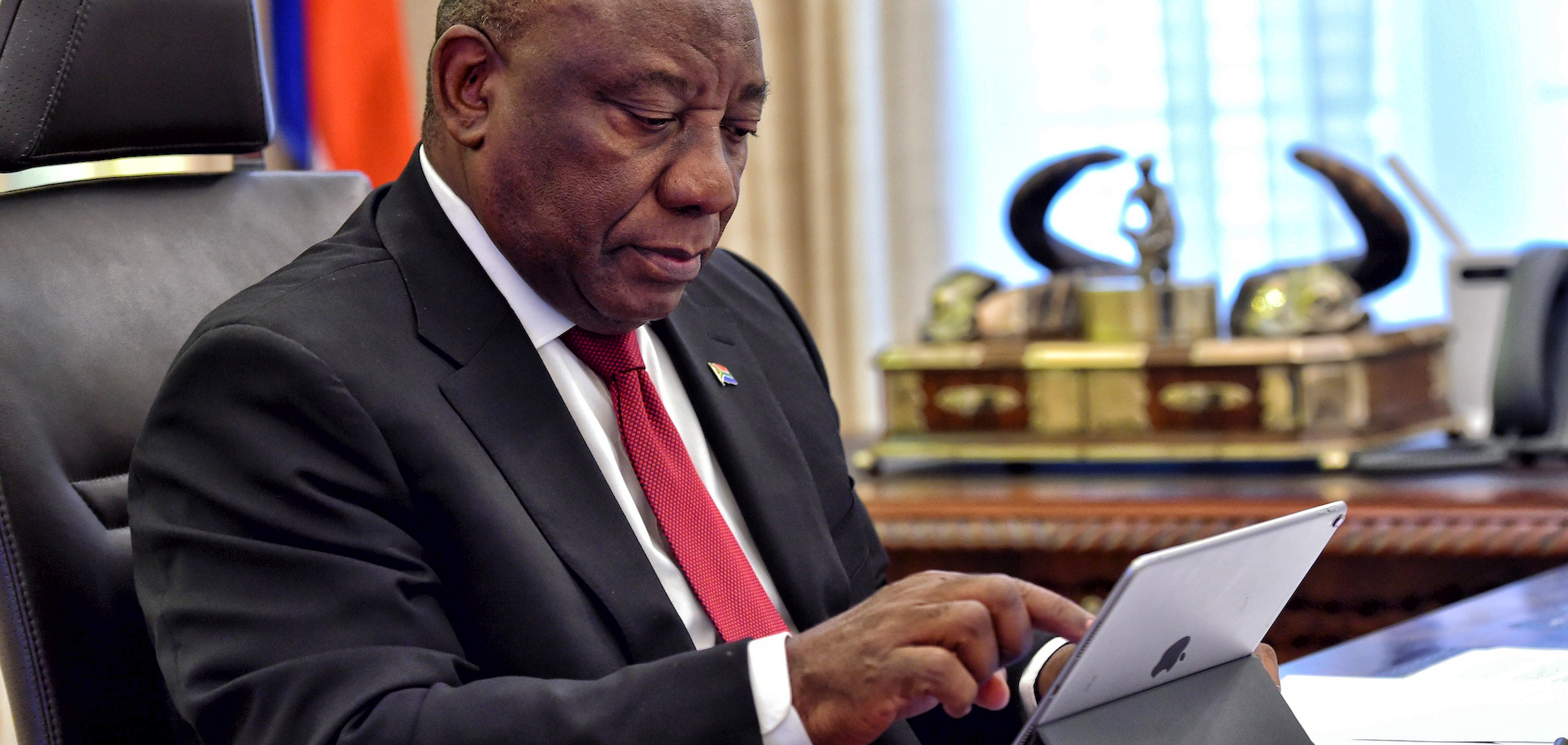
 President Ramaphosa putting final touches to his speech before walking to Parliament where he briefed Parliament on government’s approach to the national discussion on proposals by the governing party that the Constitution be amended to indicate the conditions under which land could be expropriated without compensation, to advance land reform. 22/08/2018, Elmond Jiyane, GCIS
 Our society’s racialised inequality, along with our numerous divisions, makes it a hard place to govern. Add to that the freedom that we have, and it is clear that it is difficult to get the political agreements necessary for progress. An indicator of this is the type of language that you heard before Finance Minister Tito Mboweni’s Medium-Term Budget Policy Statement. Much of the private sector and the economists employed by banks were demanding fiscal discipline and a reduction in government’s wage bill. At the same time, Saftu general secretary Zwelinzima Vavi was promising protests in the streets if government workers are let go.
In the middle of all of this, we have the ANC. It represents many, perhaps most, of the constituencies in the country; most of the country’s problems are bound to represented in its caucuses. Add to it the problems of the last few years, like the situation created by those who tried to loot the state under the leadership of former President Jacob Zuma, and a chaotic and uncertain picture emerges.
In such a context, an important sign of the party’s, and country’s, leadership success would be an emergence of a shared direction within the system – one way to measure whether or not President Cyril Ramaphosa is able to assert his will, to get things done his way. If he is, it is likely that there will also be some policy direction in the near future.
The mini-budget presented by Mboweni may well be a strong sign that direction is now coming into the system. It was not just what he said during his first big speech on Wednesday, it was the way he said it. Mboweni is nothing if not confident, he has a certain swagger to him that few other people have. His opening lines, quoting Charles Dickens about it being “the best of times, it was the worst of times.... we were all going direct to Heaven, we were all going direct the other way”, were a sign of that. (Mind you, his main point in this was that the way we are spending money, we are not going to heaven...)
But his comment about how it was now time to “demolish the walls between the private and public sectors” is surely the strongest indication from any serving ANC minister that public-private partnerships are going to be the new vogue. This is important, because it may provide a solution to some of the problems that the South African government perennially suffers from, especially in service delivery.
There are examples where public-private partnership has worked relatively well (think Telkom). But there is also likely to be strong ideological opposition to it. The SACP and Cosatu are bound to be furious, and will find this complete anathema. But, they are not the SACP and Cosatu of the past, when they wielded much more power, like when they campaigned against this kind of change during the Mbeki years.
Some of Mboweni’s other interventions, the announcement that the SANDF will now get involved in resolving the problems at the Emfuleni Municipality which has been pumping raw sewage into the Vaal River for several months, are the kind of thing that grabs headlines in a positive way. It shows that government is acting, and acting drastically. In other words, for many people, it is a symbol of how seriously government takes their problem. It is hard to think of a stronger symbol than the sight of soldiers and military equipment literally declaring war on service delivery problems.
However, at the same time, there are also signs that Team Ramaphosa still face an uphill battle.
In the Eastern Cape, Andile Lungisa has refused to comply with a decision by the ANC’s national executive committee that he resign from the Mayoral Committee of the Nelson Mandela Bay Municipality. He was appointed to the post by the UDM mayor Mongameli Bobani, clearly as part of a deal between the ANC in that council and the new mayor. Lungisa has been convicted of assault for breaking a glass jug over the head of a DA councillor during a fight in the council chamber two years ago.
Under a standing resolution of the ANC, a person is not allowed to be deployed to an executive position if they have an outstanding conviction. To add to the complexity, in 2017 Lungisa was elected chair of the Nelson Mandela Bay region, despite a rule in the ANC that you cannot run for a position in a lower structure if you already hold a position in a higher structure, which Lungisa did at the time. When he was elected, Zuma himself went to congratulate him. But, the NEC eventually ruled against Lungisa, removing him from that position.
Lungisa has a track record of this kind of behaviour, and once appeared to lie with a completely straight face about attending council meetings. But his behaviour in now refusing to accept the authority of the NEC is also an indication of his trust in the ANC’s top body’s inability to make tough decisions. It must also be remembered that he was appointed in this case not by an ANC member, but by Bobani, who is from the UDM.
The standoff does place the NEC, and Ramaphosa, in an unenviable position. Such is the power balance within that body that almost all involved would probably want to avoid making hard decisions, decisions that test the real balance of power. The Lungisa affair could turn into one of those if the NEC has to actually discipline him formally.
It is also not clear how it would all work in the National Disciplinary Committee anyway at the moment. It’s chair, Edna Molewa, has passed away, and the balance on that committee is not necessarily in the direction of Ramaphosa.
Unfortunately for Ramaphosa, this is not the only headache. The CEO of Transnet, Siyabonga Gama, is still refusing to leave, and is challenging in court the board’s decision to fire him, using the same approach adopted by suspended SARS Commissioner Tom Moyane. For the moment, while people like Moyane and Gama are probably unlikely to be able to continue to use government resources against Ramaphosa, they are an obstacle that prevents him from appointing his own people, and pushing his priorities. It is likely that many others in state-owned entities will do the same, if only to keep drawing a government salary.
What, then, is the outlook? It is still the truth that Ramaphosa has his hands on most of the important levers of power. His control over the economic cluster ministries is important, as they will become the focus of attention over the next few months. It is also still the case that it is his lack of control over the ANC that is the real problem. It is likely that this will remain the case until at least after the elections. It is only then that we may start to see real direction coming into the system, resulting in momentum towards resolving the many problems that the party, and South Africa, still face. DM