




Under the heading “issues in the environment”, the Cabinet statement said government noted “concerns of contracted coal transporters regarding the impact that renewable energy projects may have on the supply of coal to Eskom” in relation to the truckers’ protest that gridlocked Pretoria on Wednesday, the day the executive met.
Cabinet joined President Jacob Zuma “in calling for restraint amidst tensions between some South Africans and foreign nationals”. The violence erupted in Pretoria, and elsewhere, last week.
The Cabinet statement also says much about the Agriculture Department fighting the fall army worm infestation, which emerged into the public domain last month. Noted was the Armed Forces Day celebration addressed by Zuma in Durban eight days earlier. And Cabinet decided to establish “a technical task team to develop a compliance road map” in response to the North Gauteng High Court judgment on February 22, invalidating government’s decision to withdraw from the International Criminal Court, without first going through Parliament which in 2000 domesticated the court’s founding Rome Statute into South African law.
But nothing on Sassa. Not. A. Single. Word.
Yet the storm has been brewing for weeks, if not months. With less than four weeks to go before the contract of Sassa’s service provider expires, there is a real possibility that 17-million of the most vulnerable and poor South Africans will face further hardship at the hands of a government that says it is committed to a better life for all.
It has now emerged that there would be negotiations between the Social Development Department, Sassa and Cash Paymaster Services with a view to extend for another year the contract that was ruled “constitutionally invalid” two years and 11 months ago.
Really, is this how governance should be done, particularly on a matter that is not unforeseen, unexpected or unanticipated? Have the lessons of the Esidimeni tragedy, where the red flags were raised a year or so beforehand, not been learnt?
On April 14, 2014 the Constitutional Court ruled unlawful and “constitutionally invalid” Sassa’s contract for grant payments with Cash Paymaster Services. The unanimous ruling ordered the Social Development Department to rerun the tender and fix the situation.
In an aside, given the current narrative on white monopoly capitalism obstructing transformation (radical or not), one of the two reasons the Constitutional Court ruled the contract invalid was that “Sassa failed to ensure that the empowerment credentials claimed by Cash Paymaster were objectively confirmed”. The second was that the biometric verification requirements were so unclear that the original 2012 tender was uncompetitive.
R2-billion is budgeted annually for the payment of grants, according to the 2017 Estimates of National Expenditure, part of the Budget documentation.
So what has happened since mid-April 2014? That remains unclear. In a series of parliamentary committee meetings over the past 10 days it emerged that only in December 2016 were new bid proposals were sent out, but the department deemed the responses inadequate.
A day after tabling the 2017 Budget, Finance Minister Pravin Gordhan told a joint meeting of Parliament’s various finance and appropriations committees that there had been a task team last year looking at various options. But he couldn’t really say anything else because, he told MPs, he now had received a letter from Social Minister Bathabile Dlamini that she, as the minister, would make the final decision.
Some options have emerged in the public domain: banks could pay out grants, alongside the Post Office, which is on public record as saying it is ready to do its bit. Apparently Social Development has rejected all, announcing instead the negotiations with its current service provider. And on Wednesday Social Development Director-General Zane Dangor told MPs that if it all went pear-shaped, grants would be paid out in cash, according to News24. Have officials forgotten the cash-in-transit robberies that used to happen on payout days all those years ago?
Throughout, Dlamini, who is also president of the ANC Women’s League, with its own interests in the party’s succession to be determined at the ANC December national conference, skipped appearing before parliamentary committees. Neither has she answered a series of parliamentary questions in the House on the matter, according to City Press.
The Standing Committee on Public Accounts (Scopa) is having another go at getting Dlamini to appear before it next Tuesday, not only over the grant payment contract, but also the R1-billion irregular expenditure her department picked up.
While Dlamini snubbed MPs, she did chair the briefing by the social protection, community and human development ministerial cluster held elsewhere in Parliament. The statement released there did briefly mention Sassa, in all of 70 words:
“The Sassa payment system presents an opportunity for the empowering of local communities through local economic development. It has been reported that government will not be able to pay social grants after March this year. We would like to take this opportunity and reassure South Africans, in particular, social grant beneficiaries that government will through Sassa continue on its constitutional mandate to administer and pay social grants after March 2017.”
And that’s been the message this week – first from Zuma, shown on eNCA stating that he’s being briefed and the grants would be paid, then by Deputy President Cyril Ramaphosa during his Wednesday question time in the House.
“The Sassa matter is being addressed and… the Armageddon will be avoided. We will make sure the 17-million people in our country that rely on these payouts, grants… do get their pay. We will make sure the wheels don’t come off,” he said. “The minister (Dlamini) will be willing to come back here to outline the steps taken. The matter will not be allowed to go to the wall.”
But that’s not really the point. It should never have gone down to the wire. The Constitutional Court in 2014 made it very clear: Sassa is a state entity and thus is bound by the constitutional imperatives binding all state organs – transparency, responsiveness and accountability.
Yet that seems to be the furthest from governance. While the Sassa grant debacle, like the Esidimeni tragedy, is most painful because it affects the most vulnerable in society, failures of governance reach far and wide.
Gauteng Education MEC Panyaza Lesufi, well-respected for his energy and innovation, this week also was caught short. Speaking on SaFM news, he said the department would have to go back to court, where it won its case, to ask for an extension to consult on redrawing school feeder zones in a more equitable manner. Under the impression that the department “was empowered” to do so by itself, officials now finally came out to say consultations needed to happen. And there are a lot of schools in Gauteng.
All indications are of a deep-seated malaise in governance, even in departments that are praised and fly through annual audits. Shudder... what happens in those departments, provincially or nationally, and in local governments, doing their thing away from the scrutiny of media and civil society?
The executive often emphasises in public statements its prerogative to govern. But doing so seems to be a fraught business, not only on grants, medical care and education but also on government’s current centrepiece of its radical socio-economic transformation – land.
The president has a habit of referring to the Expropriation Bill, which on February 14 he returned to Parliament over concerns that the public consultation process was “inadequate”, as the “Land Expropriation Act”, a law that simply does not exist.
And there appears to be some confusion, if not by Zuma then at least by his speechwriters, over what the Constitution says on expropriation given his comments at last Friday’s launch of Operation Phakisa on Agriculture, Land Reform and Rural Development in Pretoria. “How are we going to achieve all the goals mentioned in the State of the Nation Address and all the laws and policies that we are busy amending to enable faster land reform, including land expropriation without compensation as provided for in the Constitution,” said Zuma in his speech. “I sent the Land Expropriation Act back to Parliament for further consideration, in particular to enable more public participation.”
The Constitution’s property clause, Section 25, does not allow this, but requires compensation that “must be fair and equitable”. That is quite the same as the willing seller, willing buyer principle adopted some two decades ago by government, and already criticised as an obstacle to speedy land reform several years ago.
The Expropriation Bill has taken years to get to this stage. The Land Restitution Amendment Act, passed by Parliament just before the May 2014 elections to reopen the claims window that closed in December 1998, is also back in the national legislature. The Constitutional Court ruled it invalid over lack of consultation and the fact that the thousands of outstanding land claims first needed to be resolved, before new ones are taken on.
Under government’s legislative programme, which moves at a snail’s pace, only now has Cabinet approved for public comment the draft law limiting the size of land that individuals can own. The underlying policy was thrashed out some five years ago during a robust and extensive consultation process. It is unclear when this Draft Regulation of Agricultural Land Holdings Bill will reach Parliament.
South Africans have a great knack for pulling a rabbit out of the hat well past the 11th hour to save the situation. It might still happen on the social security grants payment system.
But this is not the way to govern – not in a constitutional democracy founded on a Bill of Rights and founding values of human dignity, accountability, responsiveness and openness. DM
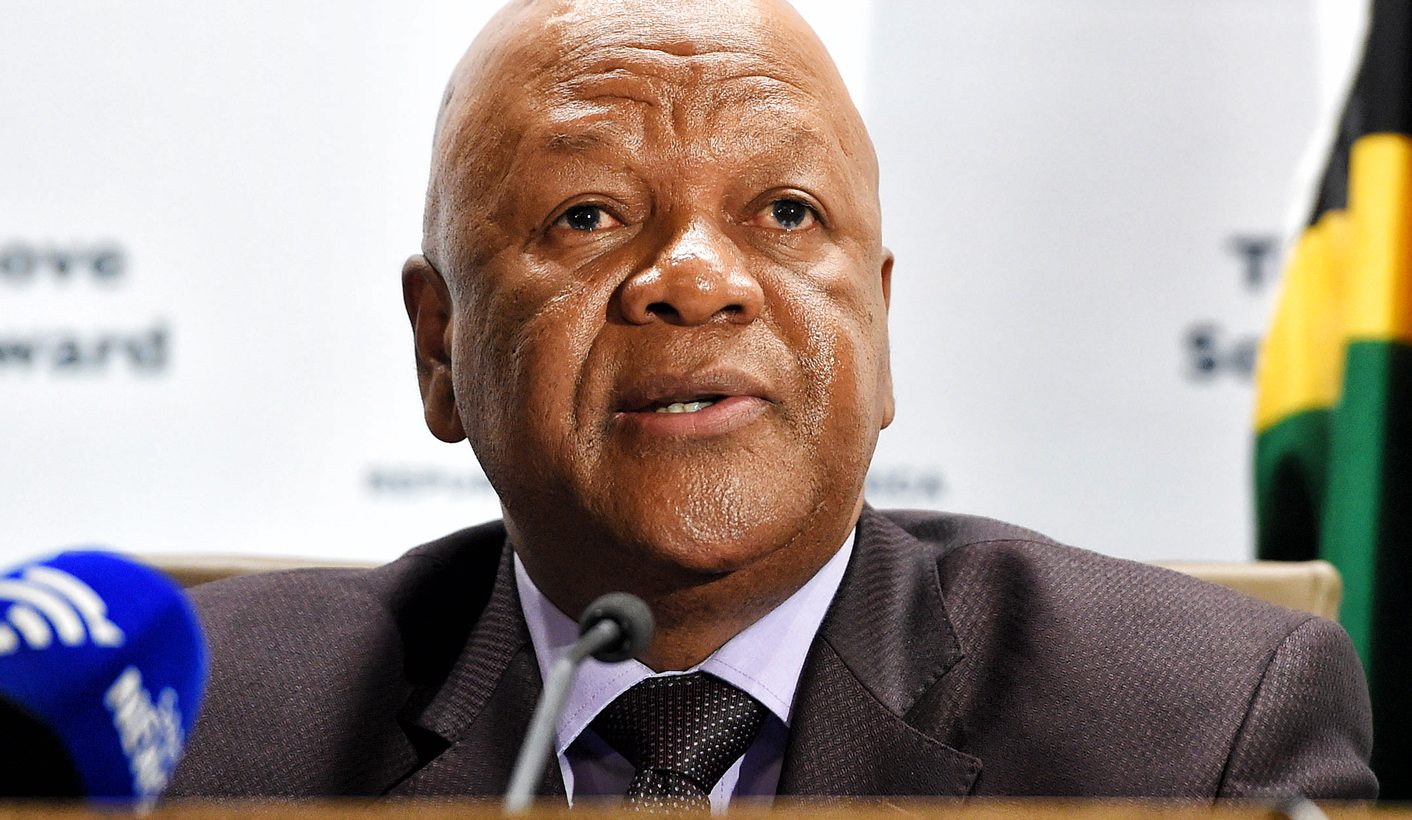
Photo: Minister Jeff Radebe during Cabinet Lekgotla briefing, 22 August 2016 (Photo GCIS)