



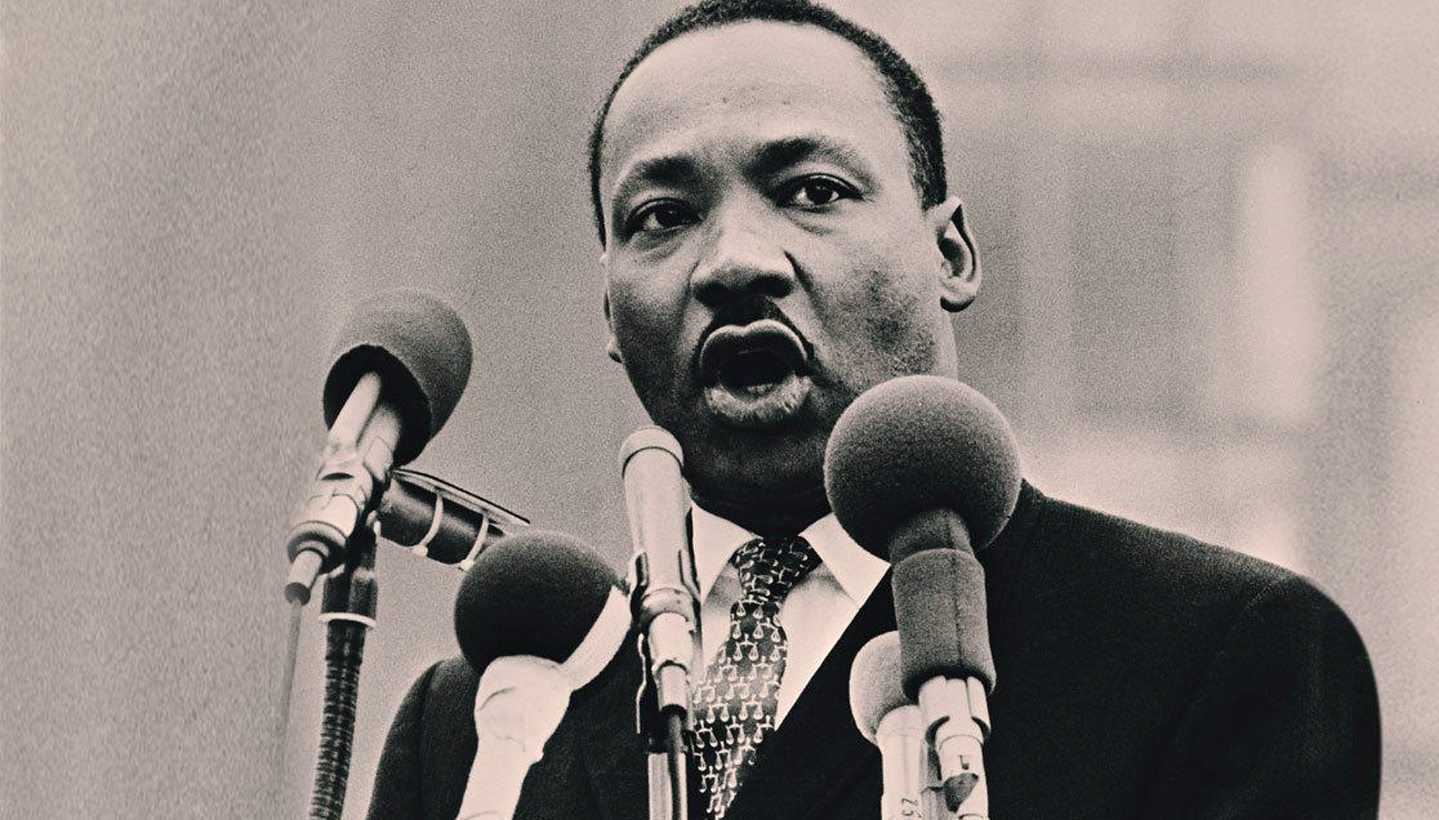
 NEW YORK - SEPTEMBER 10: Martin Luther King Speaking on September 10, 1963 in New York, New York. (Photo by Santi Visalli/Getty images)
 The rose in the barrel of the tank is withering. The poppy drips blood on the lapel. The flower fell from the braided hair of the Haight Ashbury hippy long ago, mourned only by those who have lived long enough to remember what a world once felt like that had lurched out of the nightmare tunnel and found a new, brighter, kinder future.
The Sixties didn’t come out of nowhere. The world had been a dank, harsh place from the time Adolf Hitler first was elected to power – chosen by the people, note – in the Weimar Republic Germany of 1933, until his final solution found its own defeat by allied forces that included in no small measure the might that America’s liberating military brought to bear on the Third Reich.
That America, the one that arguably was the “great” one that Donald Trump and his drooling fang club think they are aspiring to, was able to come out of that war and slowly, and with much effort and many bumps in the road, find its way into the Sixties and the hope that the American youth of that era brought to those who sought peace and harmony.
There was no quick fix once the war ended; more rations and belt-tightening than letting your hair down and inviting the crowd around except maybe for dog biscuits and flasks of water. But these things take time, and once the Fifties came around, fashion brightened up, dance turned to jive and rock ‘n’ roll, and contemporary music became unrecognisable by anybody who had lived through that war.
As ever, it was young people who led the charge, just as they (falteringly, perhaps wanly) started to lead the charge in the new United States that is emerging before our horrified gaze, then kind of faded away like the intro to the Neil Young song when, introducing it, he says, this song “sorta starts off real slow and then fizzles out altogether” (I think we call them Save SA marches). In the Fifties, mom and pop might have preferred their kids to listen to Pat Boone and Doris Day but the sprogs were were having none of that. Enter a slew of edgy pop stars, from Carl Perkins and Bo Diddley to Chuck Berry, Buddy Holly and of course Elvis Presley, and the seeds were sown for a new movement far across the Atlantic as ears in Liverpool took to the sound and turned it into a revolution.
By 1963, the Beatles and the Rolling Stones were creating the music that was the bedrock for the entire world of popular music we still have five decades later. The British Pop Invasion saw the results of that Fifties rock ‘n’ roll era fly back across the pond as young Americans drank it in and one sensational tour by the Beatles in 1966 turned the pop revolution truly global. Even in my tiny town in southern Namibia, I knew all about it, devouring magazine articles and listening to every album I could.
And with it came everything else. Guys grew their hair way down their backs, hemlines went thigh-high, Mary Jane went mainstream (culminating, in our own time, in marijuana being legalised in several US states, for now at least), the cumulative movement having ignited a spark of creativity that has everything to do with the technological revolution we have been living through. Everything was touched by the Sixties’ magic wand – movies, theatre, art, design – as a wave of hope and a striving for peace and a new world order coloured an entire decade.
That decade is not strictly speaking the period from 1960 to 1970, but rather the cultural decade spanning roughly from 1963 to 1972. It started with the assassination of John F Kennedy and the concomitant rise of the Beatles and their music and moptops, and ostensibly was brought crashing to earth with the Watergate scandal a decade later. By then the psychedelic hues had dulled, the music was changing, the flowers had fallen. The hope that had been the protest movements of the Sixties had made way for the rest of the world as we have known it.
But there are dire things happening in the USA now that turn the troubled mind to a seminal year in the annals of protest – to 1968. It was the year of Martin Luther King’s assassination (on April 4). Riots in pretty much every US city you can name, as many as a hundred. The nation reeled again when Robert became the second Kennedy to be assassinated (on June 5). And come August, the infamous Democratic Convention in Chicago’s International Amphitheatre.
The Democratic Convention of 2016, with Hillary Clinton smoothly sailing through a week of highly charged electioneering, searing her points and policies home whether or not you agreed with them, was nothing like the 1968 event. In 1968 it happened in Chicago, and all hell broke loose. What had been intended as a “festival of life” by the democrats turned ugly when anti-Vietnam War protests (against President Lyndon B Johnson’s war policies) in the city and at the convention centre were met with force by the Chicago PD with help from the Illinois National Guard. Battles between police and protesters raged in the city streets and parks. The riots became a benchmark for political protests, influencing many protest movements ever since.
Watch this disturbing footage of the Chicago protests showing police clubbing protesters; note particularly the woman in pink near the end being manhandled into a police van while singing We Shall Overcome. A searing moment of protest:
Arguably the greatest protest song of them all came out of this. The “Chicago Eight” were indicted for conspiring to cross state lines to incite a riot, among other charges. One of the eight, Bobby Seale, was bound and gagged in the courtroom after he’d made repeated outbursts, as per Graham Nash’s song Chicago, recorded later by Crosby, Stills, Nash & Young: “So your brother’s bound and gagged and they’ve chained him to a chair”, followed by “Won’t you please come to Chicago, just to sing”. Nash was there and had called up David Crosby, Stephen Stills and Neil Young to join him in the city to protest at what was going down. The chorus, We can change the world/ Rearrange the world/ It’s dying to get better, represents the spirit of the protest movement as much as it does the spirit of the Sixties, the striving for peace and a new, kinder, world order.
Donald Trump may well approve of some of the treatment of the members of the media by police during the Chicago protests. Veteran reporter Dan Rather was famously assaulted by police, as can be seen in this vintage clip:
Chicago was by no means the first protest song out of the cultural Sixties, nor the last. Dylan arguably first rolled the ball with Blowin’ in the Wind in 1963, and it remains so profound that I’d like it played in a loop in Donald Trump’s head until he finally sees what an unconscionable knobhead he is, sells all his properties and establishes a fund for the poor of the world that he’s fucked over for all his life. Okay, reality check.
But there’s a special place in the history of folk protest music for Pete Seeger’s cut-to-the-quick lyrics of Where Have all the Flowers Gone which, though it precedes the Sixties (it was first recorded in 1955), nevertheless resonated with the Sixties Flower Power generation and their values. It remains one of the finest political songs and in 1962 it found a new audience when folk trio Peter, Paul and Mary (who also covered several Dylan songs) recorded it.
In the later Sixties and in 1970, a new edge came to protest music with such releases as Marvin Gaye’s What’s Going On?.
Music made its greatest statement of intent as a standard-bearer for peace in 1969 at what we remember as “Woodstock” but which was actually called the Woodstock Music Festival, An Aquarian Exposition – Three Days of Peace and Music. Generally it was, although you could add to that, “sex, drugs and mud”. This was the heralded dawning of the Age of Aquarius, when the world would turn to peace and the sweet dreams of the Flower Power children and their sweet counterculture would lead us all (after all that temptation) into a word that would be ruled by peace. War would become something of the past. It was all about peace, hope and love but, with hindsight, it was just as much about naivety and dashed dreams.
Epitomising the end of that dream, for me, is the closing sequence of the seminal 1979 movie version of the late Sixties Broadway musical, Hair, in which peacenik Burger (Treat Williams) has impersonated his draftee friend Claude Bukowski (John Savage) in his army post so that he can have a few hours with his girlfriend. The boys marching into the void of blackness of the military plane is a grim metaphor for the world that is descending on us now.
The world could use a new Flower Power generation and Donald Trump and his blinkered fan base could well be creating the perfect circumstances in which the stirrings of protest by educated young Americans could swell into a movement to match his own “movement” of which he speaks so glowingly while a faux tear fails to spill from his lying eye. It was that young generation that found their voice in the Sixties, and they made a profound impact on the established order of the day.
There’s a small piece of ground near the edge of Central Park, across the road from the Dakota building, where pilgrims honour the spirit of John Lennon and why his quest to Give Peace a Chance had so much meaning for that world and that generation.
It makes me weep, now, to hear it knowing what happened to the world, not least to Lennon himself. I stood over the monument – a mosaic of just one word, IMAGINE – in February 2013 and felt lost in a world of regret. For my generation, it is very hard to observe what’s going on in the USA right now. Protest has moved on since those fledgling days of flowers and long hair. It has become a powerfully effective way of bringing change. Give us hope, young America. Get out onto the streets and sort this shit out. DM
Photo: Dr Martin Luter King Jr.