




On Monday ANC Secretary-General Gwede Mantashe said the ANC parliamentary caucus would “give the SABC the requisite attention”. The ANC national working committee (NWC), the structure tasked with managing day-to-day operations, had agreed the governing party was “against any form of censorship being imposed at the SABC”.
These comments came as the Independent Communications Authority of South Africa (Icasa) ordered the SABC to lift, within seven calendar days, its ban on showing destruction of property during community protests. Three media freedom organisations successfully complained to the broadcast regulator amid anti-censorship pickets in support of the eight SABC staffers who are facing disciplinary charges for speaking out. However, the public broadcaster seems intent on sticking to its guns, with an appeal against the ruling from the body that Section 192 of the Constitution says must be established in law to “regulate broadcasting in the public interest”.
By referring the SABC crisis back to Parliament it appears Luthuli House is either oblivious to, or wilfully chooses to ignore, ANC MPs’ contribution to the public broadcaster’s instability amid the shifting sands of the governing party’s factional battles. Or it’s simply a strategy of playing kick-for-touch in the hope that the controversy fades away by the time Parliament gets back to its business in mid-August after the local government elections.
Parliament’s communications committee has failed to fill six of the 12 non-executive vacancies on the SABC board dating back as far as two years. Effectively, MPs have neglected their duty under the 1999 Broadcasting Act: Section 13(1) states that the non-executive board members are “appointed by the president on the advice of the National Assembly” following nominations through a public participation process.
Instead, MPs are getting ready to process Communications Minister Faith Muthambi’s Broadcasting Amendment Bill, which will strip Parliament of its currently legislated say in SABC board appointments, and removals.
Nothing illustrates the impact of the faction-ridden Byzantine goings-on of the ANC on the SABC better than its MPs’ flip-flop between May and June 2015 on the validity of the removal of three SABC board members through the 2008 Companies Act, rather than the public broadcaster’s governing legislation, the Broadcasting Act.
In early 2015, in a controversial move, a special SABC board meeting booted out the outspoken Hope Zinde, using the Companies Act, followed by the removal of fellow SABC board members Rachel Kalidass and Ronnie Lubisi at another extraordinary board meeting in March. Muthambi subsequently endorsed these removals outside the SABC’s governing legislation, the Broadcasting Act. All three are understood to have been opposed to the controversial permanent appointment of Hlaudi Motsoeneng as chief operations officer (COO) in July 2014, just months after the Public Protector’s findings against him for purging staff, irregularly boosting his salary by R900,000 and misrepresentations over having a matric.
In May 2015, amid oversight that saw the communications committee five months earlier recommend to the president the dismissal of SABC board chairperson Zandile Tshabalala for misrepresenting her qualifications, the committee unanimously adopted a parliamentary legal opinion that those three board members’ removals were unlawful. “The only legally valid removal of an SABC board member is by the president… Any removal of an SABC board member that is not effected in line with the provisions of the Broadcasting Act as stated above is invalid and therefore unlawful,” said the legal opinion requested after an earlier stand-off between MPs and the minister in March.
Communications committee chairwoman Joyce Moloi-Moropa, the South African Communist Party (SACP) national treasurer and long-standing parliamentarian, fought off DA and Economic Freedom Fighters (EFF) requests to immediately write to the SABC for the reinstatement of the trio. Instead, the committee would write to Muthambi for action. The minister rejected the committee’s decision.
In June 2015 in Moloi-Moropa’s absence the communications committee under acting chairwoman Dikeledi Tsotetsi overturned its decision on the back of ANC numbers on the committee. This reversal effectively meant ANC MPs fell in line behind Muthambi, who informed MPs that they could not tell the executive which law to apply. [Note: The writer has attended a series of committee meetings where this and other SABC-related matters played out over the past two years.]
City Press subsequently in July reported how on the eve of the ANC MPs’ U-turn in open committee, Muthambi sharply criticised Moloi-Moropa at a behind-closed-doors ANC communications study group gathering over four hours.
Subsequently Moloi-Moropa found herself isolated from the ANC study group. Word of Moloi-Moropa’s wish to depart (there were also personal reasons) soon emerged and by February 2016 she had formally resigned to take up her SACP treasurer’s responsibilities full time. In May 2016 the ANC in Parliament announced that her post would be taken over by Humphrey Maxegwana, an Eastern Cape MPL who arrived at the national legislature after the May 2014 elections and who had previously served on the agriculture committee.
In one of its last decisions under Moloi-Moropa, the communications committee in late 2015 resolved to fill three of the six SABC board vacancies that had arisen through resignations. These were positions formerly held by Tshabalala, who resigned in mid-December 2014 rather than face dismissal for misrepresenting her qualifications, by Thembinkosi Bonakele who had resigned in mid-2014, and by Bongani Khumalo whose resignation was brought to the committee in January 2015, apparently months after he had left.
Despite this decision, more than seven months have elapsed, with no action by MPs.
The committee had also decided to turn to the Presidency for guidance with regards to the vacancies controversially created by the removal of Zinde, Kalidass and Lubisi. It’s also unclear what, if anything, has happened on that front.
However, what all this means is that for the past 17 months the SABC board has operated with its bare quorum of nine to take legitimate decisions. It means everyone has to be present: the remaining six non-executive members plus the chief executive officer, chief financial officer and COO, who by law are executive board members.
Granted, the situation is not as dire as the governance crisis of March 2013 when eight board members resigned in little more than a week, again amid controversies over Motsoeneng, then acting COO, although under a different minister.
There are numerous other questions that arise about Parliament’s at best spotty oversight over the financially troubled SABC where a revolving door of senior executives and board members has long distressed good governance. This includes how Motsoeneng could have been put in charge of editorial policy, regardless of what explanation may be proffered, when the Broadcasting Act in Section 6(5) states that the board determines, among other things, news editorial, local content and programming policies.
On Monday Mantashe’s words backed up pro-freedom of expression comments made a week earlier by Jackson Mthembu, the ANC Chief Whip in Parliament and chairman of the communications sub-committee of the national executive committee (NEC), the ANC’s highest decision-making structure between the five yearly national conferences.
“Any policy changes or editorial decisions by the SABC that in any way limit these freedoms can never be sanctioned by the ANC… The ANC stands opposed to any actions that infringe on our people’s rights to hear and see what they want to hear and see,” Mthembu said in a statement on 5 July.
Like Mthembu, Mantashe cited the ANC’s commitment to a free flow of information so citizens can take part in democratic decision-making. Mantashe also cited ANC resolutions of the 2012 Mangaung national conference calling for action to resolve various SABC crises, reiterated at the ANC’s 2015 national general council.
Yet the ANC has done little in the way of concrete action to resolve any of these issues.
Instead the intra-ANC factional power plays have allowed the SABC mess to drag on.
MPs have not fulfilled their legislated mandate under the Broadcast Act, their constitutional oversight duty, nor their power to investigate any matter given to them by the National Assembly rulebook.
And thus kicking the SABC saga back to Parliament is putting the ball back into the court of those responsible for losing it in the first place. Unless, of course, these latest SABC dramas have shifted the factional balance of power. DM
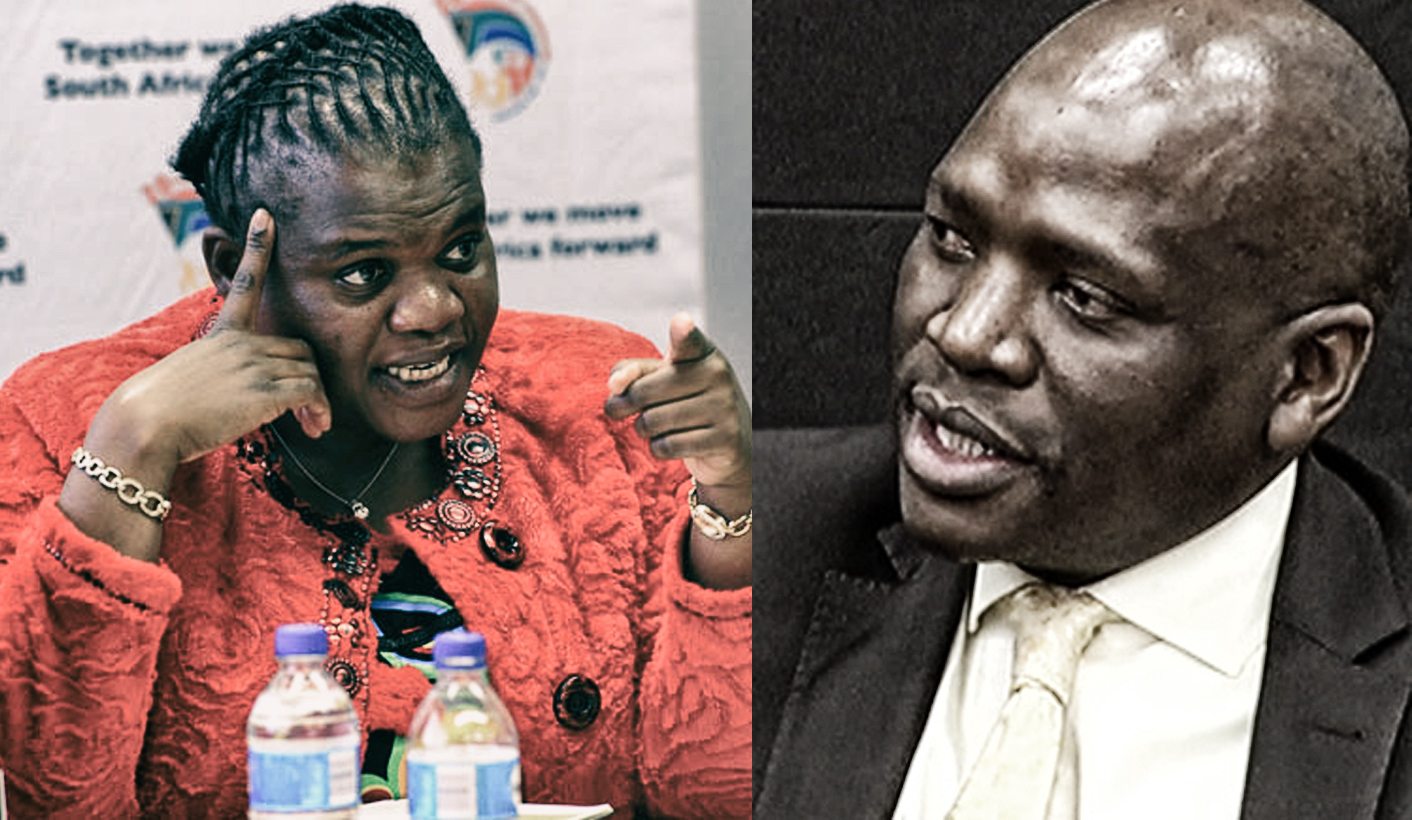
Photo: Communications Minister Faith Muthambi (GCIS), SABC COO Hlaudi Motsoeneng (City Press)