



It all began almost immediately as the credits rolled after the first episode of the second season of musician Karen Zoid's late night televison talk show, Republiek van Zoid Afrika, broadcast on the pay channel Kyknet on 2 July. The guest musician that night was rapper Jack Parow. Zoid – known for her wide collaboration with other artists – and Parow did a once-off mash-up of Parow's Cooler as Ekke.
“At the end of the show, one of the members of the band, who has an app tracking the iTunes charts, noticed the song had already clocked in at No 54. The next morning it was number one. We first thought it was a fluke and it was because of Jack Parow,” Zoid's producer, Carien Loubser, told the Daily Maverick.
Watch: Francois van Coke & Karen Zoid - Toe vind ek jou
At the close of the season, last week on 25 September, every single song performed live by Zoid and guest artists and released immediately on iTunes dominated the South African iTunes charts for 10 long weeks, including her opera/heavy metal mash-up with diva Rina Hugo of Bono's Ave Maria, which flighted in August. Even more miraculous is that the song, because of it's listing on Top40SA and iTunes received extensive airplay on commercial radio stations. What became clear as the series pushed on is that it was listeners and viewers who were driving sales of these songs up the charts.
In April, before Zoid's talk show series flighted, a single, Toe Vind Ek Jou, off Francois van Coke's debut solo album and featuring Zoid, was the first South African song to shoot to the number one slot on iTunes South Africa. It was also the first Afrikaans song ever to do so. Local artists compete on the platform with all other releases, so it was a significant accomplishment. Five months later the YouTube post of the single had clocked almost 1-million views.
Loubser says iTunes is so intrigued by Zoid's domination over 10 weeks while Republiek Van Zoid Afrika aired that it will be researching it as “a case study”.
The artist's extraordinary online success can be attributed to several unique factors that have all coalesced in the right place at the right time to create a momentary 'phenomenon'.
“It might be a phenomenon right now,” opines Zoid “but very soon it is going to become the way things are.”
The first and most important contributing factor is just how much technology has inexorably altered the music industry and how music is made, engineered, marketed and sold and also who owns the copyright and licensing. This has freed many artists who have the business savvy and foresight to seize aspects of the means of production and, in so doing, control their artistic output. Success in turn offers artists more leverage in relation to negotiating copyright and licensing with partnering media platforms.
Untethered from lumbering big corporations with their hierarchies of control and frustrating red tape, musicians can move swiftly to catch whatever wave crashes ashore in the digital ocean.
“Ten years ago we could never have done this,” said Loubser, adding: “Back then artists were signed to major record labels who controlled them. There would have been so much red tape and they would not have been allowed to collaborate outside of the record company. It was not about their artistic expression. It was about a record company wanting to manage a product. Ten years ago the record company would have given you money and you would have to sing and record.”
Many artists who have achieved a measure of success have broken this tradition of signing up with a major label, going solo like Macklemore and Ryan Lewis's independently released single Thrift Shop in 2012 which sold over 4-million copies and clocked over 200-million views on YouTube.
Then there are mega stars like Beyonce who made iTunes history in 2013 with her 'surprise' self-titled album selling 828,733 copies worldwide in the first three days of its release. Beyonce's deal with Sony in this case was a partnership/joint-venture rather than the usual 20% artist royalty rate.
In the past record companies also owned expensive engineering studios that artists were forced use. Today technology allows an artist to produce top-quality digital recordings from anywhere in the world while retaining creative agency.
“Look, there are many artists who do need to be managed by a record label. Not all of them can work alone. But the music industry, like media, is in a state of flux,” said Loubser.
Last year, according to the International Federation of the Phonographic Industry, global revenue from music downloads and subscriptions overtook physical sales for the first time. In 2014 digital revenue jumped 7% to $6.85-billion while physical sales of CDs fell 8% to $6.82-billion.
The CD and DVD for the first season of Republiek van Zoid Afrika, which first aired on Kyknet in July 2014, was only packaged and released in November, several months later. What Loubser determined to accomplish with the second season this year was an immediate digital release of each collaboration on iTunes on the night the show aired.
“A lot of people said we could not go digital and that it wouldn't work. But around 500,000 people were watching that show nightly and what we wanted was for them to have songs immediately available as a download after they heard them,” said Loubser.
In preparing for the show and its spin-offs Loubser drew up a schedule which looked like the flight plan of a small airport. The second season, including dealing with the logistics of flying in guests and artists and arranging songs, was set in motion earlier in the year and pre-recorded. Tracks and instruments were mixed separately at former Springbok Nude Girls band member Theo Crous's Bellville Studios.
“And then we sent it to iTunes in Los Angeles where it was mastered for the platform,” said Loubser.
As the first episode of season two aired, behind the scenes, everything had already been lined up and was ready to roll. Loubser and Zoid worked social media platforms to post teasers to each song while Kyknet's own website also featured short video clips the following day.
In 10 weeks, says Zoid, the show drew to iTunes a generation of buyers who, until it had aired, had preferred their music packaged in ancient 20th century CDs.
“If you look at the stats for iTunes you notice that it is a market for 14-year-old girls. The CD market in South Africa is for 60-year-olds. The biggest sellers on the iTunes charts are Justin Bieber and One Direction. Younger people who follow the charts set the ratings on iTunes. But what our show did, I think, is drive a generation who would not usually buy their music digitally to the platform. What the show also did was expose viewers to opera for example. They might not have thought they liked the genre but they haven't given it a chance. And then you notice that opera and heavy metal are really very similar.”
During her now 15-year career in the music industry Zoid has shown herself not only to be a versatile and savvy songwriter and musician but also an astute businesswoman. She works hard and has toured almost every town and festival in the country, meeting, befriending and collaborating with fellow musicians along the way. Zoid views her collaborations with some artists, including Zolani Mahola of Freshlyground, as partnerships.
“Zolani and I are partners, we create productions together, we understand each other and we like and respect each other and enjoy working together while we still work as individual artists. Sometimes you can create a partnership that doesn't work but you will learn from it.”
Watch: "Suzanne"- Karen Zoid + Zolani Mahola (YouTube)
The Republiek van Zoid Afrika is essentially a space within a space. It is Zoid's world “a small idea that you build outwards”.
“I've done a lot of miles. I have been all over the place and I have worked hard to get here. I know everyone in the industry and for me it is all about media and how it is changing and how artists can begin to have a measure of control. I watch how my father reads newspapers religiously and I know that no one my age does that. I certainly don't. I select what I want to read. My speciality music magazines or whatever. People who listen to music are doing the same.”
Today, says Zoid, artists no longer depend or rely on newspapers and magazines to reach fans.
“I know all of these artists and they are in my world. I only invite legends onto my show. People who have accomplished something. If you don't know who my guests are then that is your problem and you have to know you are out of touch. I don't invite people onto my show to trash them. They are there to inspire others. All of them are hugely accomplished and I wanted viewers to get to know them as they are, not as the media might see them. I have access to these people in a different way,” said Zoid.
For Zoid this is the age of not only of the individual artist but also of synergies, currents that are mirrored on social media in an era of personal branding that occurs within a sharing communal environment.
“Partnerships and real-life collaborations function along the same principles as social media. So you connect with circles of people and it spreads out in ever widening circles and it will continue to grow. Word of mouth is the most powerful driver in the long term in reaching the masses. Business and government understand this,” she says.
But the individual artist, writer, actor, painter, is where it all still begins, she says. In the past 15 years she has seen many changes in the music industry, none as exciting as those offered in the digital age.
“This is an exciting time in history. Technology has grown exponentially as well as our access to information. Today you can win a Nobel Peace Prize before you are 18 years old. Anything is possible. Of course there are difficulties but the world is there for the taking. And the people today who have the power and money are those who control the data. The petrol that drives the internet engine. It's not about the car anymore. You have to be the platform. It's all about Me, Inc.”
Traditional media platforms – television, newspapers and magazines – says Zoid will increasingly become obsolete as viewers find and select the content they desire online or on Apple TV, YouTube and other platforms.
“Those days are over. Today there are young artists and entrepreneurs who are using technology to do what it is they want to. I tell young people not wait or ask someone else. Go onto the net, read about it and then read more. Don't waste your time on Tinder or facebook. Use the technology to learn and then go out and make it,” says Zoid.
The power of the age of Me, Inc and the individual artist is: “We know what we want to create and what we want to achieve. We want to make music in different styles and record it properly with high production values, something record companies never did. Music has always been like a sick child but the sands are shifting.” DM
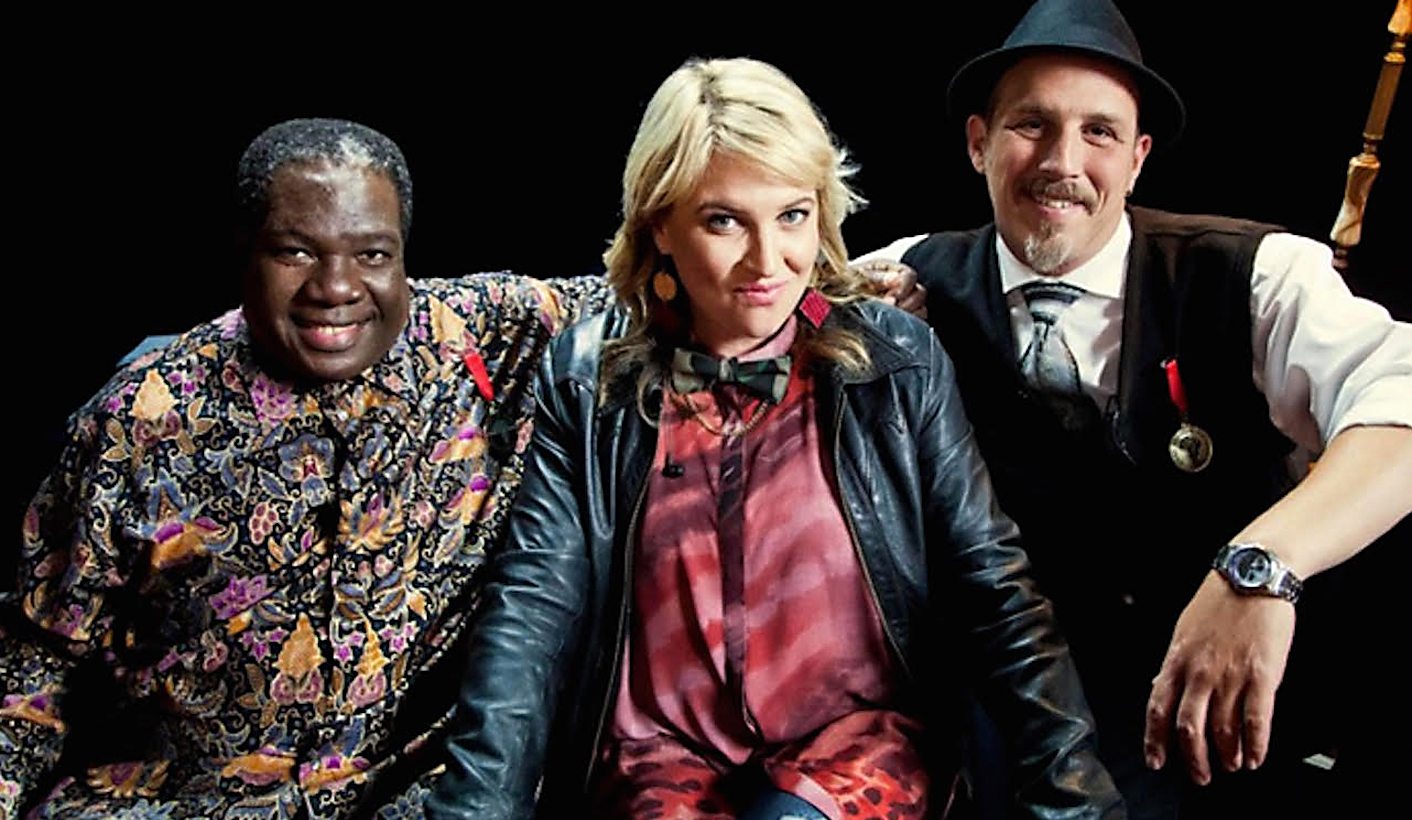
Photo: Vusi Mahlasela, Karen Zoid and Waldimar Schultz (Photo by Kyknet)