




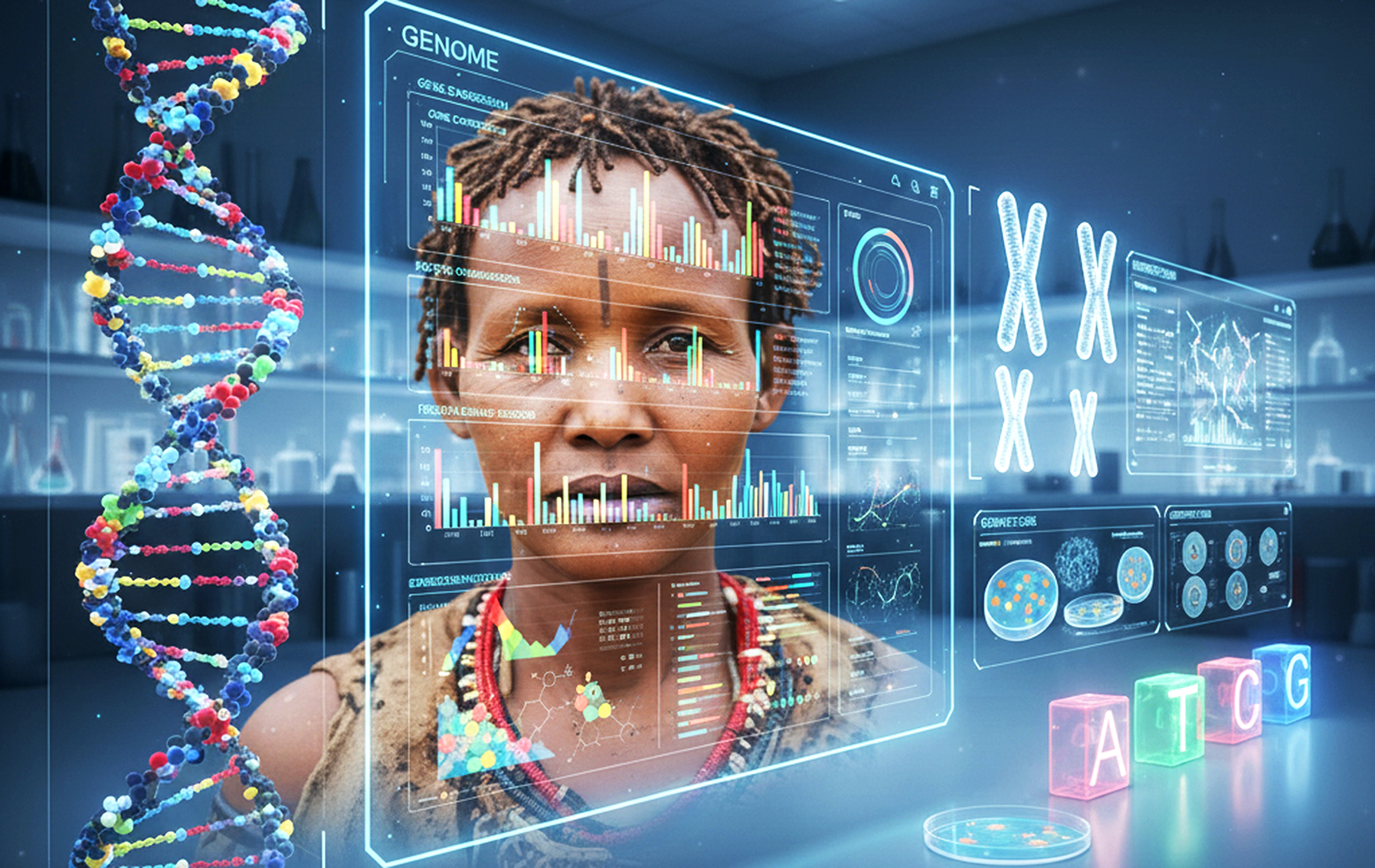
 DNA, genome data and a hunter-gatherer woman. (Image: Marlize Lombard, AI-generated, Gemini 2.5 Flash)
 The genomes of 28 ancient hunter-gatherers from southern Africa have revealed a population with unique genetic variants that contributed to the evolution and adaptation of Homo sapiens.
The research published in the journal Nature shows that southern Africa served as a long-term ecological refuge where hunter-gatherer populations thrived and maintained continuity through changing climatic and cultural conditions.
The individuals lived between 10,200 and 150 years ago and were recovered from archaeological sites across South Africa, including the well-known Matjes River Rock Shelter on the southern coast.
Professor Carina Schlebusch, from the department of Human Evolution and Genetics at Uppsala University, explained: “What our study shows is that the first population split is between San ancestors and all other populations – a confirmation of what was already shown.
“But, what we also show is that San ancestors definitely stayed in southern Africa for 10,000 years – and maybe much longer – before any other groups moved into southern Africa.
/file/attachments/orphans/Mandible_328881.jpg "The mandible of Matjes River 1 woman who lived 7,900 years ago in southern Africa. The<br>material is housed at the National Museum in Bloemfontein. (Photo: Mattias Jakobsso)<br>")
material is housed at the National Museum in Bloemfontein. (Photo: Mattias Jakobsso)
“Only from 1,400 years ago do we see other groups moving in. First east Africans, the cattle farmers, who mixed with the San to form the Khoekhoe groups. And shortly after the “Bantu speakers” – they are agropastoral who can trace their origins to west Africa.”
With such high-quality ancient data, researchers can now study evolutionary patterns at a genuine population level.
The project is a collaboration between Uppsala University in Sweden and the University of Johannesburg.
Genetic variants
Marlize Lombard, a professor of cognitive and Stone Age archaeology at the University of Johannesburg, says: “Our research confirms the position of southern African hunter-gatherers as one of the earliest genetically modern human populations going back about 300,000 years.
It seems that southern Africa provided an ecological refuge where people adapted successfully for more than 200,000 years – without other hunter-gatherer groups coming in from elsewhere.
“We found 490 modern human or Homo sapiens-specific genetic variants, amongst them, immune system-related genes and genes related to kidney function were prevalent.
“Some of the Homo sapiens-specific variants are also associated with neurons for brain growth and cognitive traits, or the way that human brains process information today.”
/file/attachments/orphans/MATJESRIVER_251477.jpg "The Matjes River rock shelter seen from the hillside. (Photo: Nicholas Wiltshire)")
The ancient southern Africans shared maternal and paternal lineages still common among present-day San peoples, such as the Ju/’hoansi in Namibia and Botswana and the Karretjie people in South Africa.
About 80% of their genetic material remains present in these modern populations, highlighting an exceptional degree of continuity across time. This means the other 20% was “added” in the past 1,000 years.
It was also found that San ancestors didn’t have the protective variants against sleeping sickness or malaria, but the ancestors of “Bantu speakers” from west Africa did carry these variants, most probably because they came from an endemic area.
Schlebusch says that between 600,000 and 300,000 years ago, selection acted on genes involved in kidney function in the ancestors of all modern humans. The San branch and other branches lead to all other humans. This might have been connected with water retention – something that differentiates us from other primates.
Lessons from the ancient past
Lombard says much can be learnt about Homo sapiens from this.
“It tells us that apart from physical adaptations, the complex Homo sapiens behaviours and thinking observed in the southern African archaeological record from about 100,000 to 70,000 years ago.
“Such as making synthetic paints and glues, or hunting with long-range weapons, originated locally.
/file/attachments/orphans/HelenaMalmstrm_788779.jpg "Dr Helena Malmström sampling at the Florisbad research station in South Africa, using the mobile clean lab. (Photo: Alexandra Coutinho)<br>")
“Our species probably evolved simultaneously in other ‘hotspots’ in central, eastern and northern Africa. Similar, large-scale ancient-DNA studies on hunter-gatherers from those regions will help us gain insight into how our species evolved on the continent, how often and when some Africans moved into Eurasia mixing with other humans, and why we ultimately became the only surviving species – even though some of us still carry small portions of Neanderthal and Denisovan genes.”
“As we recover more ancient genomes of this quality, we gain a clearer view of how genetic variation evolved across time and space,” says Professor Mattias Jakobsson from the Department of Organismal Biology at Uppsala University. “This work shows how local populations have contributed to the global genetic diversity of humankind.” DM