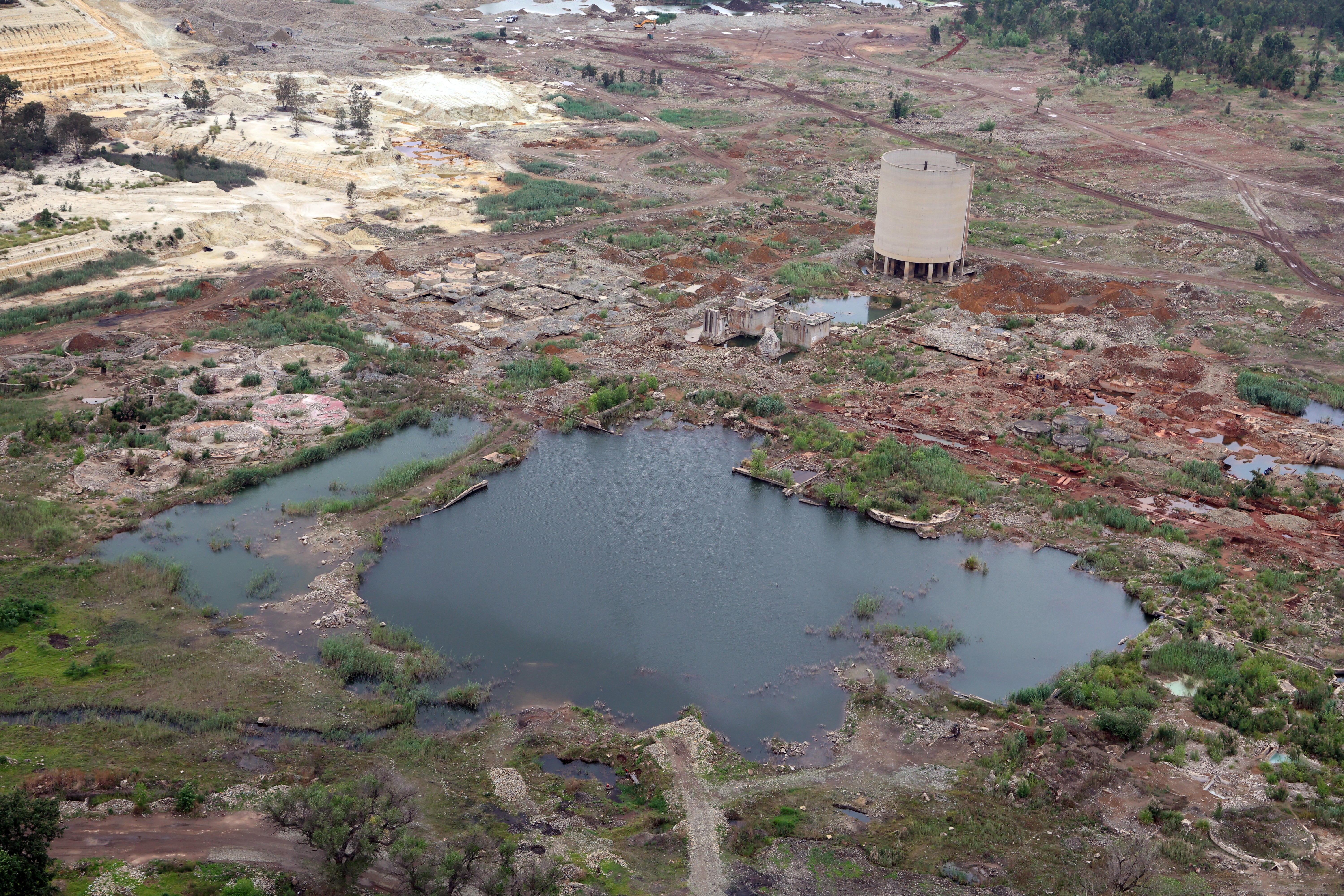
 An environmental catastrophe in the making. (Photo: Felix Dlangamandla)
 The old Grootvlei gold mine on the East Rand closed in 2011, but the tailings dam there has recently been a hive of questionable activity that experts say poses an environmental threat to the Blesbokspruit, which flows through a Ramsar wetland site (designated to be of international importance) and the Marievale Bird Sanctuary.
Daily Maverick’s queries into the matter prompted a probe by the Department of Water and Sanitation, which found that no water use authorisation had been issued for the “rehabilitation work” being undertaken by Upward Spiral 1471, an unlisted mining services company.
“Our objective is to rehabilitate and preserve the area, with the aim of long-term discouragement of illegal mining activities. We remain committed to lawful, transparent, and environmentally responsible operations for the safety of our people and the communities we operate in,” the company said in an emailed response to Daily Maverick’s queries last year.
That narrative does not jive with the visual evidence of what has been unfolding there, or the department’s findings.
Daily Maverick flew over the site by helicopter on 31 October last year. The photos we took from that bird’s eye view were shared with several mining experts, who raised numerous red flags after examining them.
/file/attachments/orphans/6I1A1766_214511.jpg "Protective cladding being removed and signs of zama zama activity. (Photo: Felix Dlangamandla)")
To wit, it is clear that protective cladding – a measure to contain dust in the atmosphere or slimes from entering the wetland at its door step – is simply being stripped, and mining including what appears to be zama zama activity can be seen.
“From the photographs it is clear that the water management by the operator is a matter of a concern. The possible contribution of irresponsible tailings reclamation activities on surface to Acid Mine Drainage may be significant,” was a comment from one leading mining expert who asked not to be named because of their concerns about possible zama zama or illegal mining links to the operation.
“Outer cladding/berms of the tailings deposit have been stripped in multiple segments; benches show fresh, pale sand with little to no vegetative cover. The paddock grid on top of the dump is visible; several paddocks appear breached or re-profiled,” the expert said.
This does not suggest “rehabilitation” – it suggests among other things that the site is being stripped for leftover gold from the skeletal remains of Grootvlei, which itself was asset stripped in one of the most notorious chapters of corruption and negligence in the post-apartheid history of SA mining.
The expert cited above also noted concerning visual evidence regarding water quality around the site.
“Rust-orange pools suggest ferric hydroxide precipitation (oxidised Fe) typical of acidic, metal-bearing drainage interacting with oxygen. Bright green pools and stagnant water within reeds suggest algal growth/eutrophication, and high suspended solids,” the expert said.
/file/attachments/orphans/WFD_4284_307484.jpg "A Ramsar wetland site threatened. (Photo: Felix Dlangamandla)")
In layman’s terms: the water is being rendered toxic. And this is on the edge of one of SA’s 28 Ramsar sites, which are recognised under a 1971 convention for their importance to biodiversity and conservation.
A 2024 peer-reviewed study in the journal Science of the Total Environment found that: “The water and sediments quality in Blesbokspruit wetland has deteriorated drastically.”
The mining expert cited above also noted that an excavator operating inside the wetland/floodplain was visible, while you can see small groups of people present near the pits and ponds – a situation “consistent with informal re-working” or illegal mining.
There are also no pegged “no-go buffers or wetland demarcation lines” that are are visible, nor any visual indication of signage or fencing along sensitive edges.
Other experts who viewed our photographs were equally scathing in their assessment.
“This shows high-risk reclamation work in wetland conditions without visible safety controls. When you excavate saturated tailings containing potential acid-generating materials without proper engineering oversight, you risk both structural failure and widespread water contamination,” Alastair Bovim, the CEO of environmental consultancy Insight Terra, told Daily Maverick.
“The aerial images clearly show this tailings facility is situated within or immediately adjacent to wetland areas, as evidenced by: extensive standing water and saturated soils, natural watercourses and drainage patterns, green vegetation indicating permanent/seasonal water logging and multiple water bodies surrounding the facility.
“This wetland setting dramatically amplifies the risks associated with tailings reclamation and creates additional regulatory obligations.”
None of this is in line with proper “rehabilitation”.
“If they are rehabilitating, they should be doing the opposite of what they are doing. They should not be removing the cladding, there should be more of it,” said another mining expert who viewed our photographs.
Downward spiral
Upward Spiral said in response to our queries that the cladding would be replaced with “waste rock buttress (cladding) to aid stability and, importantly, eradicate illegal activities that cause erosion, contamination, and other vandalism of the TSF (Tailings Storage Facility)”.
“As for the slimes dam, hydro-mining and pumping to a metallurgical plant in large volumes to offset the low grade will be conducted in future. This will enable us to continue rehabilitating Grootvlei indefinitely and protect wetlands, while deposition will occur at a new, approved and licensed facility to be confirmed through relevant due diligence studies.”
One problem with this: aside from “rehabilitation”, “reclamation” is also taking place as well as re-mining.
Rehabilitation refers broadly to restoring a mining site to its “natural” state, while the aim of reclamation is often to clean up the area for future productive use such as agriculture or even urban development.
After our initial queries last year to the Department of Water and Sanitation, officials from its Compliance Monitoring and Enforcement section – using GPS coordinates that Daily Maverick provided – conducted a site investigation on 21 November 2025.
“The Department of Water and Sanitation found that there was no water use authorisation for the rehabilitation work, and the department is initiating an enforcement process against the responsible company. An update will be provided as and when progress is registered on the process,” the department told Daily Maverick in an email on 20 January.
“The decommissioning of the tailings storage facilities for reclamation commenced around October 2025. It was established that the reclamation works are being undertaken within the regulated area of the Blesbokspruit without obtaining prior authorisation from this department. The department will institute the appropriate administrative enforcement actions against Upward Spiral.”
The department said it could not at this time outline its enforcement measures. Penalties cited under Sections 21 and 151 to 155 of the National Water Act include heavy fines, imprisonment of up to five years and orders to take remedial measures to clean up the mess.
The Department of Water and Sanitation explained that its probe uncovered the fact that there were two projects being implemented concurrently on the site.
“The first project entails rehabilitation works ...,” it told Daily Maverick in an email.
This work was under contract for another company – but the company in question told Daily Maverick that the contracted rehabilitation work did not include the Grootvlei site.
“The second project being implemented at the site involves the decommissioning of the tailings storage facilities for the purpose of reclamation. These reclamation activities are authorised by the Department of Mineral Resources and Energy through an Integrated Environmental Authorisation (EA) issued on 15 May 2024,” the Department of Water and Sanitation said.
“This department issued a Record of Decision (ROD) dated 10 April 2024 in respect of the Waste Management Licence application and advised Upward Spiral to submit a Water Use Licence Application for water use activities... To date, the department has not received a Water Use Licence Application from Upward Spiral in respect of the reclamation works.”
So the Department of Mineral Resources and Energy – now the Department of Mineral and Petroleum Resources – signalled to Upward Spiral to apply for water use authorisation. But it did no such thing.
The Department of Mineral and Petroleum Resources’ media desk acknowledged our queries but typically was asleep at the wheel and did not respond beyond that.
Questionable integrated environmental authorisation
Upward Spiral said it had obtained all of the regulatory approval required – while pointedly failing to mention the lack of water use authorisation.
“Our activities are conducted under a valid Integrated Environmental Authorisation (GP 30/5/1/1/2 (000050) BP Bar) issued by the Department of Mineral Resources and Energy in full compliance with the National Environmental Management Waste Act, 2008 (Act 59 of 2008), as amended, and the National Environmental Management Act,” Upward Spiral said in response to our queries.
“All environmental and waste-related approvals were obtained through prescribed regulatory processes, and the scope of work is defined within our approved Environmental Management Programme (EMPr)... As required under SA’s environmental legislation, a comprehensive public participation process was conducted during the environmental authorisation stage.”
Daily Maverick subsequently asked if it could provide the full provide the full public participation process or PPP pack – such as advertisements, a comments/response report, or attendance registers from meetings. It has not responded to that request.
Environmental activists in the area are certainly not aware of any “comprehensive public participation process” on this front. Daily Maverick has reviewed the minutes of the meetings of the Blesbokspruit Catchment Management Forum (CMF) going back to 2023, and there is no mention of any such consultation.
“I am unaware of any consultation. As active members of the Department of Water and Sanitation’s Catchment Management Forums, including the Blesbokspruit CMF, the application by Upward Spiral ought to have been presented to the forum,” Mariette Liefferink, the CEO of the Federation for a Sustainable Environment and who is deeply involved in the forum, told Daily Maverick.
This raises questions about the Department of Mineral and Petroleum Resources’ issuance of Integrated Environmental Authorisations and subsequent monitoring to ensure compliance.
SA mining’s dark underbelly
This is not the first time that Upward Spiral has been on the radar screen of the authorities and the media.
A 2024 amaBhungane report on illicit mining in the City of Gold by Dewald van Rensburg uncovered the SA Revenue Service’s interests in the company’s activities.
“According to documentary information, Upward Spiral is managing to extract what is by industry standards a bizarrely high yield of gold from the old waste it is running through its plants,” the report noted.
Read more: The #Laundry: City of Gold (Part Three) — How ‘fake’ mines allegedly feed the illicit gold machine
“This yield is supposedly 5 grams of gold per tonne of material. Major mining companies with dump reprocessing operations struggle to achieve a tiny fraction of that.”
The bottom line is that striking gold on this scale is suspicious, to say the least.
This is the dark underbelly of SA mining: illicit gold and other commodities laundered through transnational organised crime networks that present a clear and present danger to the safety and security of communities, the economy and the environment.
Eradicating the toxic legacy of SA’s mine dumps in a legal, transparent manner that also generates capital, shareholder value and jobs is being undertaken by listed companies such as Sibanye-Stillwater, DRDGold and Harmony Gold.
They are held to account by the regulator, investors, unions and the wider public including NGOs.
But there are operators who lie in the murky depths below the radar screen at a time when gold’s price has surged to breathtaking peaks. Getting to the bottom of this sometimes requires taking to the skies with a camera. DM
Also read: The Blesbokspruit wetland: a national ecological treasure under siege